
Frilled Lizard
Chlamydosaurus kingii
 AI-generated
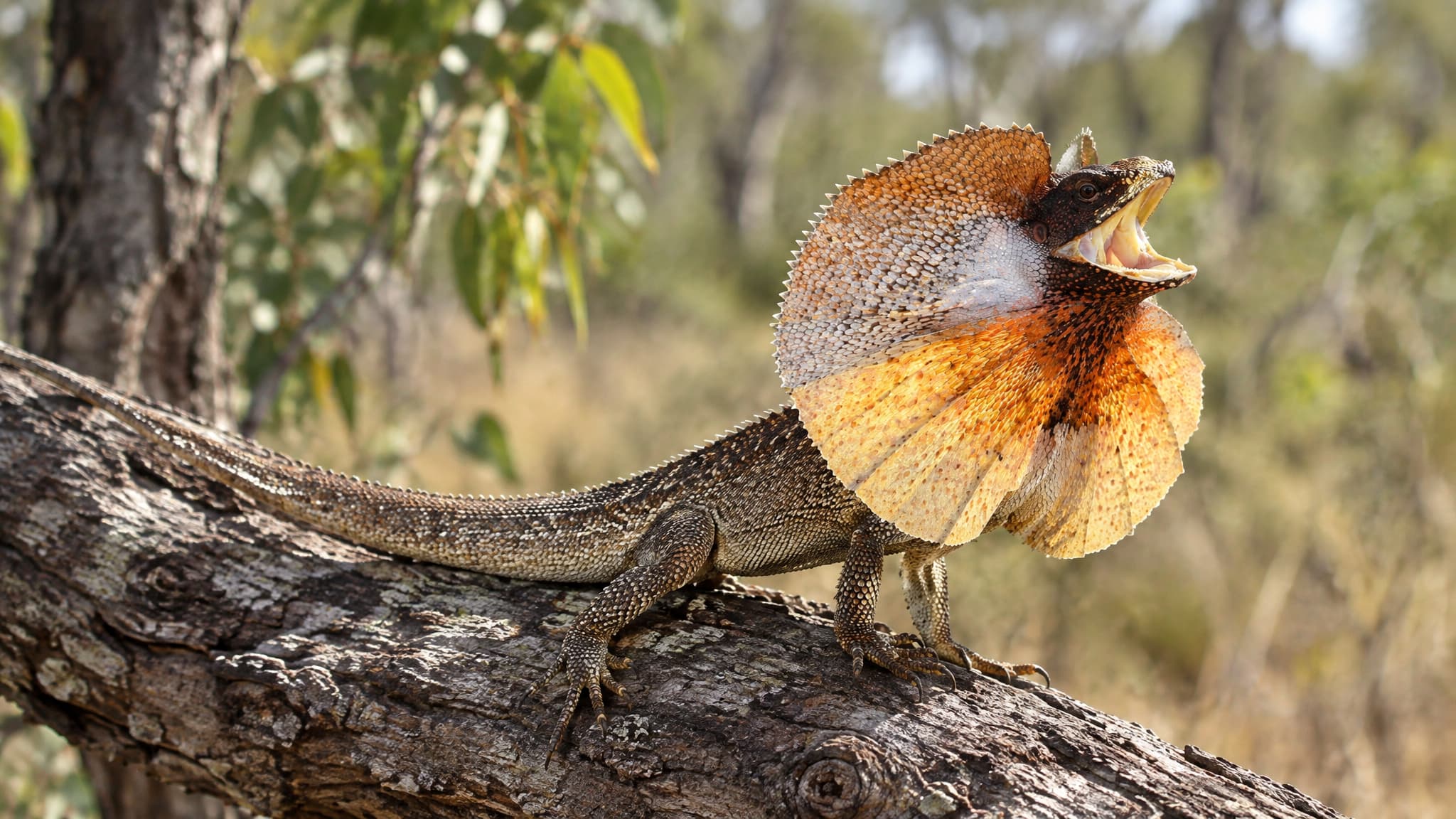
A Frilled Lizard (*Chlamydosaurus kingii*) perches horizontally on a tree branch with its broad neck frill fully expanded and its mouth open. Its long tail, scaly body, and clawed feet are clearly visible against a woodland background.
The frilled lizard (Chlamydosaurus kingii), also called the frill-necked lizard or frilled dragon, is one of Australia's best-known dragon lizards. It belongs to the family Agamidae and is the only species in its genus.
Identification
This is a large lizard. It averages about 85 cm in total length and reaches about 90 cm, and most of that length is tail. Males are bigger and more heavily built than females. The body is fairly robust, with long limbs and a moderately long tail. It is mostly grey-brown, and the tail has faint stripes and a dark tip. The lizard's best-known feature is a wide fold of skin around the neck. This frill normally lies flat against the body, but the lizard can spread it out like a ruff, showing patches of red, orange, yellow or white. The lining of the mouth is pink or yellow.
Distribution and habitat
The species lives across northern Australia, in Western Australia, the Northern Territory and Queensland, and in southern New Guinea. It is found in subhumid to semi-arid grassy woodlands and dry sclerophyll forests, where it spends much of its time on tree trunks and low branches.
Behavior and diet
The frilled lizard is active by day and mainly lives in trees. It often waits on a trunk and then drops to the ground to catch prey. Insects make up most of its diet, especially ants and termites, along with beetles and spiders. It sometimes eats small vertebrates. When threatened, it spreads its frill, opens its mouth wide and hisses to bluff the attacker. If that fails, it may run off on its hind legs. Its diet, growth, habitat use and activity all change markedly between the wet and dry seasons.
Reproduction and lifespan
The species lays eggs. Breeding takes place during the wet season, from about October or November to February or March. Males defend territories and appear to use the frill when courting. Females lay 4 to 13 eggs, usually about 8, in sunny, sandy soil. The eggs hatch after about 70 days, and the young get no parental care. Captive lizards average about 10 years, and some have lived longer.
Ecology and conservation
Frilled lizards help control insect populations, including termites and ants. They are in turn eaten by snakes, owls, birds of prey and dingoes. The IUCN lists the species as Least Concern.



