Geoffroy's side-necked turtle
Phrynops geoffroanus
 AI-generated
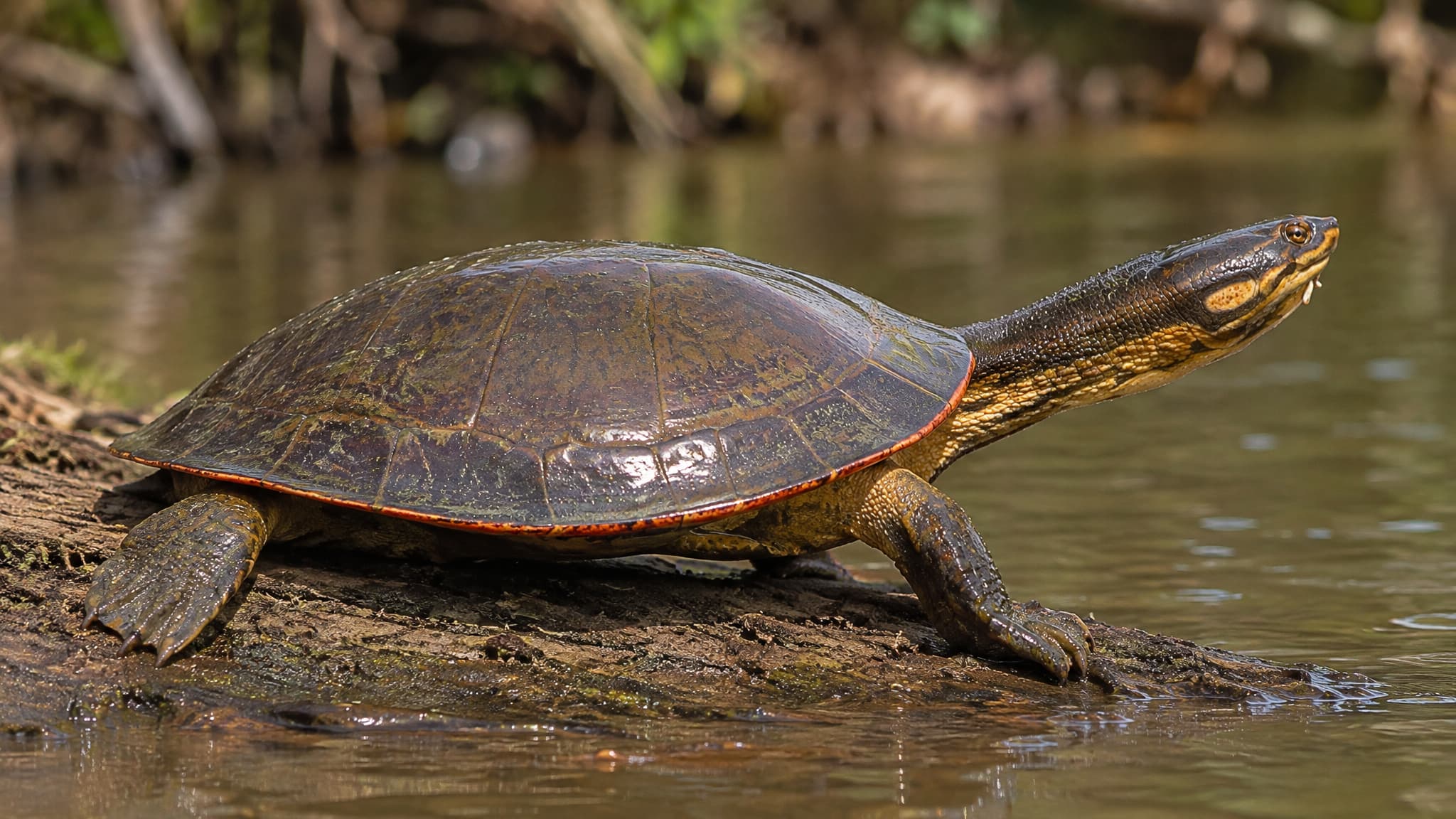
A Geoffroy’s side-necked turtle rests on a wet log at the edge of calm water, with its long neck extended and patterned head raised. Its domed, dark shell has a narrow orange-red margin, and the webbed feet are visible.
Geoffroy's side-necked turtle (Phrynops geoffroanus) is a freshwater turtle of the family Chelidae, described by Schweigger in 1812 and named after the French zoologist Étienne Geoffroy Saint-Hilaire. Like other side-necks, it folds its long neck sideways under the rim of the shell instead of pulling the head straight back. The carapace is broad and flattened, with a low midline keel, and ranges from dark brown to black, sometimes tinged with green. The plastron is usually pinkish red with irregular dark blotches. The head is wide and flat with a blunt snout, the underside of the head and neck is banded in black and white, and two white barbels under the chin help it find prey in murky water. Juveniles have a bold black-and-orange pattern that softens with age.
Females are the larger sex. The largest straight carapace lengths on record are 46.3 cm for a female and 39.5 cm for a male. Males have a long tail and a slightly concave plastron, while females have a short tail, a flat plastron and a higher, more domed shell.
This is the most widespread chelid turtle in South America. It ranges from Colombia, Ecuador and Peru through Bolivia, Paraguay and northeastern Argentina, and occurs in almost every Brazilian state. It lives in rivers, streams and lakes, often in muddy, low-visibility water, and is active by day. It also adapts well to people and is one of the turtles most often found in Neotropical cities.
It is an opportunistic omnivore that eats fish, molluscs, arthropods, amphibians and small birds, and also takes aquatic plants and some fruit. It hunts by sight and smell, sucking in small prey and tearing larger items apart with its front feet.
Sex is set by genes, not by nest temperature. On sandy beaches of the Upper Xingu River, in Mato Grosso, females nested during the low-water season. Nests there held an average of 13.1 eggs (9 to 17), and incubation took 76.5 days, much shorter than in the laboratory. Predators, mainly the crab-eating fox, wiped out 11 of 31 nests, and 60.8% of the eggs hatched in protected nests. Hatchlings had a carapace of about 38.3 mm and weighed about 9.1 g. The longest recorded lifespan is 37.5 years, in captivity.
The species is rated Least Concern. Its wide range and tolerance of disturbed habitats help it, though local nest losses can be heavy. Genetic work published in 2022 found at least four lineages within P. geoffroanus, so the species may one day be split into several.