Gharial
Gavialis gangeticus
 AI-generated
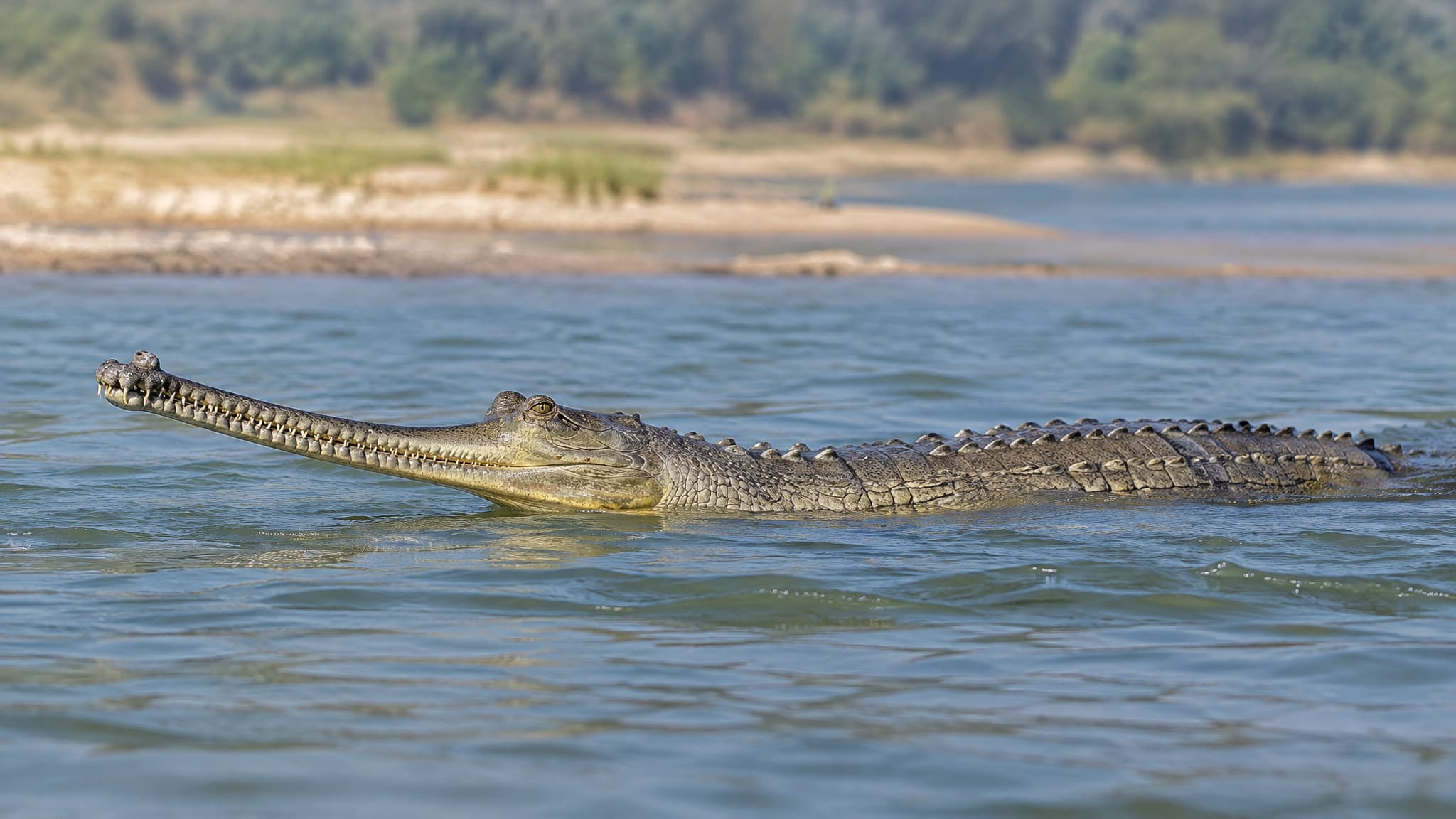
A gharial swims side-on through a broad river, with its head and armored back above the water; its long, narrow, tooth-lined snout bears a visible bulbous nasal growth, and raised dorsal scutes run along the back.
The gharial (Gavialis gangeticus), also called the gavial or Indian gharial, is one of the most distinctive living crocodilians. Its extremely long, slender snout is lined with many small, interlocking teeth, which makes it well suited to catching fish. It is among the largest crocodilians. Females reach about 3–4 m, and males can grow to roughly 5–6 m and weigh up to about 250 kg. Adult males grow a hollow, bulbous lump on the tip of the snout called a ghara, after the local word for an earthen pot. The gharial uses it in displays and vocal signals.
The species is native to the northern Indian subcontinent. It historically lived in the Indus, Ganges, Mahanadi and Brahmaputra river systems and possibly the Ayeyarwady in Myanmar. Today it survives in only a few fragments of its former range, mainly in India and Nepal. The Chambal River holds the largest remaining wild population. Gharials prefer clear, fast-flowing rivers and gather at deep river bends where the current slows.
The gharial is the most aquatic crocodilian and moves poorly on land. It usually leaves the water only to bask and to nest, often on sandbars in mid-river. Adults feed mainly on fish, catching them with quick sideways sweeps of the narrow snout. Young gharials eat more insects, crustaceans and frogs. Because its jaws are built for fish, the gharial is not considered dangerous to people. Gharials gather at basking and nesting sites but are otherwise mostly solitary.
Mating takes place in the cooler months, and nesting follows in the late dry season, around March to May. A female digs a nest hole in a sandy bank and usually lays about 28–60 eggs, though very large females can lay close to 100. Incubation lasts about 60–90 days, and the temperature of the eggs determines the sex of the hatchlings. Females guard the nest and protect the young for several weeks, often until the monsoon floods arrive. Females mature at about 8 years and 3 m long. Males mature later, at about 15 years and 4 m or more. The only documented longevity record is a captive individual estimated at 29 years old.
As a top fish predator, the gharial helps shape fish communities in large rivers and is a good indicator of river health. Its eggs are eaten by jackals, wild pigs, mongooses, rats and monitor lizards.
The IUCN lists the gharial as Critically Endangered, with fewer than 1,000 adults thought to remain. Major threats include dams and barrages that fragment rivers, sand mining on nesting banks, drowning in fishing nets, pollution and past hunting. Captive breeding and release programs in India and Nepal, along with protected areas such as the National Chambal Sanctuary, are central to its recovery.