
Giant anteater
Myrmecophaga tridactyla
 AI-generated
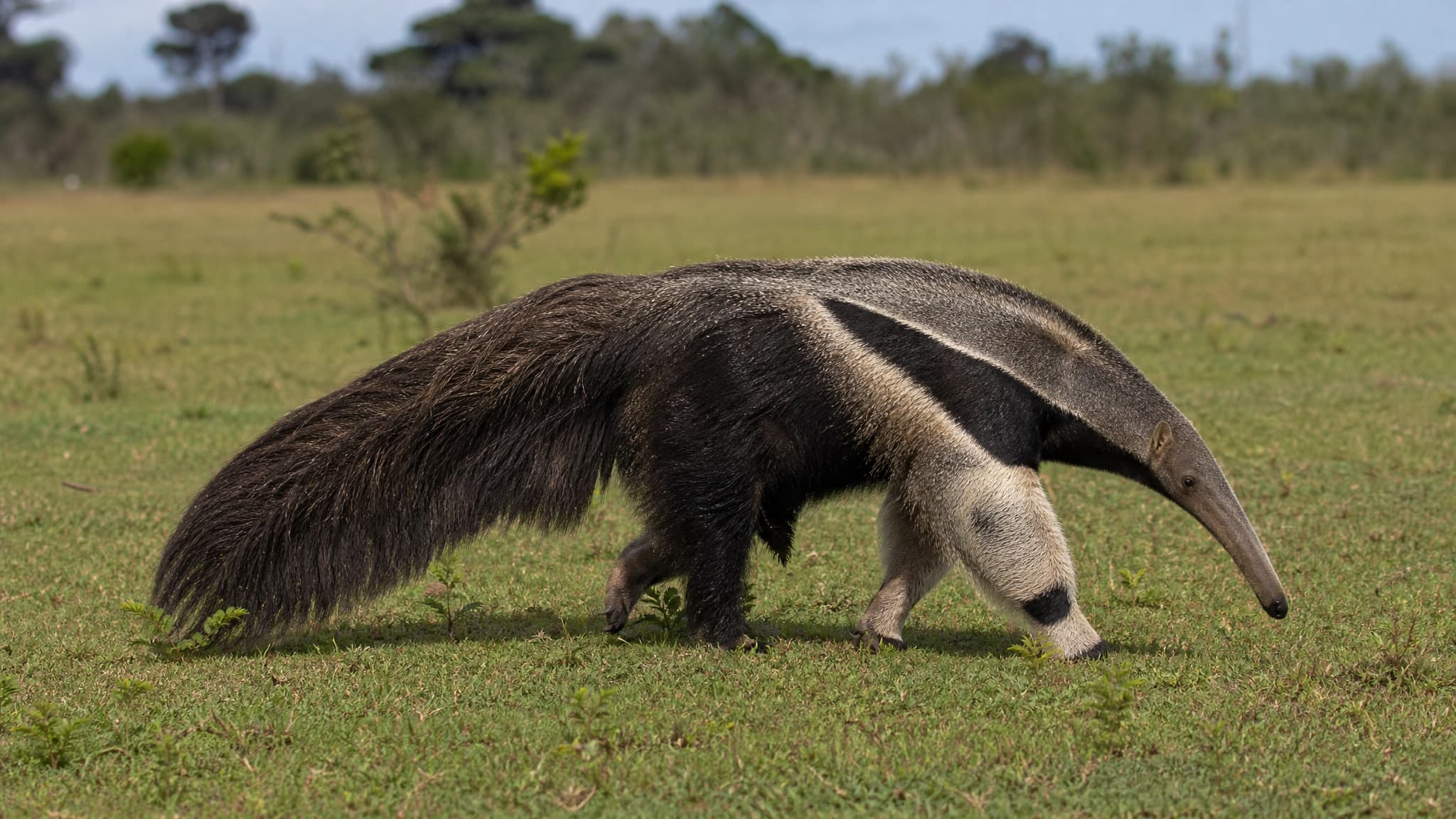
A giant anteater (Myrmecophaga tridactyla) walks across a grassy field, showing its elongated snout, large bushy tail, dark-and-cream diagonal body markings, and powerful limbs. Trees and scrub form the background.
Identification and appearance. The giant anteater is the largest living anteater, a striking, ground-dwelling mammal with a long, tubular snout, small eyes and ears, powerful forelimbs, and a huge plume-like tail. Its coarse coat is gray-brown with a bold black-and-white diagonal shoulder stripe. Adults commonly measure about 1.8–2.4 m from nose to tail and weigh roughly 27–45 kg. It has no teeth; instead, a sticky tongue about 60 cm long gathers prey.
Range and habitat. This species occurs from parts of Central America through much of South America, reaching the Gran Chaco and northern Argentina; its distribution has become patchy and it has disappeared from portions of its historical range. It uses a mosaic of savannas, grasslands, wetlands, and tropical or subtropical forests. In Brazil it is best known from open formations such as the Cerrado and Pantanal, but it also occupies forested landscapes where food and cover remain available.
Food and behavior. Usually solitary outside the mother-young bond, giant anteaters rely strongly on smell to locate ant and termite nests. They rip nests open with enlarged claws, rapidly lap up insects, and generally move on before consuming the entire colony. Their foreclaws are folded inward while walking, so the animal bears weight on its knuckles. Activity can be mainly daytime in quieter areas but may shift toward nighttime where human disturbance is high. By feeding on social insects, it helps shape local insect communities.
Reproduction, lifespan, and conservation. Females normally produce one well-developed young after a gestation of about six months. The offspring climbs onto its mother’s back soon after birth, where its matching coat pattern provides camouflage; it is weaned at around six months and may remain associated with her for up to two years. Wild longevity is uncertain, while animals in human care can live about 26 years. The species is listed as Vulnerable: habitat conversion and fragmentation, wildfires, road mortality, and hunting are important threats. Brazil’s ICMBio also treats the tamanduá-bandeira as Vulnerable and maintains conservation-management measures for it.



