Giant South American River Turtle
Podocnemis expansa
 AI-generated
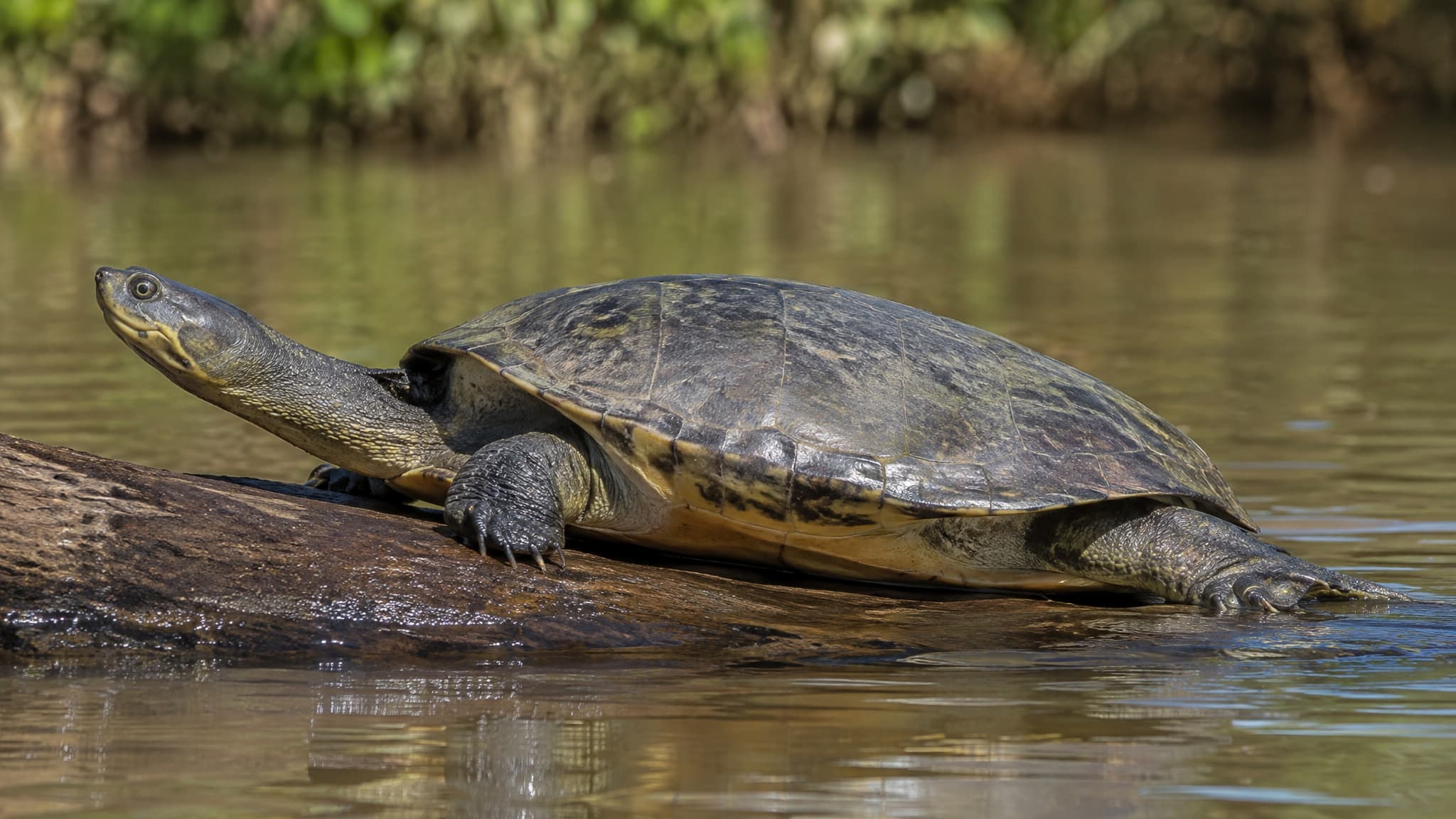
A river turtle rests on a wet fallen log at the water’s edge, with its head raised and broad, clawed limbs extended. Its domed, darkly mottled shell and yellow-speckled head and neck are clearly visible.
The giant South American river turtle (Podocnemis expansa), also called the Arrau turtle, is the largest side-necked turtle and the largest freshwater turtle in South America. It belongs to the family Podocnemididae. Like other members of the suborder Pleurodira, it pulls its head in by bending its neck sideways rather than drawing it straight back into the shell. The carapace is broad, flattened and oval, and it is wider toward the rear. Adults are olive-grey to brown, and algae growing on the shell often changes this colour. Females are much larger than males. They can exceed 80 cm in carapace length and weigh up to about 90 kg, while males usually measure about 50 cm.
Distribution and habitat
The species lives in large rivers of the Amazon and Orinoco basins in northern South America, including Brazil, Venezuela, Colombia, Peru, Bolivia and the Guianas. It uses main river channels, lakes and seasonally flooded forests. It is strongly aquatic and comes ashore mainly to bask and to nest on sandy beaches and sandbars exposed during the dry season.
Diet and behaviour
Adults are mainly herbivorous. They eat fallen fruits, seeds, leaves, roots and aquatic plants, and only occasionally take sponges, insects, crustaceans, molluscs or small fish. The turtles are active by day and migrate seasonally between flooded-forest feeding areas and nesting beaches. Because they eat fruit and pass the seeds, they help spread riverside plants.
Reproduction and lifespan
Females gather in large numbers to nest together on sandbanks in the dry season. Each female lays a clutch of roughly 50 to 150 eggs, and studies report an average of nearly 100. Incubation temperature determines the sex of the hatchlings: warmer nests produce mostly females. Hatchlings are only about 5 cm long. The species matures slowly and can live for several decades.
Conservation
For centuries, people harvested adults for meat and eggs for food and oil, and populations dropped sharply. Today the main threats are poaching of nesting females, egg collection, dams and habitat loss. Brazil's ICMBio lists the species as Near Threatened, and international trade is regulated under CITES Appendix II. Long-term programmes that protect nesting beaches have been key to its recovery in parts of its range.