Gila Monster
Heloderma suspectum
 AI-generated
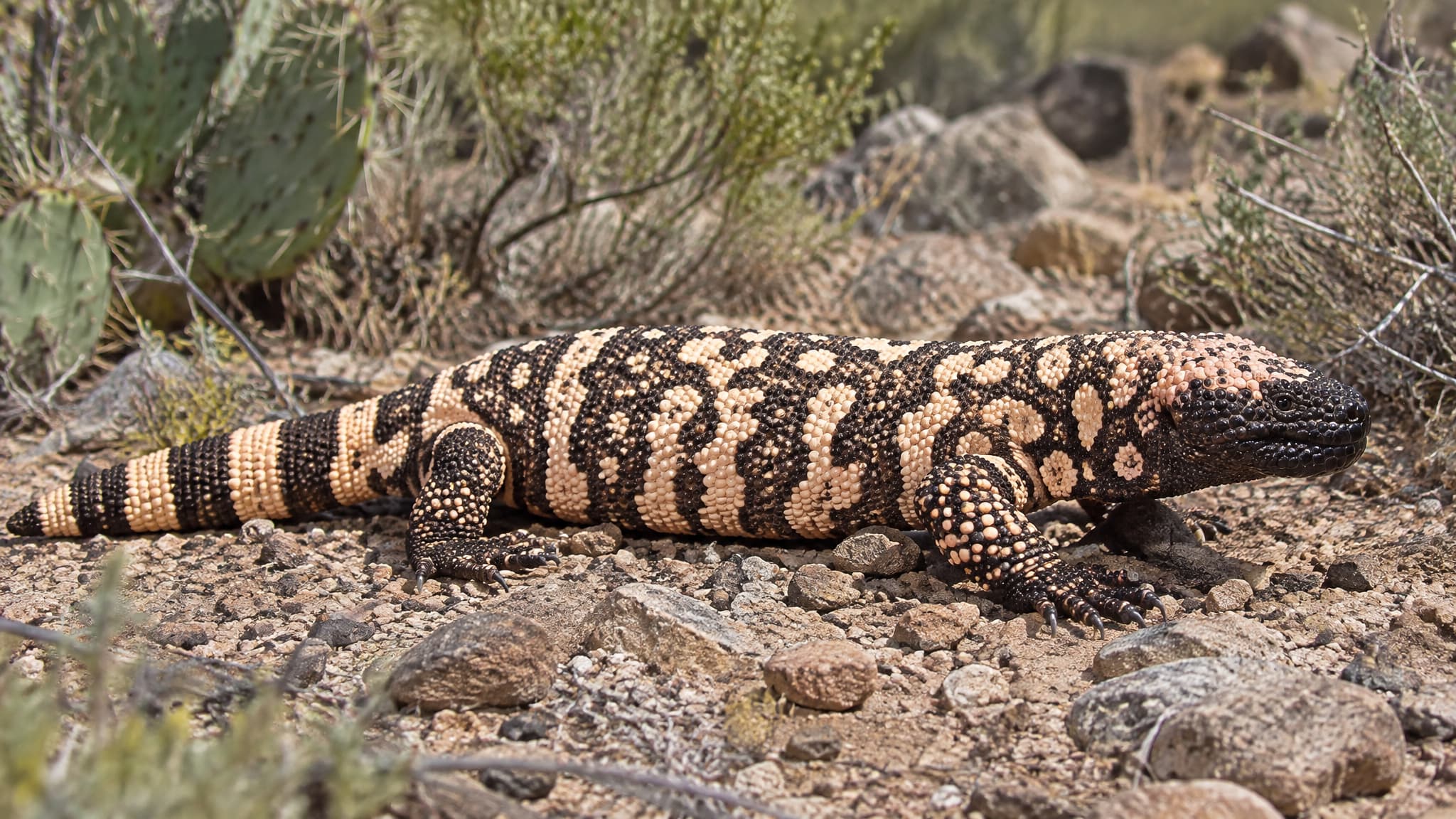
A Gila Monster (Heloderma suspectum) rests low on rocky desert ground, facing right among cacti and scrub. Its stout body, thick banded tail, bead-like scales, and robust clawed limbs are clearly visible.
The Gila monster (Heloderma suspectum) is a heavy-bodied, slow-moving lizard. It is one of only a few venomous lizards in the world, and its close relatives are the beaded lizards of Mexico and Central America. It is the largest lizard native to the United States and reaches a maximum length of about 56 cm. Its skin is covered in rounded, bead-like scales in a pattern of black mixed with pink, orange or yellow. The head, chin, neck and legs are mostly black. It has a broad head, small dark eyes with round pupils, and a short, fat tail where it stores fat.
The species lives from extreme southwestern Utah, southern Nevada and nearby parts of California, through western and southern Arizona and southwestern New Mexico, and south into Sonora and northwestern Sinaloa in Mexico. It is found from sea level up to about 1,500 m. It prefers dry, semi-arid land with scattered cacti, shrubs, mesquite and grasses, and it uses rocky slopes, arroyos and canyon bottoms. It tends to avoid open flats and farmland.
Gila monsters are carnivores and look for prey that cannot escape or defend itself. They eat newborn rodents and rabbits, nestling birds, small lizards, and the eggs of birds, lizards, snakes and tortoises. They sometimes also take insects and carrion. An adult can eat about a third of its body weight in one meal. Because its metabolism is very slow, it can live on just a few large meals a year. It spends about 90–95% of its life in burrows or rocky shelters and hibernates roughly from late November to February. Its venom comes from glands in the lower jaw and is chewed into a victim, mainly as a defense. It is a shy animal, and bites to people almost always happen when someone handles or provokes it.
Mating usually takes place in May and June. Males may wrestle each other for access to females. In southern Arizona, females lay an average of about 5 leathery eggs, but up to 12, in burrows from late June to mid-August. The eggs develop through the winter, and the young hatch the following spring at about 16 cm long. Gila monsters live about 20 years in the wild and much longer in captivity.
As a predator of nests and young animals, the Gila monster helps shape small vertebrate populations in desert ecosystems. Compounds in its venom, such as exendin-4, have led to medicines used to treat type 2 diabetes. The IUCN lists the species as Near Threatened. Its main threats are habitat loss from urban growth and farming, illegal collection for the pet trade, and persecution by people. It is protected by state law in its range and is listed on CITES Appendix II.