
Golden lion tamarin
Leontopithecus rosalia
 AI-generated
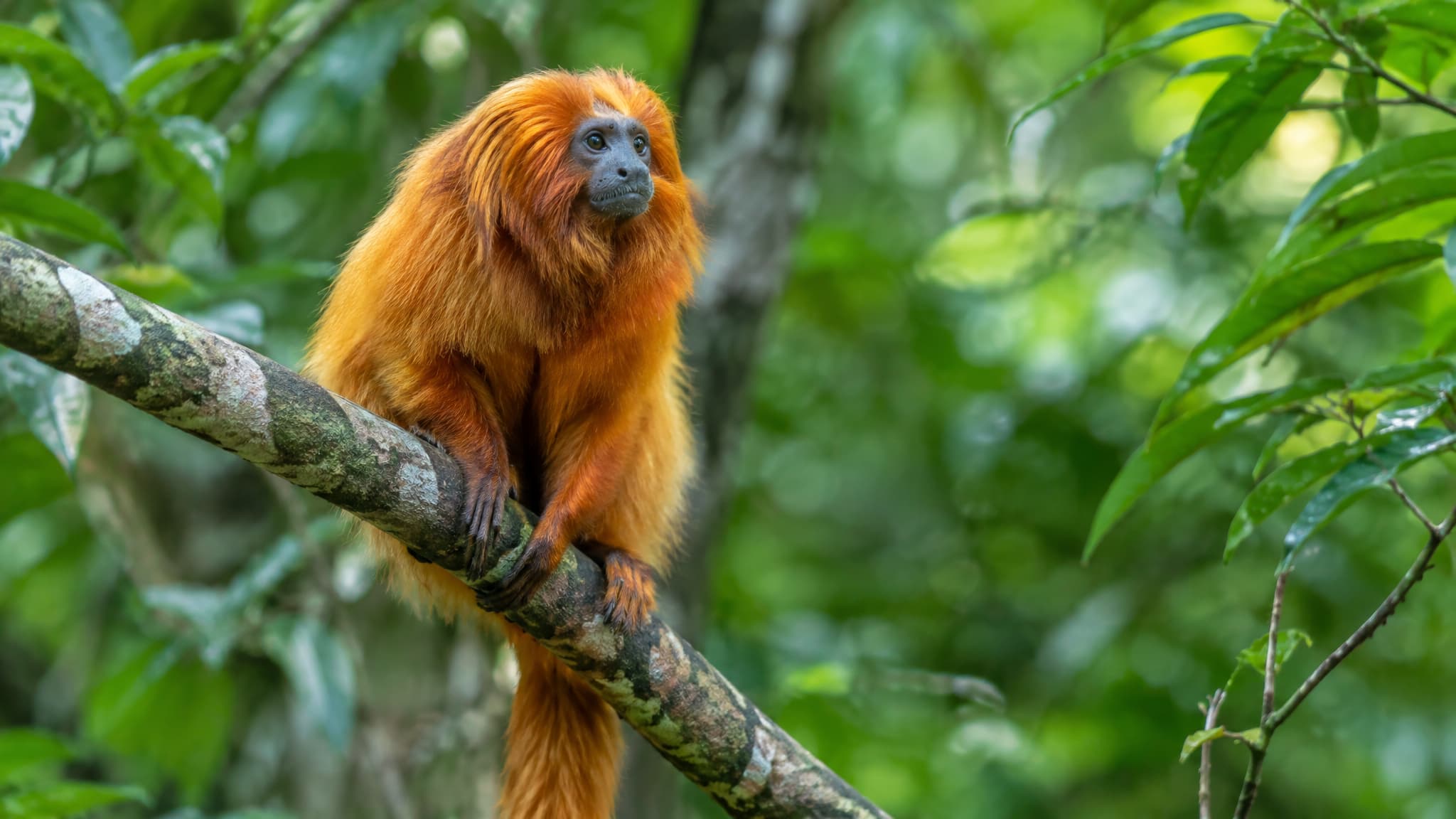
A golden lion tamarin sits astride a diagonal moss-covered branch in dense green forest, with its vivid orange mane, dark bare face, grasping hands, and long tail visible. Its body faces forward while its head turns slightly to the side.
The golden lion tamarin is a small New World monkey instantly recognizable by its silky orange-to-reddish-gold coat and the long mane framing its dark, mostly bare face. Its hands have claw-like nails rather than the flattened nails typical of many primates, an adaptation that helps it probe bark, crevices, and tangled vegetation while searching for food. Adults have a compact body and a tail longer than the body, but males and females are broadly similar in appearance. (animaldiversity.org)
This species is native only to southeastern Brazil, where it inhabits lowland coastal Atlantic Forest. It is strongly arboreal, moving through vines and branches in dense forest and using tree cavities as sheltered night sleeping sites. Golden lion tamarins are active by day and live in small, territorial family groups, usually centered on a breeding pair and their offspring. Scent marking and a varied vocal repertoire help maintain contact and signal danger or territorial defense. (animaldiversity.org)
An omnivore, the tamarin eats fruit as well as insects, spiders, snails, small vertebrates, eggs, and other available foods. Its slender fingers are used in careful extractive foraging. Fruit feeding also makes it an ecologically meaningful seed disperser: a field study found that it consumed fruits from dozens of plant species and dispersed viable seeds of many of them. (animaldiversity.org)
Reproduction is cooperative. A dominant pair normally breeds, females commonly give birth to twins after roughly 130–135 days of gestation, and fathers and other relatives assist with carrying and caring for young. Wild individuals can live at least 15 years. The species is classified as Endangered; forest clearing, fragmentation, and conversion for agriculture, ranching, resource extraction, and urban growth remain major threats. Captive breeding, reintroductions, habitat protection, and forest-corridor work have been central to its recovery efforts. (animaldiversity.org)



