
Green Anaconda
Eunectes murinus
 AI-generated
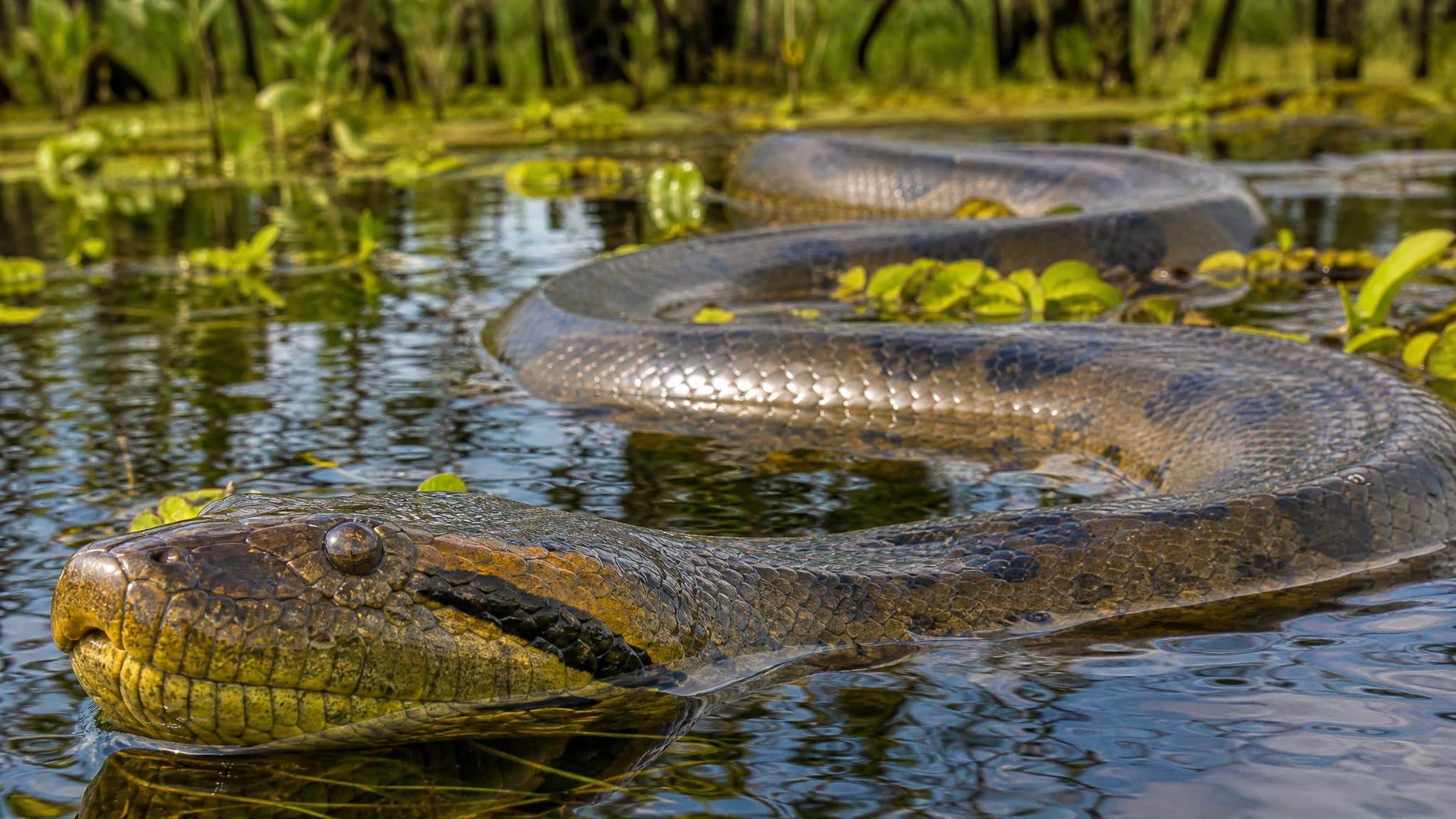
A green anaconda lies partly submerged in calm, plant-filled water, with its broad head, high-set eyes, and thick coils visible above the surface.
The green anaconda is a huge, heavy-bodied, nonvenomous constrictor of tropical South America. Called the sucuri-verde in Brazil, it is generally regarded as the world’s heaviest snake. Its back is olive to dark green, marked with large rounded brown-black blotches; the underside is yellowish. Small eyes and nostrils sit high on the head, an adaptation that lets the animal watch and breathe while most of its body remains submerged.
This species occurs east of the Andes, from Colombia and Venezuela through the Guianas and Amazonian countries to northern Bolivia, Paraguay, and Trinidad; it is also widespread in Brazil. It is closely associated with freshwater environments, including slow rivers, lakes, swamps, marshes, flooded forest, and seasonally inundated savannas. It swims powerfully but also rests and hunts along muddy banks and dense waterside vegetation.
A patient ambush predator, the green anaconda detects prey using chemical cues, vibrations, vision, and heat-sensitive pits. It eats fish, amphibians, reptiles, birds, and mammals, with larger individuals capable of taking sizeable prey such as caimans, capybaras, and peccaries. It seizes prey with recurved teeth and kills chiefly by constriction before swallowing it whole. By preying on many vertebrates—and serving as prey when young—it is an important part of wetland food webs.
Females are substantially larger than males. During the breeding season, several males may coil around one female in a “breeding ball.” The species is ovoviviparous: embryos develop inside the female, which gives birth to live young after roughly seven months. Litters commonly contain dozens of independent newborns. Wild longevity is often reported around 10 years, while captive animals may exceed 30 years. Habitat conversion, persecution, collection for trade, and local hunting may threaten populations, though the species is listed in CITES Appendix II and does not have a global IUCN assessment in the consulted references.



