Green Sea Turtle
Chelonia mydas
 AI-generated
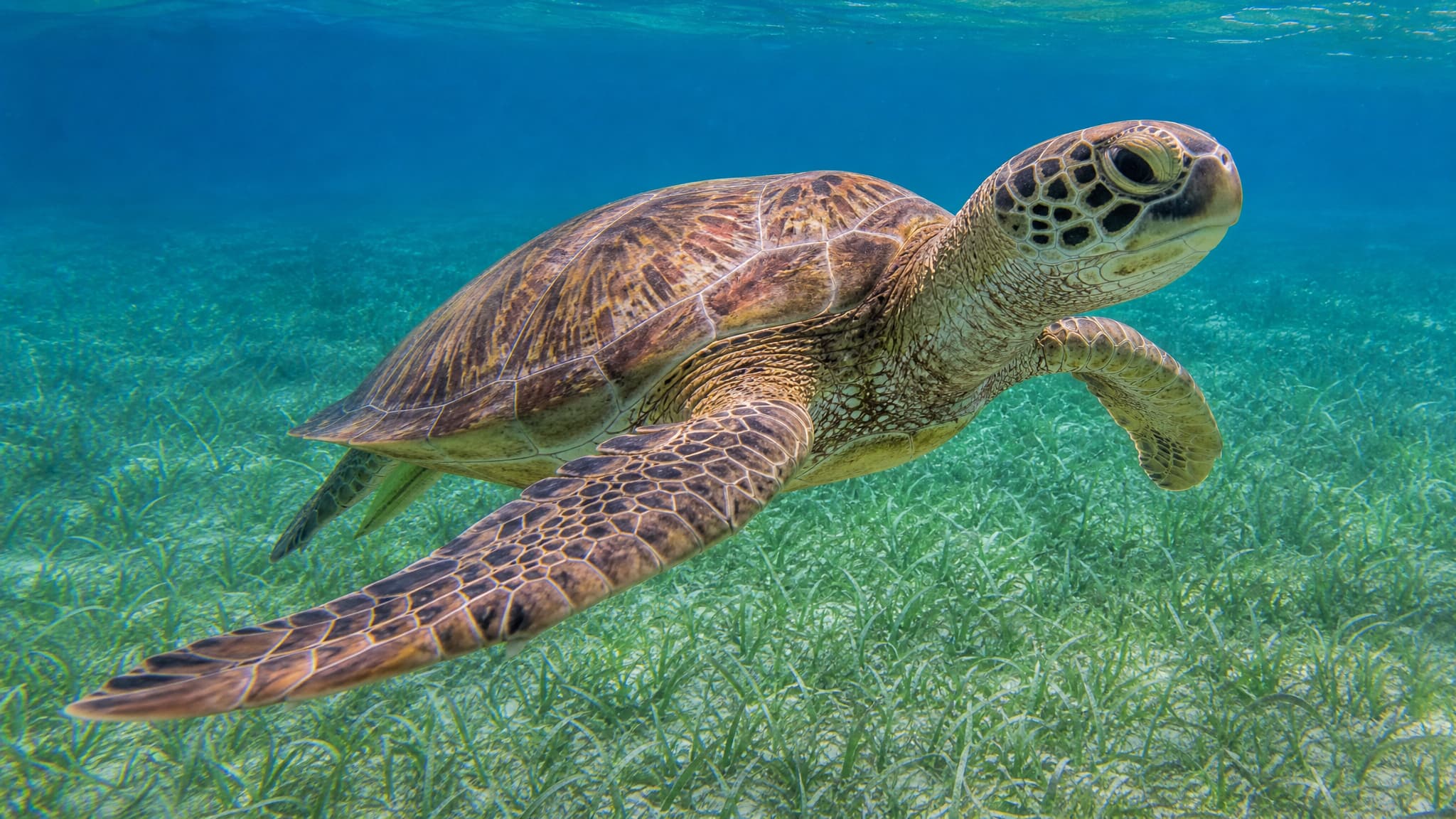
A green sea turtle swims above a seagrass meadow in clear, shallow blue water, with its broad foreflippers extended and patterned shell and head visible.
The green sea turtle, Chelonia mydas, is the largest living hard-shelled sea turtle. Adults typically measure about 1–1.2 m in carapace length and commonly weigh roughly 113–181 kg, although larger individuals occur. Its smooth, oval shell is usually olive, brown, gray, or darkly mottled, with a pale yellowish-to-white underside. A relatively small, rounded head, serrated beak edges, and a single pair of large scales between the eyes help distinguish it from other sea turtles. Its English name refers not to the shell, but to the greenish body fat beneath it.
This species occupies tropical and subtropical waters of the Atlantic, Indian, and Pacific oceans, as well as the Mediterranean Sea. Young turtles spend an oceanic phase offshore, while older juveniles and adults often feed in shallow coastal habitats: seagrass meadows, algal beds, bays, reefs, lagoons, and estuaries. Green turtles are capable of long migrations between feeding grounds and nesting beaches. Females come ashore only to nest, usually returning to beaches within the broader region where they hatched.
Unlike most other sea turtles, mature green turtles are largely herbivorous. They crop seagrasses and graze algae, although juveniles and some populations may also eat jellyfish, sponges, or other invertebrates. This feeding makes them important ecosystem participants: grazing can influence the productivity and structure of seagrass and algal communities. Like all sea turtles, they breathe air and must surface regularly, but they can rest underwater for extended periods.
Females dig nests in dry beach sand with their rear flippers and lay clutches commonly containing around 100–125 eggs; they may nest repeatedly during a breeding season. Incubation lasts roughly two months, depending strongly on conditions. Nest temperature also influences hatchling sex, with warmer nests tending to produce more females. Hatchlings immediately travel to the sea, but only a small fraction survive to adulthood. Sexual maturity is slow, often taking decades, and lifespan is estimated at 70 years or more.
The IUCN Marine Turtle Specialist Group lists the species globally as Least Concern following its 2025 assessment, but this does not mean all populations are secure: some regional subpopulations remain Endangered, Vulnerable, or Near Threatened. Principal pressures include accidental capture in fishing gear, direct harvest of turtles and eggs, coastal development and loss of nesting habitat, vessel strikes, marine debris, pollution, disease such as fibropapillomatosis, and climate-driven changes to beaches and nest temperatures. Continued protection of nesting beaches, foraging habitat, and migratory routes remains essential.