Guianan squirrel monkey
Saimiri sciureus
 AI-generated
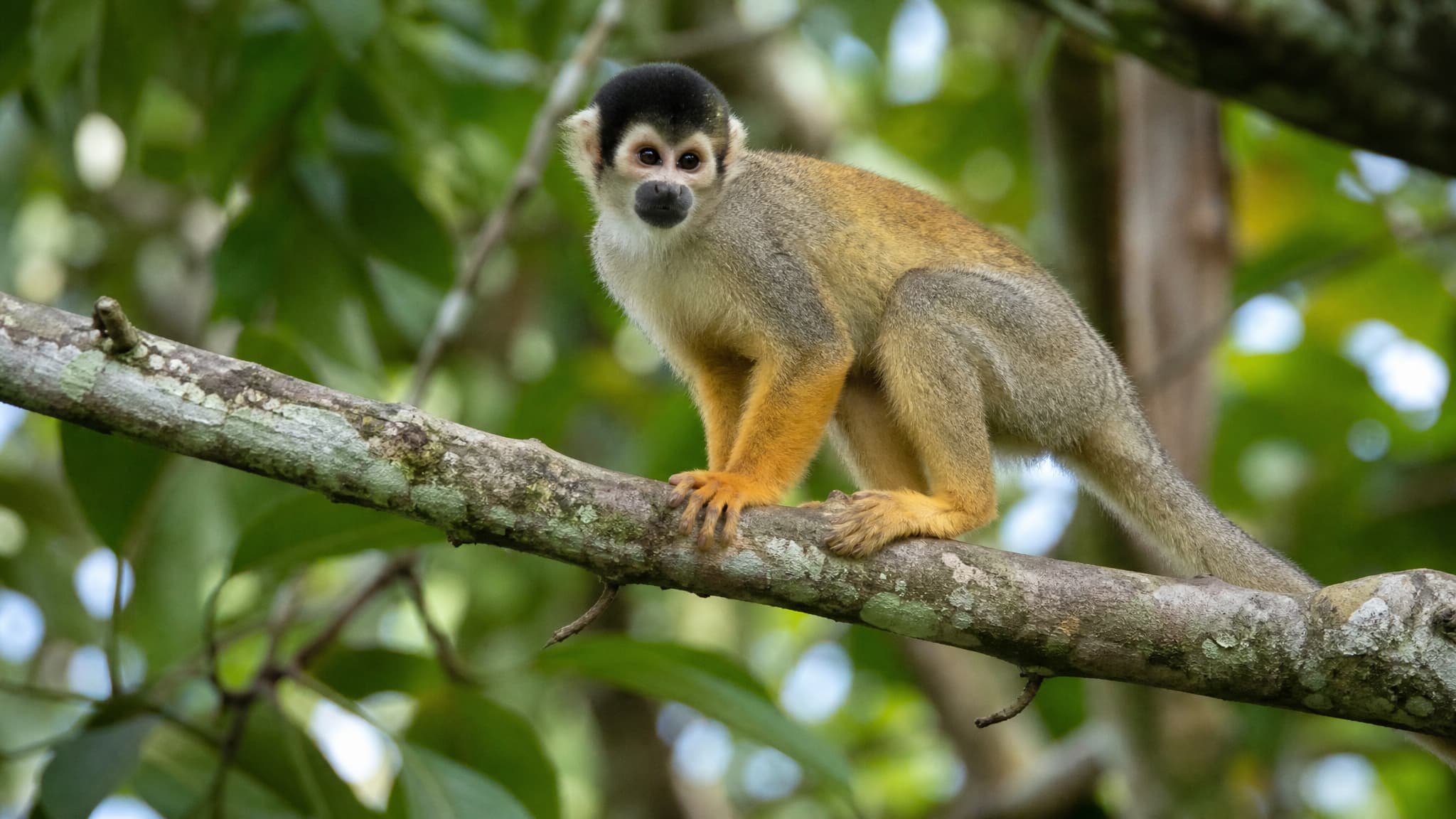
A squirrel monkey perches on a lichen-covered branch in dense green forest, facing the camera with its long tail extending to the right; its dark cap, pale facial markings, golden limbs, and gray-brown coat are clearly visible.
The Guianan squirrel monkey is a small, slender New World monkey with a gray to olive-gray coat, vivid yellowish limbs, and a long, non-prehensile tail. Its white facial mask and dark muzzle give the face a distinctive expression; the tail may curl over the shoulder while the animal rests. Adults have a body length of roughly 30 cm, with a tail that is longer than the body. Like other primates, it has nails rather than claws, and males have especially large upper canines.
This species occurs in the Guianas—Guyana, Suriname, and French Guiana—and in northern Brazil. In Brazil it is found north of the Amazon River, from the Branco and Negro river region eastward to the Atlantic coast, including Roraima, Amazonas, Pará, and Amapá. It uses primary and secondary tropical forest, gallery forest, forest edges, and other wooded habitats, usually traveling through the middle levels of the forest but sometimes descending lower.
Active by day and highly agile, Guianan squirrel monkeys move through branches in social troops that can be very large. Females and their young form the social core, while males have a dominance hierarchy and social relationships shift with the breeding season. The species is an omnivore with a strong reliance on fruit and insects; it also takes spiders and other arthropods, along with leaves and seeds. By consuming fruits and searching widely for food, it contributes to food-web connections and may help disperse seeds.
Breeding is seasonal. After a gestation of about 160–170 days, a female normally gives birth to one infant, which she nurses and protects; males do not provide direct parental care. Females can mature at about 2.5 years and males around 4 years. Reported average lifespan is about 21 years, including records from wild populations. The IUCN status is Least Concern, but local populations can still be affected by forest loss, hunting, and capture for the pet trade or research.