
Harbor porpoise
Phocoena phocoena
 AI-generated
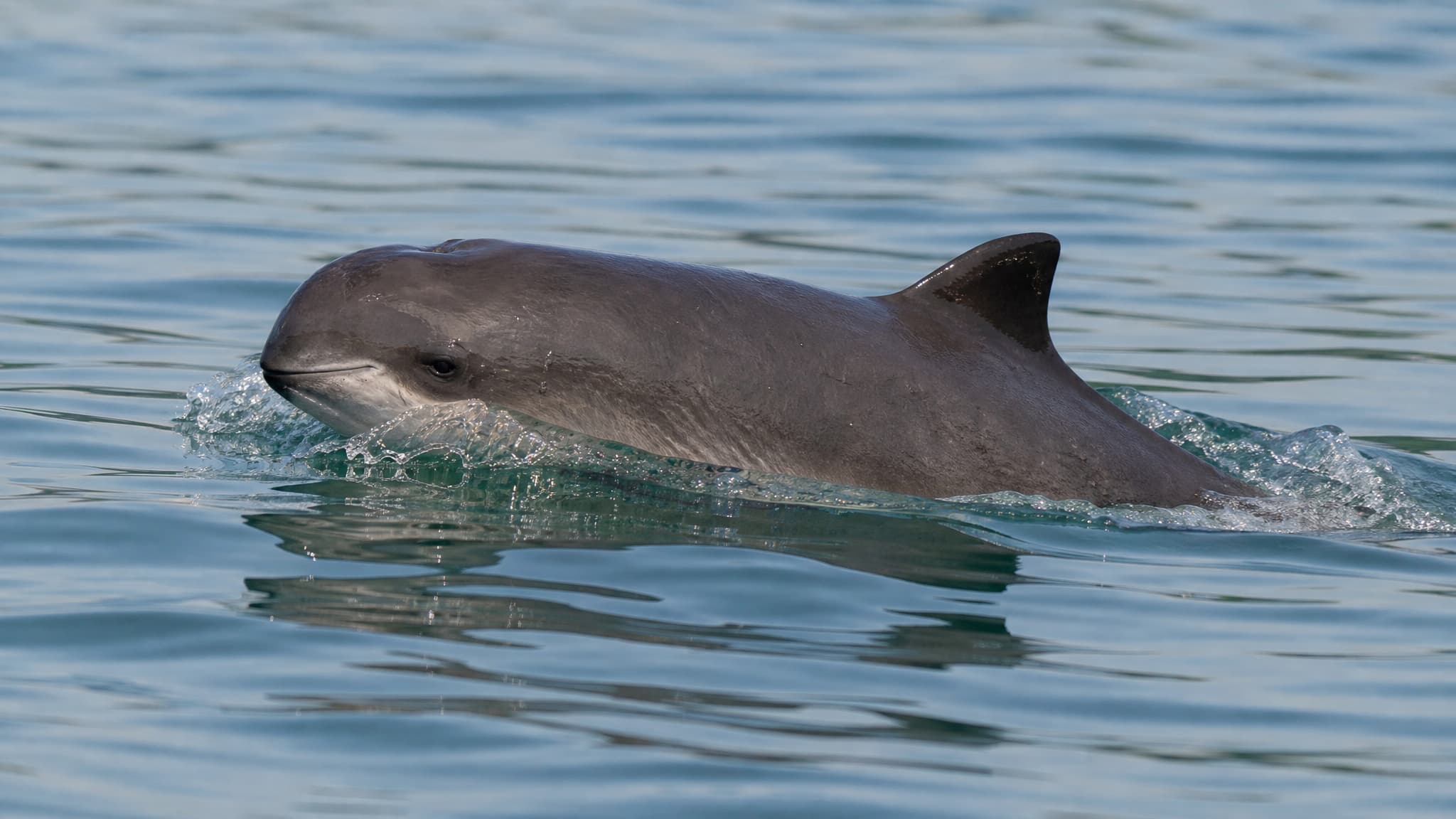
A harbor porpoise surfaces side-on in calm open water, with its rounded head, short blunt snout, dark gray back, and triangular dorsal fin visible above the surface.
The harbor porpoise is a compact, cold-water cetacean and one of the smallest porpoises. Adults usually measure about 1.4–2 m long, with females tending to be slightly larger than males. Its back is dark gray to nearly black, fading through gray flanks to a pale belly. A short, blunt snout, small spade-shaped teeth, and a triangular dorsal fin distinguish it from many dolphins; dark markings commonly run from the mouth or eye area toward the flippers.
This species occurs across temperate, subarctic, and Arctic waters of the Northern Hemisphere. It ranges through coastal parts of the North Atlantic and North Pacific, with occurrences in the Baltic, Black, and Mediterranean regions. Harbor porpoises favor relatively shallow coastal waters—especially bays, estuaries, fjords, and river mouths—though some populations move farther offshore seasonally or travel into rivers.
Usually inconspicuous and wary of boats, harbor porpoises are often seen alone or in pairs, although larger groups can gather where food is plentiful. They make high-frequency clicks for echolocation and feed chiefly on small schooling fishes such as herring and mackerel; squid and octopus are also taken. As active predators of small marine animals, they help transfer energy through coastal food webs.
Females generally mature at about three to four years old. Mating is concentrated in summer in many areas, and births commonly occur from May through July after a gestation of roughly 10–11 months. A single calf is nursed for about 8–12 months, and the species can live for around 24 years. Globally it is listed as Least Concern, but entanglement in fishing gear, underwater noise, pollution, and localized population declines remain serious threats; Baltic animals are of particular conservation concern.



