
Hawksbill Sea Turtle
Eretmochelys imbricata
 AI-generated
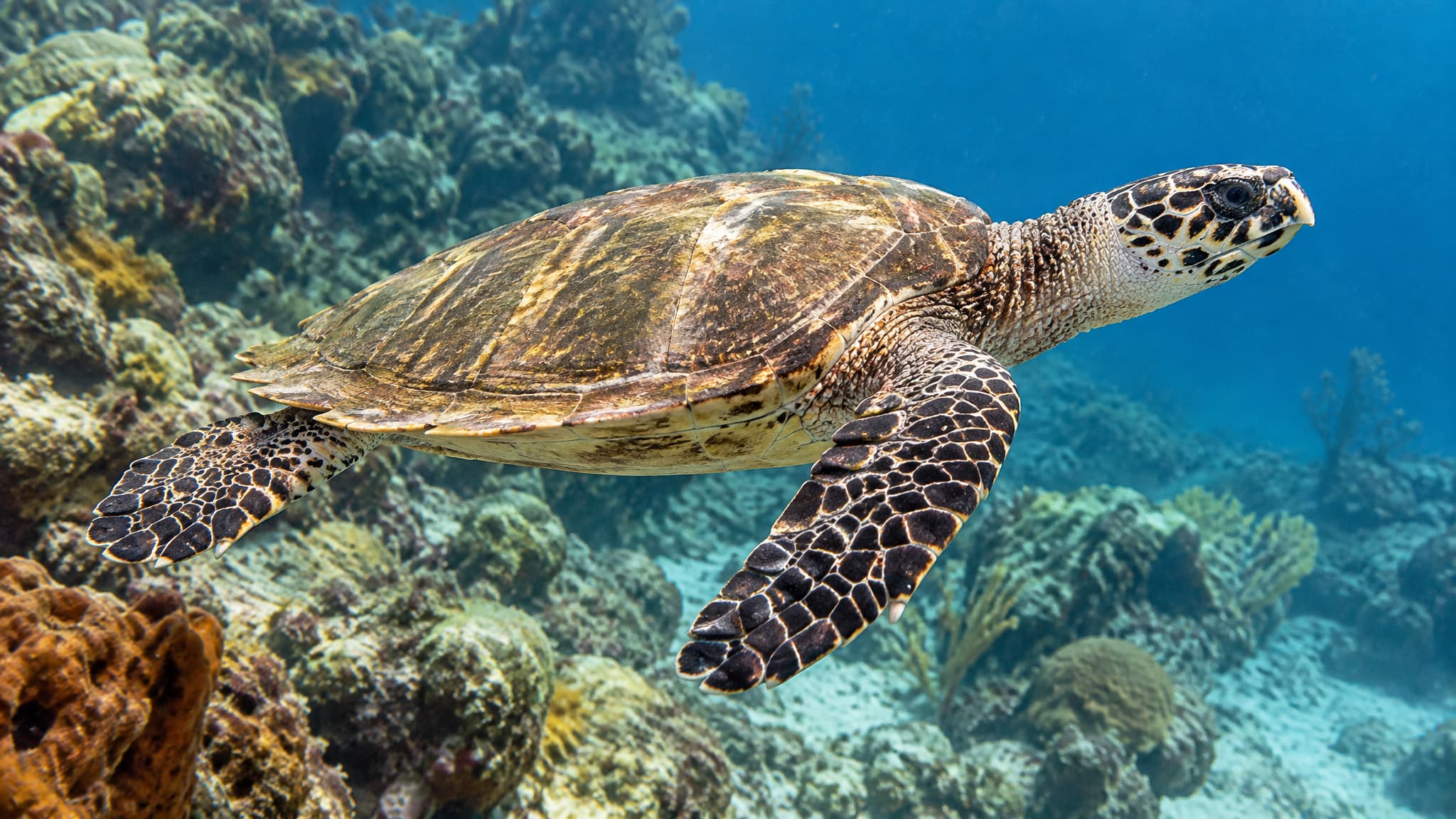
A hawksbill sea turtle swims to the right above a coral reef, showing its strongly hooked beak, mottled overlapping shell scutes, and patterned front flippers.
Hawksbill Sea Turtle
The hawksbill sea turtle (Eretmochelys imbricata) is a small to medium-sized sea turtle in the family Cheloniidae. It is easy to recognize by its narrow head, which tapers to a sharp, curved point that looks like a bird's beak. This is where the name comes from. The scutes on its carapace overlap like roof tiles, which is what the epithet imbricata refers to. The shell is amber to brown with lighter, yellowish markings. Hatchlings have a heart-shaped carapace.
Size and distribution
Adults are usually about 90 cm long. In the Indian Ocean they typically weigh 45 to 70 kg, and some reach about 90 kg. Hatchlings in the US Caribbean measure about 42 mm and weigh only 13.5 to 19.5 g. This is the most tropical of the sea turtles. It lives mainly in tropical parts of the Atlantic, Pacific and Indian oceans and, less often, in subtropical waters.
Habitat, diet and behavior
Hawksbills are most often found on coral reefs and other hard-bottomed areas where sponges grow. Sea sponges make up most of their diet, and their narrow beak lets them reach into cracks in the reef to feed. Adults are usually solitary and active by day, searching reefs and continental shelves for food. They also migrate between feeding areas and nesting beaches.
Reproduction and lifespan
Females return to the beaches where they hatched about every two to three years to nest. In one season a female may dig three to five nests or more, each with about 130 eggs on average. The species grows slowly and lives a long time. In Brazil, sexual maturity is estimated at about 25 years and the generation time at about 35 years.
Ecological role and conservation
By eating sponges, hawksbills help shape reef communities. The species is listed as Critically Endangered by the IUCN and appears on CITES Appendix I. For a long time, people hunted females for their shell (the source of 'tortoiseshell') and collected their eggs. Today, accidental capture in fishing gear is a serious problem around the world. Rare hybrids with loggerhead turtles have been recorded in Brazil.



