
Heaviside’s dolphin
Cephalorhynchus heavisidii
 AI-generated
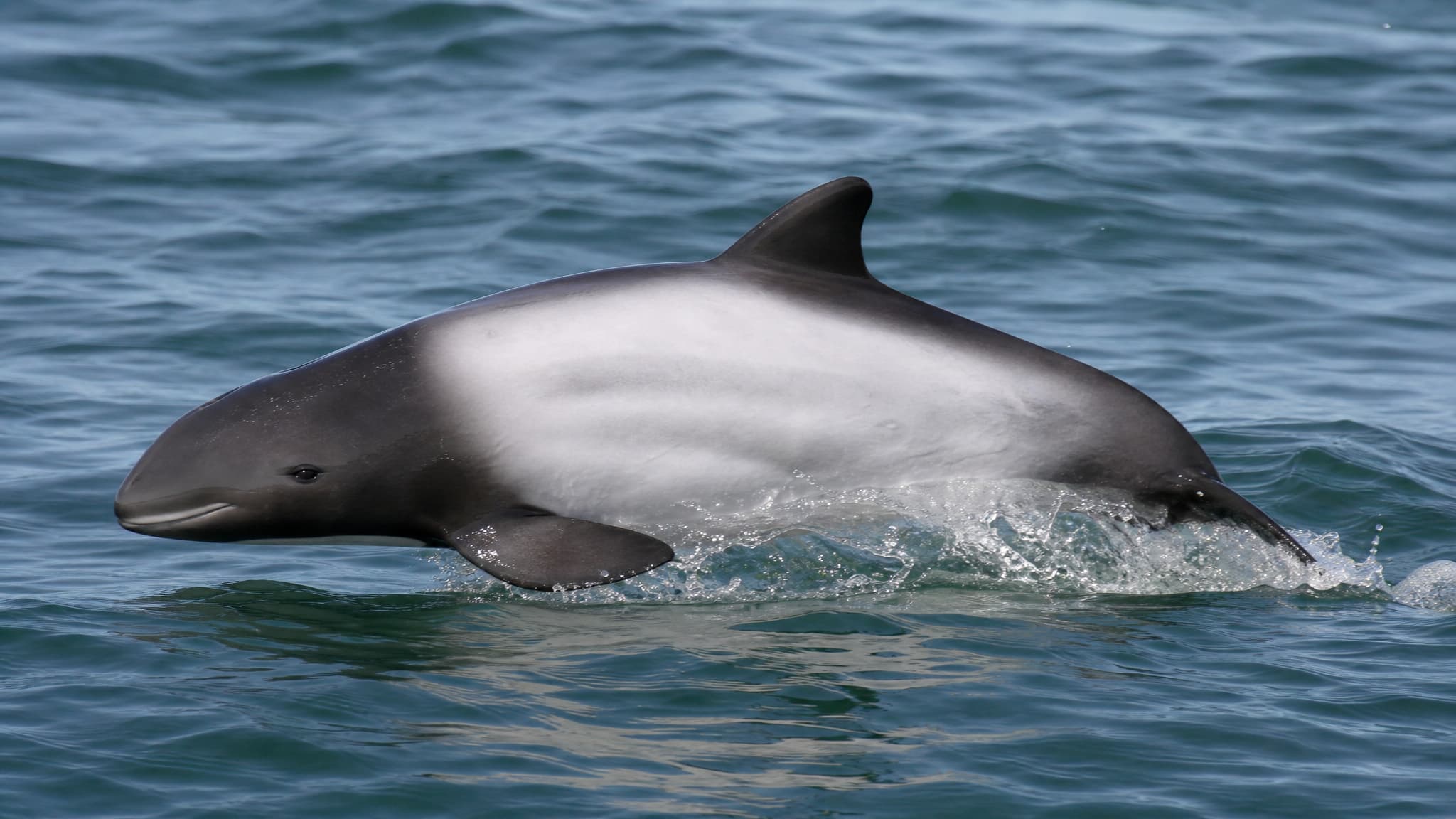
A Heaviside’s dolphin surfaces side-on in open seawater, with its rounded head, short snout, dark head and flippers, pale flank, and dorsal fin clearly visible amid splashing water.
Heaviside’s dolphin
Heaviside’s dolphin (Cephalorhynchus heavisidii) is a compact, blunt-headed dolphin of the south-west African coast. Adults average about 1.74 m long and commonly weigh 60–70 kg. Its large triangular dorsal fin, rounded paddle-like flippers, dark grey-and-black upper body, and bold white belly markings give it a distinctive appearance; from a distance, it can be mistaken for a very small orca.
It occurs only in the south-eastern Atlantic, from southern Angola through Namibia to western South Africa. It is strongly associated with cool, productive coastal waters of the Benguela Current, generally close to shore and usually in water shallower than 100 m.
This is an active, social toothed whale, most often encountered alone, in pairs, or in small groups. It uses echolocation while hunting and eats fish and cephalopods, including hake, kingclip, gobies, squid, and octopus. Its movements can track the daily vertical movements of prey, with dolphins often spending mornings nearer shore.
Females usually produce one calf after a gestation of roughly 10–11 months and reproduce only every few years. Calves are about 85 cm long at birth. Sexual maturity is reached at about 5–9 years by females and 6–9 years by males; available estimates place wild longevity at roughly two decades, although life-history data remain limited.
As a coastal predator, it helps link fish and cephalopod populations within the Benguela marine food web. The species is listed as Near Threatened. Entanglement in gillnets and other inshore fishing gear is a major concern, alongside illegal or opportunistic hunting, vessel disturbance, pollution, and climate-driven change to its unusually restricted cold-water habitat.



