
Honey badger
Mellivora capensis
 AI-generated
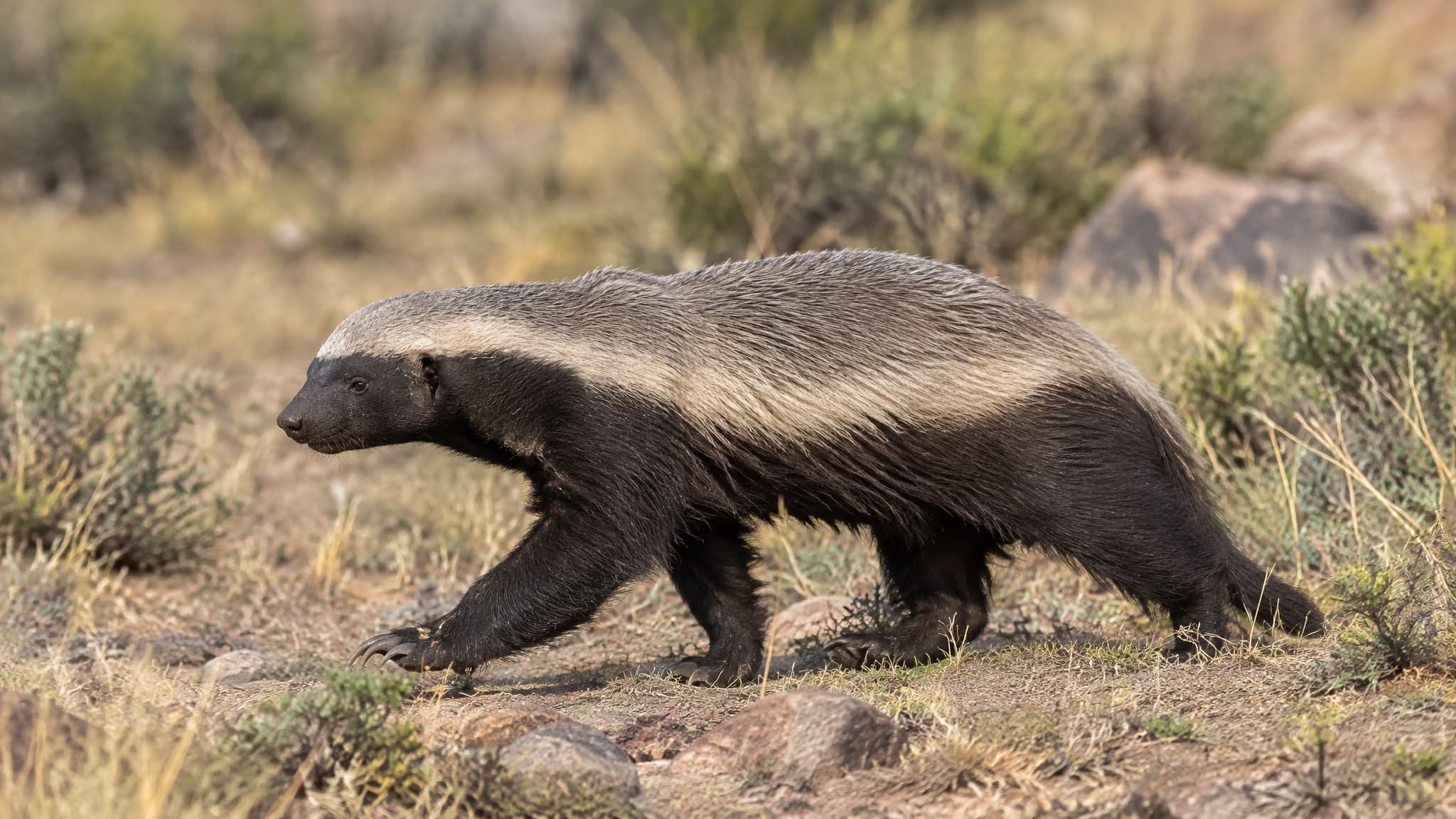
A honey badger walks in left profile across rocky, dry scrubland. Its broad body, dark underside, pale dorsal stripe, sturdy legs, and long curved claws are clearly visible.
The honey badger, or ratel, is a stocky, low-slung member of the weasel family and the only living species of its genus, Mellivora. Adults measure 55 to 77 cm from head to rump, with a tail of 12 to 30 cm, and stand 23 to 28 cm at the shoulder. In Africa, males weigh 9 to 16 kg and females 5 to 10 kg. The coat is boldly two-toned: the lower body and legs are black, while a broad grey or white mantle runs from the crown down the back. Its small eyes, broad skull and thick, loose skin give it a tough look, and older males are often covered in scars.
The species ranges across most of sub-Saharan Africa, north to southern Morocco and southwestern Algeria, and through the Arabian Peninsula, Iran and Western Asia to Turkmenistan and the Indian subcontinent. It lives in deserts, steppes, grasslands, woodlands, forests and rocky hills, from sea level up to about 4,000 m in the Bale Mountains of Ethiopia. It needs burrows or rock crevices for shelter.
Honey badgers are opportunistic hunters with one of the least specialised diets in their family. They dig out rodents, lizards, snakes, frogs, insects and scorpions, take birds, eggs and tortoises, eat carrion, and add berries, roots and bulbs. They are famous for breaking into beehives to eat the larvae and honey. Mostly solitary and nomadic, they forage over long distances; in the Kalahari, males have home ranges of about 548 km² and females about 138 km². When threatened they charge fearlessly and release a foul-smelling secretion.
Breeding has no fixed season. After a gestation of 50 to 70 days, the female gives birth to one or two cubs and raises them alone. The young are weaned at 2 to 3 months but stay with their mother for a year or more. Females mature at about 1 year and males at 2 to 3 years. Wild honey badgers typically live 7 to 8 years, and captive animals have reached about 24 to 26 years.
By preying on rodents and insects, the honey badger helps keep their numbers in check, while lions, leopards and spotted hyenas occasionally prey on it. The IUCN lists it as Least Concern, but numbers are thought to be declining in places. The main threats are trapping and poisoning by beekeepers and livestock farmers, hunting for traditional medicine and bushmeat, and accidental deaths in predator control programmes.



