
Honey Possum
Tarsipes rostratus
 AI-generated
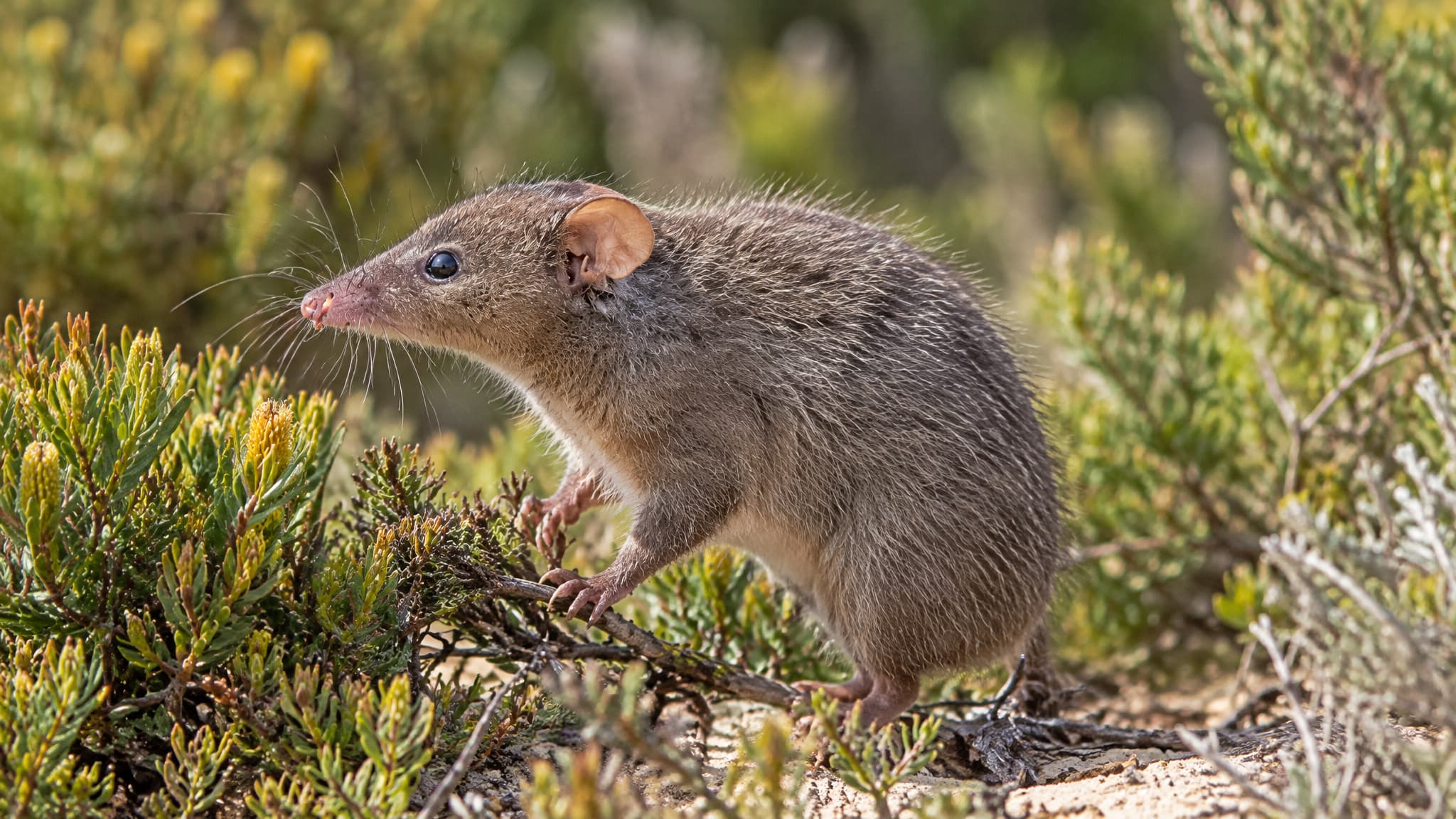
A honey possum is shown in side profile, balancing on a branch amid flowering heath, with a long pointed snout, large eyes, rounded ears, and slender claws visible.
The honey possum or noolbenger (Tarsipes rostratus) is a tiny marsupial from southwestern Australia and the only living member of the family Tarsipedidae. Mouse-sized, it has an exceptionally long, pointed muzzle and a prehensile tail that is longer than its body. Adults measure 65–85 mm from head to rump, with a tail of 70–100 mm. Females are heavier than males: males weigh 7–11 g and females 8–16 g. The fur is grey and brown above and cream below, shading to rufous on the flanks, and three brown stripes run down the back, the central one darkest.
The species is endemic to the southwest of Western Australia. It lives in heath, shrubland and woodland, especially on coastal sandplains, and is most common where plants of the protea family are diverse, as in Banksia woodlands.
The honey possum feeds almost only on nectar and pollen, and it is the only mammal other than bats that lives wholly on them. It visits flowers of Banksia, Adenanthos, eucalypts and other plants, probing them with a long tongue tipped with brush-like bristles. Its teeth are greatly reduced, the molars shrunk to tiny cones. An individual of about 9 g needs roughly 7 ml of nectar and 1 g of pollen a day. It is mainly nocturnal, climbs nimbly with its feet and tail, and sleeps in tree hollows, rock crevices or old bird nests. In cold weather it can drop into torpor to save energy. Outside the breeding season individuals hold territories of about 1 ha.
Breeding can happen at any time of year, depending on how much nectar is available, and females mate with several males. Males produce the longest sperm known in mammals, about 365 µm. After a gestation of about 28 days, a litter of two to four young is born; the newborns are the smallest of any mammal. They stay in the pouch for about 60 days. Embryonic diapause lets a female carry a dormant embryo that resumes growth once the pouch is empty. Honey possums usually live only one to two years.
As a pollinator the honey possum is a keystone species of southwestern heathlands. It is an important pollinator of Banksia attenuata, Banksia coccinea and Adenanthos cuneatus, and the principal pollinator of nodding banksia (Banksia nutans). Predators include barn owls, black-shouldered kites, red foxes and feral cats. The IUCN lists it as Least Concern, but it depends on a year-round supply of flowers, so it is threatened by the plant disease Phytophthora cinnamomi, frequent or intense fires and climate change.



