
Indian Rhinoceros
Rhinoceros unicornis
 AI-generated
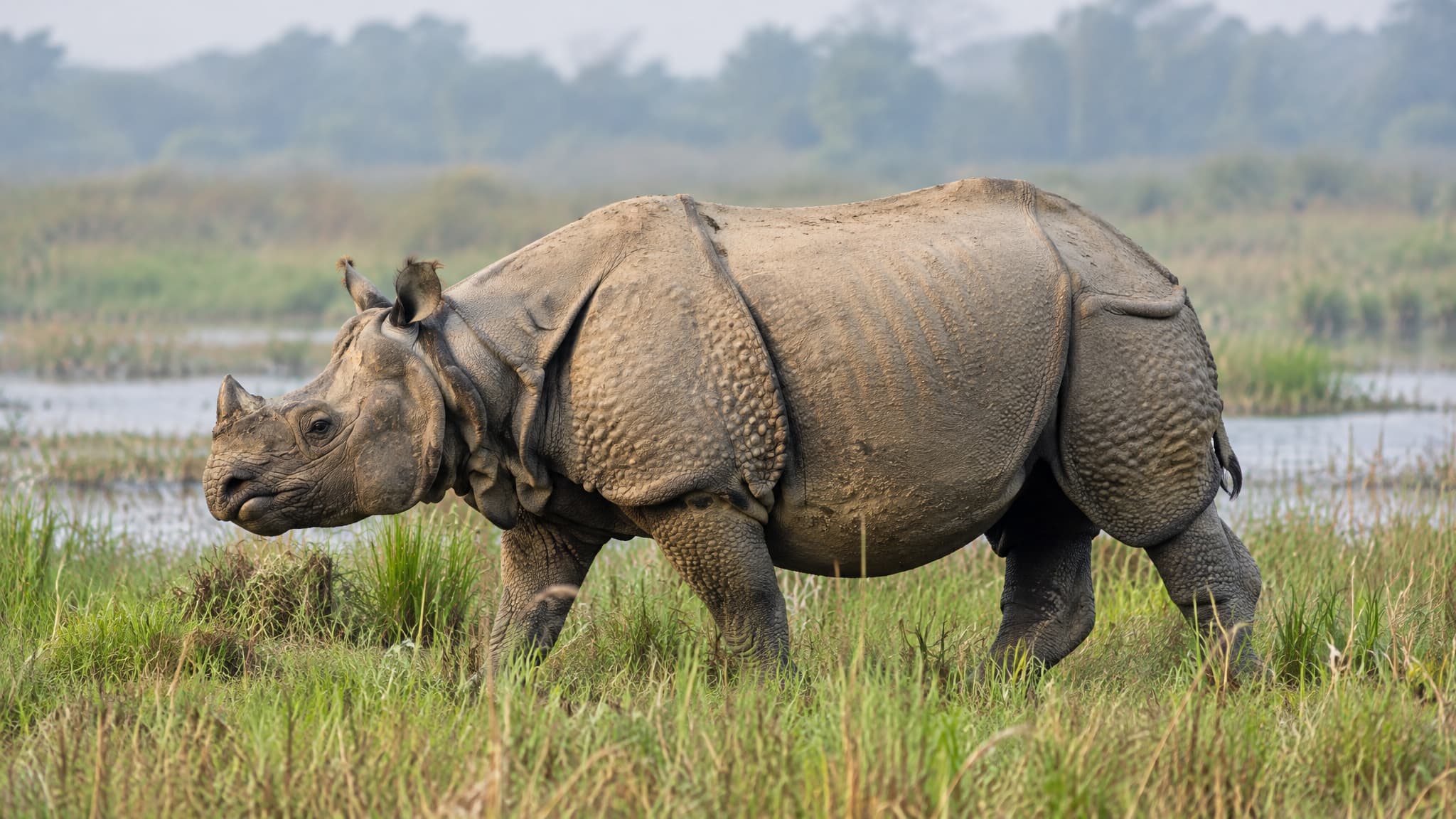
An Indian rhinoceros walks left through tall grass beside a wetland, showing its single nasal horn, folded armored skin, and upright ears.
The Indian rhinoceros, also called the greater one-horned rhinoceros, is one of the largest land mammals alive. Its thick grey-brown skin forms deep folds over the shoulders, rump and legs and is studded with rivet-like bumps, giving it an armour-plated look. Adult males measure 3.7 to 3.8 m in head-body length, stand 1.70 to 1.86 m at the shoulder and average about 2,200 kg, while females are 3.1 to 3.4 m long and average about 1,600 kg. Both sexes carry a single horn of keratin on the snout, usually about 25 cm long, and a prehensile upper lip that grasps tall grass.
The species once ranged across the northern Indian subcontinent from Pakistan to Bangladesh. Today it survives in 12 protected areas in northern and northeastern India and southern Nepal, mainly in the alluvial grasslands of the Terai and the Brahmaputra basin. It favours floodplains near large rivers, tall grass, reed beds, swamps and wooded meadows.
This rhino is a grazer that needs about 150 to 200 kg of food a day. Grasses dominate its diet, supplemented by leaves, twigs, shrubs, flowers, fruit, aquatic plants and crops such as rice. It is mostly solitary, apart from mothers with calves, and feeds in the early morning, late afternoon and at night, resting in the heat of the day. Long wallows in mud and water cool it and protect its skin from sun and biting flies. Communal dung heaps and urine spraying mark its paths. It swims well and can charge at up to 55 km/h over short distances.
Breeding happens all year round. After a gestation of about 16 months, the female gives birth to a single calf weighing 40 to 81 kg, which is weaned at 12 to 18 months. Females mature at 4 to 5 years and males at 7 to 8 years. Wild rhinos live 30 to 40 years, and animals in human care have reached 47 years.
By grazing grasses, shrubs and young trees, the Indian rhino helps shape the vegetation of its floodplains. Common mynas and cattle egrets pick parasites from its skin folds, and Bengal tigers occasionally kill calves up to six months old.
The IUCN lists the species as Vulnerable, and it is on CITES Appendix I. Fewer than 200 remained around 1900, but strict protection raised the count to 4,075 by March 2025, with 3,323 in India and 752 in Nepal. Poaching for horn, habitat loss and flooding remain threats, and with over 70% of all rhinos in Kaziranga National Park, a single disaster or disease outbreak could hit the species hard.



