
Indian Star Tortoise
Geochelone elegans
 AI-generated
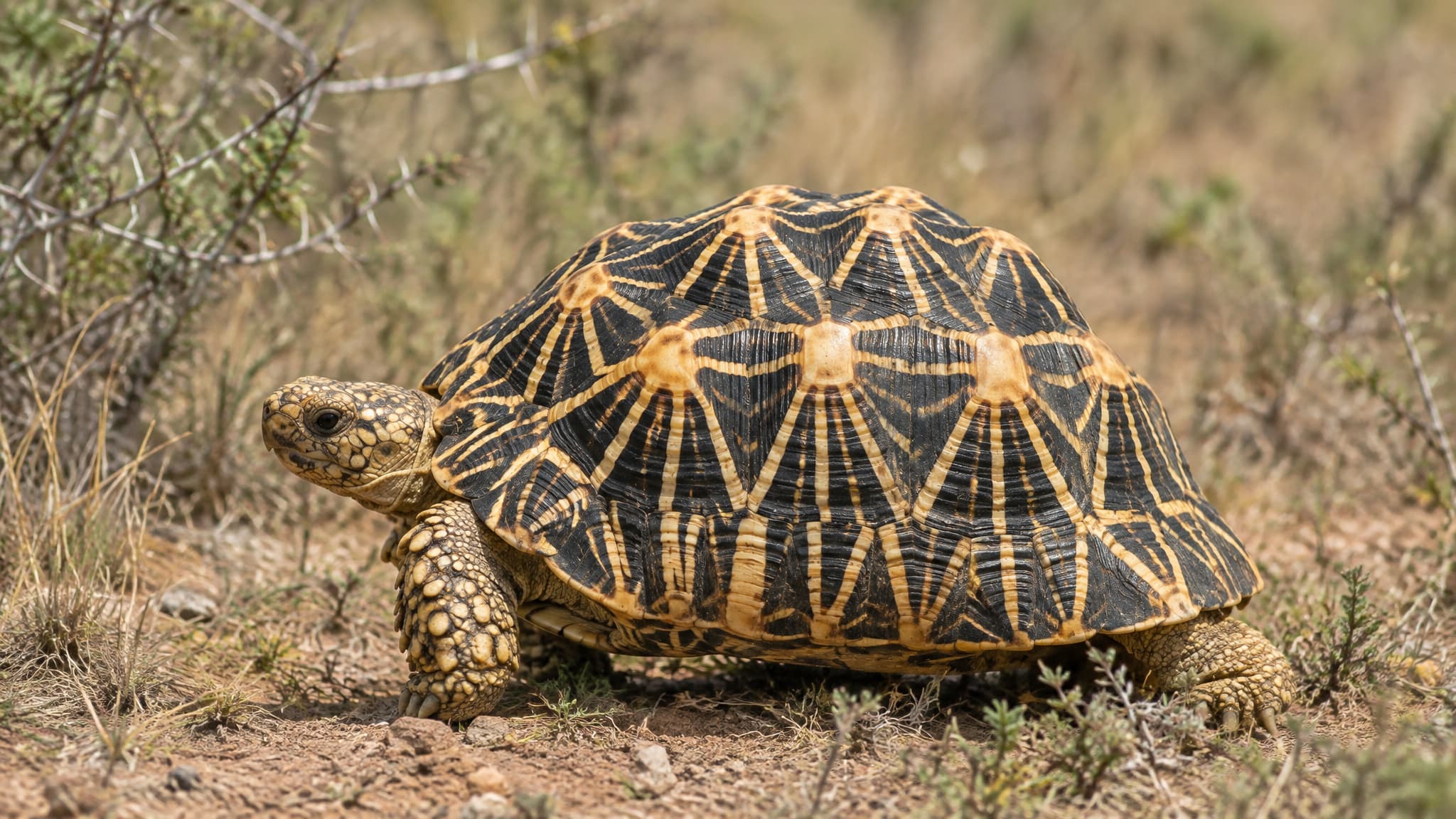
An Indian Star Tortoise walks left through dry scrub, its domed shell marked with prominent radiating yellow star-like lines and its head and forelegs extended.
The Indian star tortoise (Geochelone elegans) is a medium-sized land tortoise named for the bold pattern on its high, domed shell: each dark scute carries yellow lines radiating from a pale centre, forming a star. The pattern works as disruptive camouflage among grass and shadows, and the steep dome helps an overturned tortoise roll back onto its feet. Females are much larger than males, reaching a carapace of 25–30 cm (a record female measured 38 cm), while males usually measure 15–20 cm. Adults weigh about 1 to 6.6 kg. Hatchlings lack the star and show yellow blotches on a dark shell instead.
The species lives in three separate parts of the Indian subcontinent: western India and southeastern Pakistan, including the edge of the Thar Desert; southeastern India; and Sri Lanka, where animals tend to be larger with broader yellow markings. It occupies dry grassland, thorn scrub, semi-desert and moist deciduous forest from sea level to about 450 m, and sometimes farmland. Two subspecies are recognized, G. e. elegans and G. e. actinodes.
It is mainly herbivorous, grazing on grasses, herbaceous leaves, fallen fruit and flowers, and only occasionally taking insects, carrion or dung. Solitary and ground-dwelling, it is most active in early morning and late afternoon during hot weather and shelters under vegetation at midday. Activity rises sharply in the rainy season, and in the north-west of its range it becomes inactive in cold winters. Rival males shove and ram each other, trying to tip the opponent over.
Breeding coincides with the monsoon. A female lays 1 to 9 clutches a year, each with 1 to 10 eggs, and gives no care after nesting. Incubation lasts about 47 to 180 days, usually 90 to 170, and temperature sets the sex: about 28–30 °C yields mostly males and 31–32 °C mostly females. Females mature at about 7–12 years and males at 6–8 years. Lifespan in the wild has not been studied; Animal Diversity Web cites a typical range of 35 to 80 years.
Where common, the star tortoise is an important grazer and may spread seeds of the fruit it eats. Jackals, foxes, mongooses, birds of prey, monitor lizards and snakes eat eggs and young, while adults rely on the shell. The IUCN lists it as Vulnerable, and in 2019 it was moved to CITES Appendix I, banning commercial international trade. Habitat loss and poaching for the pet trade are the main threats; an estimated 10,000–20,000 animals are taken from the wild in India each year, making it one of the most seized tortoises in the world.



