
Indo-Pacific humpback dolphin
Sousa chinensis
 AI-generated
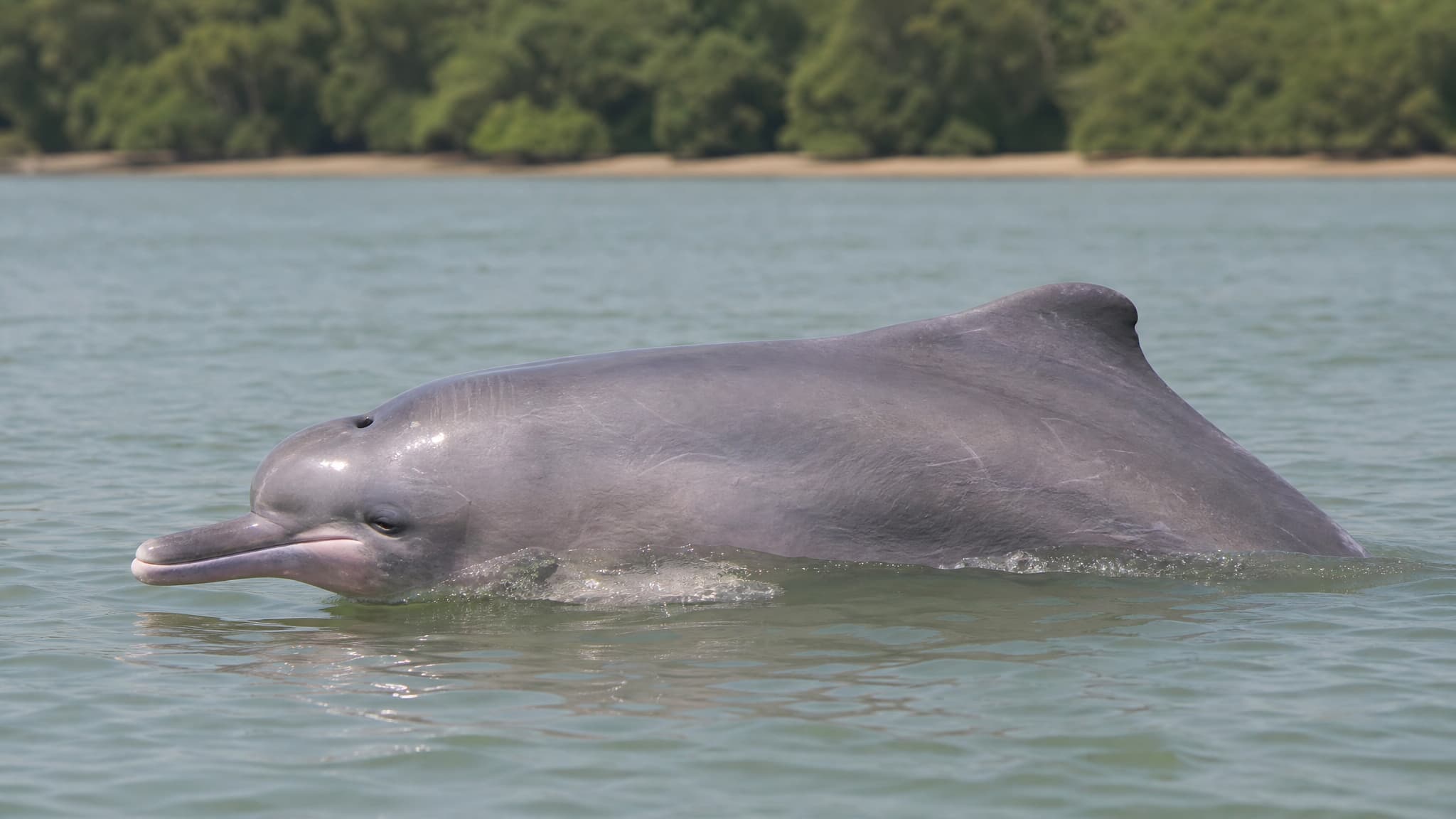
An Indo-Pacific humpback dolphin (Sousa chinensis) swims leftward at the surface in shallow coastal water, with its long beak, eye, blowhole, and prominent rounded dorsal hump visible; the pectoral fins and flukes are submerged.
Indo-Pacific humpback dolphin
The Indo-Pacific humpback dolphin, Sousa chinensis, is a robust coastal dolphin distinguished by the low fatty ridge or “hump” beneath its dorsal fin. Adults are usually about 1.8–3 m long. Color varies greatly across its range: many animals are gray to brownish gray, while dolphins in parts of southern China and Southeast Asia can become pale, white, or white with a pink flush and darker speckles. The pink appearance is associated with blood vessels visible through relatively lightly pigmented skin, rather than with pink fur or scales.
This species lives in warm, shallow nearshore waters of South and Southeast Asia, from the Bay of Bengal eastward to coastal China and south through the Indo-Malay region. It favors estuaries, river mouths, bays, mangrove-fringed coasts, sandy shallows, and reef-associated coastal habitat. Its distribution is patchy because it is closely tied to narrow belts of productive coastal water rather than the open ocean.
Indo-Pacific humpback dolphins feed chiefly on fishes found near coasts, estuaries, and reefs; cephalopods are also eaten in some places. They usually occur alone or in small, changeable groups, although larger gatherings may form where prey is concentrated or around fishing activity. As predators in estuarine and coastal food webs, they link fish populations with the larger marine ecosystem and can signal the condition of heavily used shore habitats.
Females generally bear a single calf after a gestation of roughly 10–12 months. Calves are around 1 m long at birth and depend extensively on their mothers; mother–calf associations can continue for several years. Available accounts indicate a long life history, with individuals capable of living for about 40 years or more, but slow reproduction makes local populations less able to recover from sustained losses.
The species is globally assessed as Vulnerable. Entanglement in gillnets, trawls, and other fishing gear, along with coastal construction, land reclamation, vessel traffic, pollution, and degradation of estuaries, are major concerns. Because many populations are small, isolated, and live beside densely populated coasts, protecting intact estuaries and reducing bycatch are central conservation needs.



