
Indus river dolphin
Platanista minor
 AI-generated
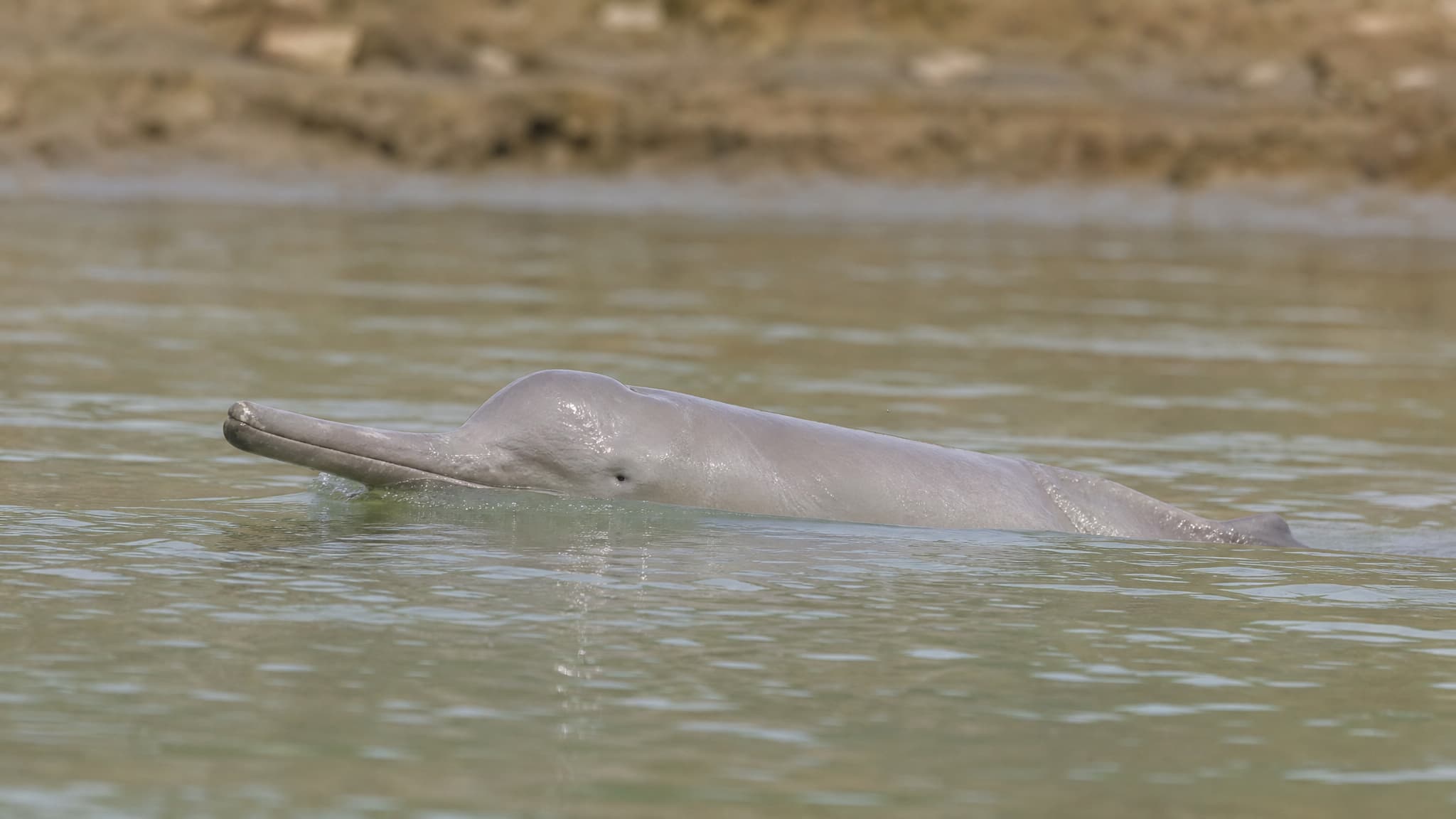
An Indus river dolphin swims horizontally just below the surface of a turbid river, with its long narrow snout and small eye visible above the water.
The Indus river dolphin (Platanista minor), locally known as the bhulan, is a freshwater toothed whale with a stocky gray body, pale underside, long narrow beak, and a small dorsal fin set far back on the body. Adults are usually about 2–2.5 m long, and females tend to be larger than males. Its tiny eyes have very limited function, an adaptation to the silty water in which it lives.
It is now restricted chiefly to the middle and lower Indus River in Pakistan, with a small isolated population in India’s Beas River. It uses shallow, turbid freshwater channels, though it can move through main river channels and tributaries during seasonal floods. Dams, barrages, canals, and water extraction have divided what was once a much more continuous range.
Nearly constant echolocation clicks allow this dolphin to orient itself, communicate, and locate prey where vision is ineffective. It generally occurs alone or in pairs, but temporary groups can form where feeding conditions are favorable. Its long, tooth-lined jaws help it capture fish, shrimps, clams, and other aquatic invertebrates, including prey found near the river bottom.
Breeding can occur year-round. Females produce one calf after a long gestation and nurse it for roughly a year; individuals may live about 30 years. As a high-level freshwater predator, the species is an indicator of river health. It is Endangered, threatened by fragmented habitat, entanglement in fishing gear, dolphins trapped in irrigation canals, pollution, underwater noise, and vessel strikes.



