Japanese macaque
Macaca fuscata
 AI-generated
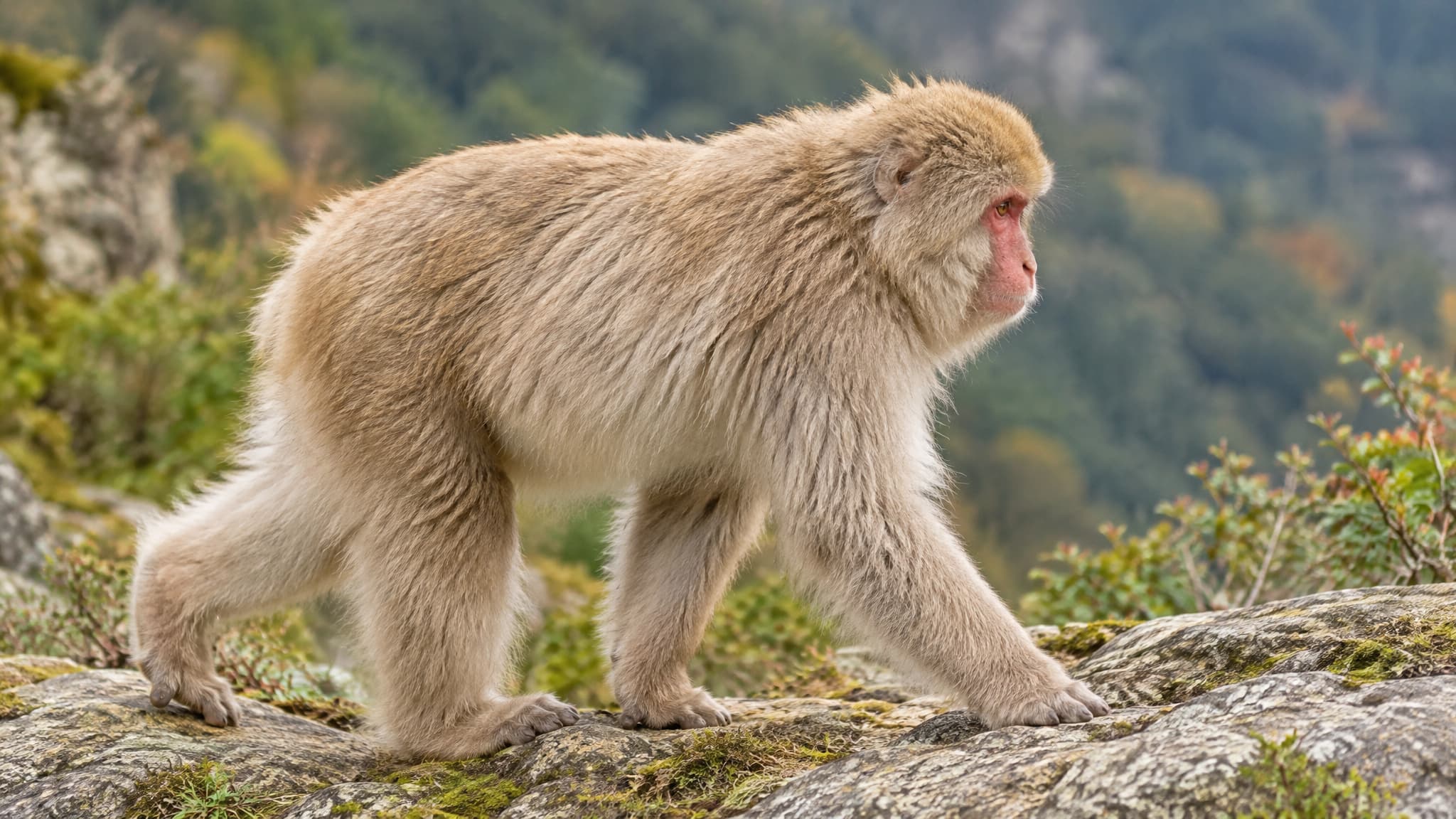
A Japanese macaque walks across moss-covered rocks in a mountainous, wooded setting, shown in profile with dense pale fur and a pink, bare face.
The Japanese macaque (Macaca fuscata), often called the snow monkey, is a stocky Old World monkey with thick brown to grey fur, a bare pinkish-red face and rump, and a stumpy tail. Adult males average about 57 cm in body length and 11.3 kg, while females average about 52.3 cm and 8.4 kg; the tail measures only about 92.5 mm in males and 79.1 mm in females. Animals from colder regions tend to be heavier.
The species is endemic to Japan, living on Honshu, Shikoku and Kyushu and several smaller islands, but not Hokkaido. Its northernmost groups on the Shimokita Peninsula make it the most northerly non-human primate in the world, and the southernmost live on Yakushima, home of the subspecies M. f. yakui. It occupies subtropical evergreen forests in the south and cool temperate deciduous and subalpine forests in the north, and has been recorded up to 3,180 m.
Japanese macaques are generalist omnivores. More than 213 plant species are on record in their diet, with fruit dominant in summer, flowers and young leaves in spring, and seeds, bark and mature leaves in winter, plus insects, eggs and fungi. Troops average about 41 animals, ranging from 10 to 161 in the wild. Groups are matrilineal: females stay for life and inherit their mother's rank, while males leave around 5 to 6 years of age. Famous learned traditions include sweet potato washing on Koshima Island and winter hot spring bathing at Jigokudani.
Mating takes place roughly from September to April, and births from March to September. Gestation lasts about 171.7 days and usually produces a single infant, weaned by about 18 months. Females first come into estrus at about 3.5 years and males mature at about 4.5 years. The oldest known wild individuals reached 28 years for males and 32 years for females.
As fruit eaters, the macaques disperse and also destroy seeds, and on Kinkazan Island the leaves they drop are eaten by sika deer. The IUCN lists the species as Least Concern; a 1989 study estimated about 114,431 wild animals. Hunting was banned in 1947, but conversion of natural forest into timber plantations and the culling of more than 20,000 crop-raiding monkeys each year remain concerns. An introduced population has lived in Texas since 1972.