
Ka’apor capuchin
Cebus kaapori
 AI-generated
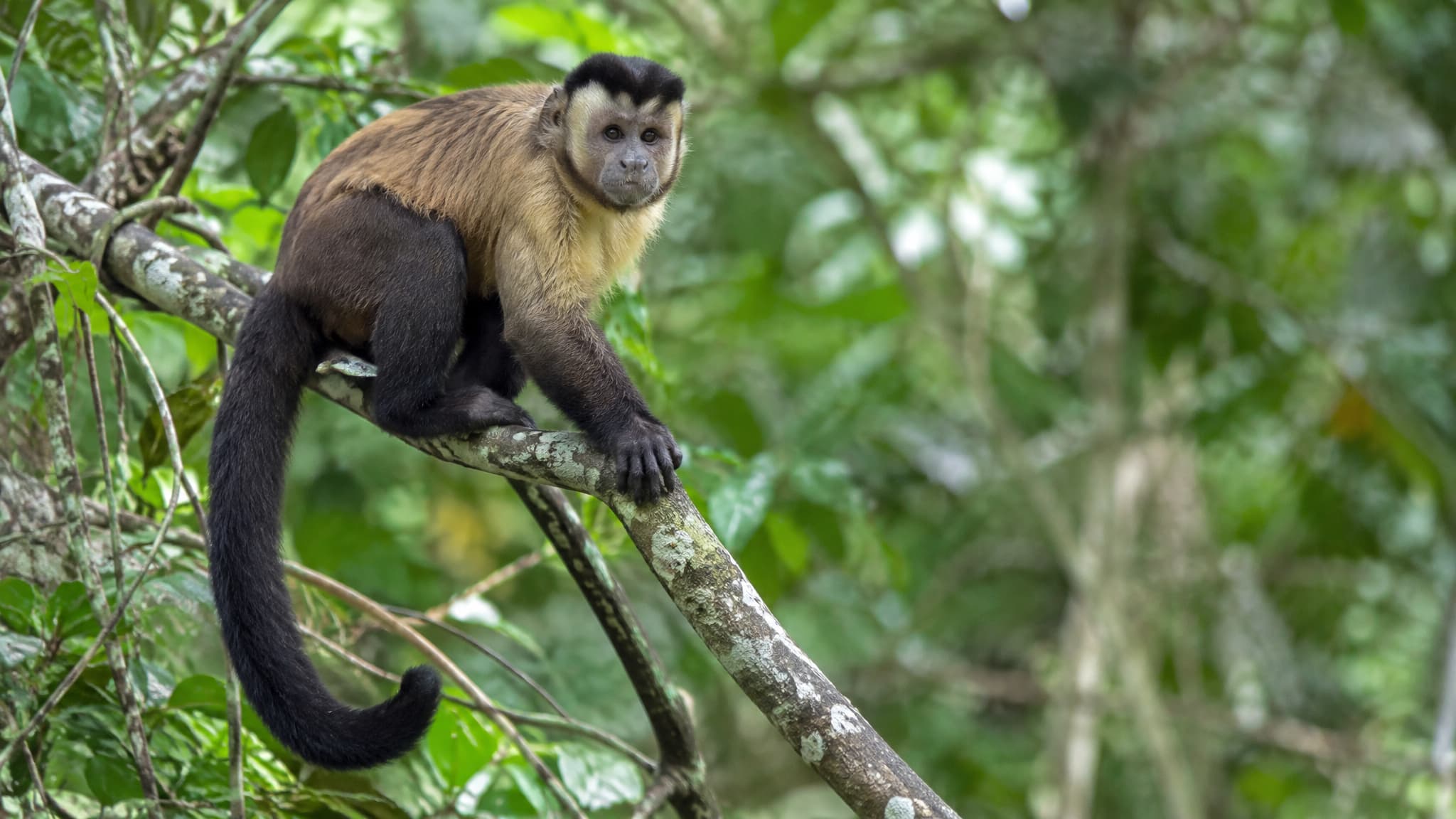
A Ka’apor capuchin sits astride a lichen-covered branch in dense green forest, facing the camera with one hand gripping the branch and its long dark tail curled below. Its pale face, dark crown, golden-brown upper body, and darker limbs are clearly visible.
The Ka’apor capuchin is a small, gracile capuchin monkey of the family Cebidae. In Brazil it is also known as the caiarara or caiarara-ka’apor. It belongs to the untufted capuchin genus Cebus, rather than Sapajus, the genus used for the robust, tufted capuchins. Its coat is generally agouti brownish-gray above, with a conspicuously silvery-gray throat; the long tail assists balance but is not prehensile. A measured male type specimen had a head-and-body length of 46.5 cm, a 51 cm tail, and a mass of 3.05 kg.
This primate is endemic to Brazil’s eastern Amazon, chiefly in eastern Pará and western Maranhão, south of the Amazon River. It occurs in the heavily altered Belém area of endemism and the wider “arc of deforestation.” It uses lowland dense rainforest, including primary and secondary forest, and has also been recorded in estuarine floodplain forest and mangroves near the Pará coast. Although it can be found in disturbed remnants, it appears highly sensitive to habitat alteration and fragmentation.
It is diurnal and mainly arboreal. Field research on one group documented a strongly fruit-based diet: arils and fruit pulp accounted for 74% of feeding records, with arthropods and seeds providing important supplements. The monitored group travelled about 2.17 km per day on average while ranging through its forest area. Small groups have been reported, but the species remains poorly studied and population density is low across surveyed sites.
By moving through the canopy and consuming many fruits, the Ka’apor capuchin is likely an important disperser of seeds within the forest remnants it inhabits. Direct species-specific evidence on mating, gestation, infant development, and maximum lifespan is still scarce; these should not be assumed from better-studied capuchin relatives.
The species is Critically Endangered. Brazil’s 2024 assessment attributes its decline to severe forest loss and degradation, fragmentation, hunting, and fire; it estimated an 85.28% reduction from 1972 to 2020. Remaining strongholds include Indigenous territories and the Gurupi Biological Reserve, but protecting connected forest, reducing hunting, and preventing further degradation are essential to its survival.



