
Kinkajou
Potos flavus
 AI-generated
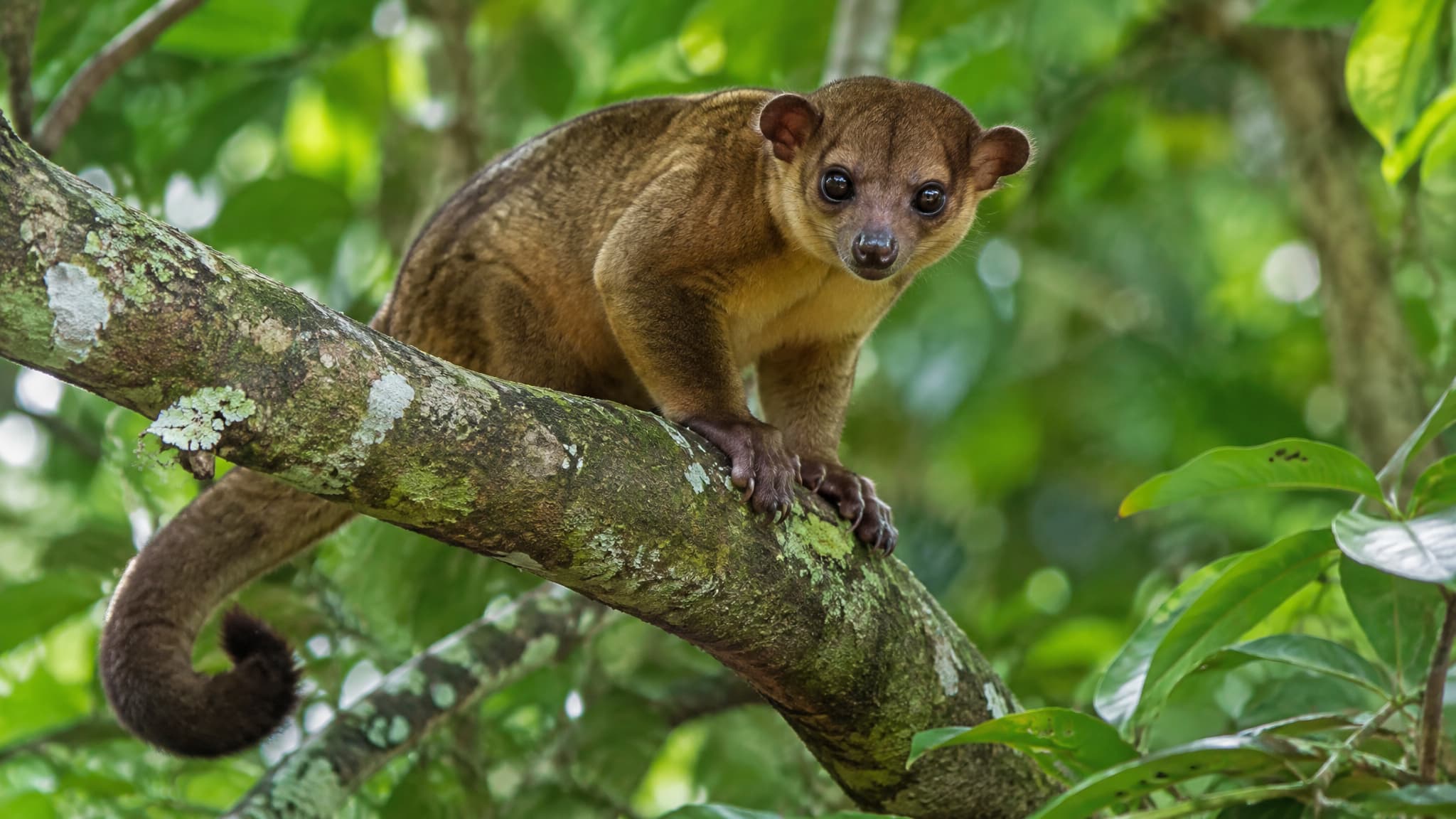
A kinkajou crouches on a lichen-covered tree branch in lush tropical foliage, facing the camera. Its rounded ears, dark eyes, short muzzle, grasping feet, and curled prehensile tail are visible.
The kinkajou (Potos flavus) is a medium-sized, nocturnal tree-dwelling mammal in the raccoon family, Procyonidae. It has dense golden-brown to olive-brown fur, a rounded head, large dark eyes adapted to low light, short limbs, and a long fully prehensile tail. Its flexible body, reversible hind feet, and grasping tail make it an agile but deliberate climber; it can even hang beneath branches while feeding.
It occurs from southern Mexico through Central America and across much of northern and central South America, reaching Brazil. Kinkajous use several forest types, including humid tropical forest, secondary forest, seasonally dry woodland, Amazonian forest, and Atlantic Forest. They spend most of their lives in the canopy and usually rest by day in tree hollows, dense branch forks, or other sheltered arboreal sites.
Although classified in the order Carnivora, the species is chiefly a fruit-eater. Figs and other ripe fruits are important foods, supplemented according to season by nectar, flowers, and insects. It forages mainly at night, often alone, but individuals may share feeding trees or daytime dens. By carrying and passing viable seeds, kinkajous contribute to tropical-forest regeneration; nectar feeding may also transfer pollen between flowers.
Females can breed throughout the year, with timing often linked to local fruit availability. A pregnancy lasts roughly 98–120 days and usually produces one young, which is weaned at about two months and becomes independent after several months. Wild longevity is difficult to measure, while captive animals may live for 20–40 years. The species is assessed as Least Concern, but deforestation, forest degradation, hunting or capture, and exposure to diseases from domestic animals can threaten local populations.



