
Komodo Dragon
Varanus komodoensis
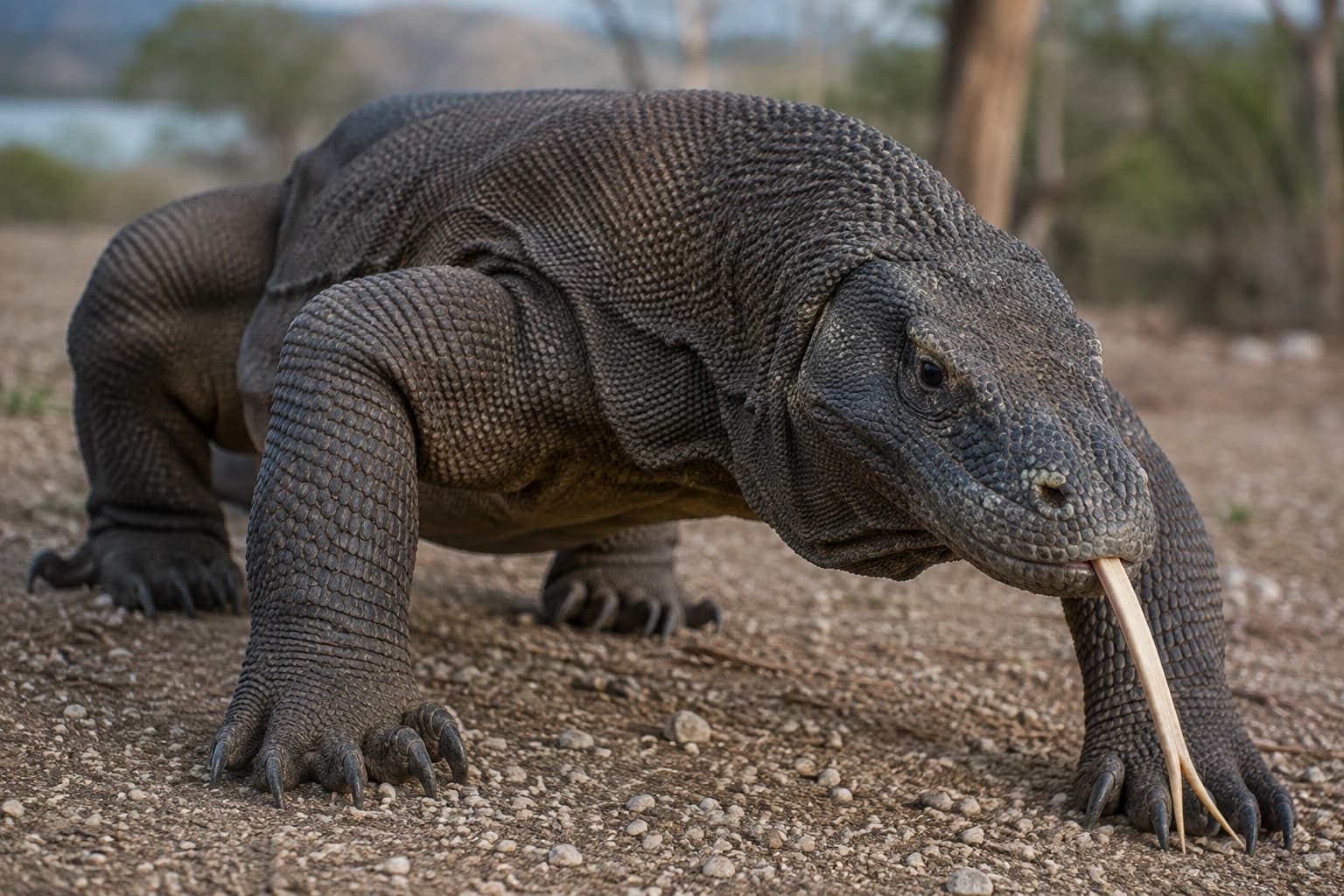
Komodo dragon (Varanus komodoensis)
The Komodo dragon (Varanus komodoensis) is a very large monitor lizard and the world’s largest living lizard. It has a heavy, low-slung body, powerful limbs with long curved claws, a muscular tail, an elongated neck, and a broad, flattened head. Adults are generally stony gray to brown, with rough skin covered in prominent scales; younger animals are more boldly patterned. Males are usually larger and more robust than females. Verified exceptional individuals have exceeded 3 m in total length, although most wild adults are smaller.
This species is endemic to Indonesia’s Lesser Sunda Islands. Its surviving natural range is restricted to Komodo, Rinca, Flores, Gili Motang, and Nusa Kode; it has not been recorded on Padar since the 1970s. Komodo dragons occupy tropical savanna woodland and move across a range of settings, from coastal areas to ridges. They are chiefly terrestrial and active by day, sheltering in burrows, particularly at night and during intense heat. Young dragons spend much more time in trees, a habit that helps them avoid predation and cannibalism by larger dragons.
Komodo dragons use their long, yellow, forked tongues and vomeronasal (Jacobson’s) organs to detect chemical traces in the air. This sense is central to locating carrion and prey, while vision is especially useful for detecting movement. Adults are apex predators and scavengers. Their diet includes carrion and vertebrate prey such as deer, wild pigs, goats, and smaller reptiles; juveniles eat insects, small lizards, eggs, birds, and small mammals. Large prey may be ambushed and bitten, then followed if it escapes. The dragon’s serrated, backward-curving teeth tear flesh, and venom produced by glands in the lower jaw contributes anticoagulant and shock-inducing effects. The once-popular claim that lethal mouth bacteria are the principal killing mechanism is not supported by later venom research.
Individuals may overlap in range and congregate at carcasses, where feeding order is strongly influenced by size and dominance. Males compete for mates by rearing up and wrestling. Mating occurs roughly from May to August. Females lay clutches of about 30 eggs in excavated sites or in megapode nesting mounds; incubation lasts about nine months. Hatchlings receive no known parental care. The species can also reproduce by facultative parthenogenesis: females have produced offspring without mating, although normal sexual reproduction is the usual mode.
The Komodo dragon is classified as Endangered on the IUCN Red List. Its limited, fragmented island range makes it vulnerable to habitat change, declines in prey, human disturbance, and climate-change-driven sea-level rise. Protection in Komodo National Park, anti-poaching measures, and management of habitat and prey populations are important conservation tools. It is also listed in CITES Appendix I, so international commercial trade is tightly controlled.



