Large Flying Fox
Pteropus vampyrus
 AI-generated
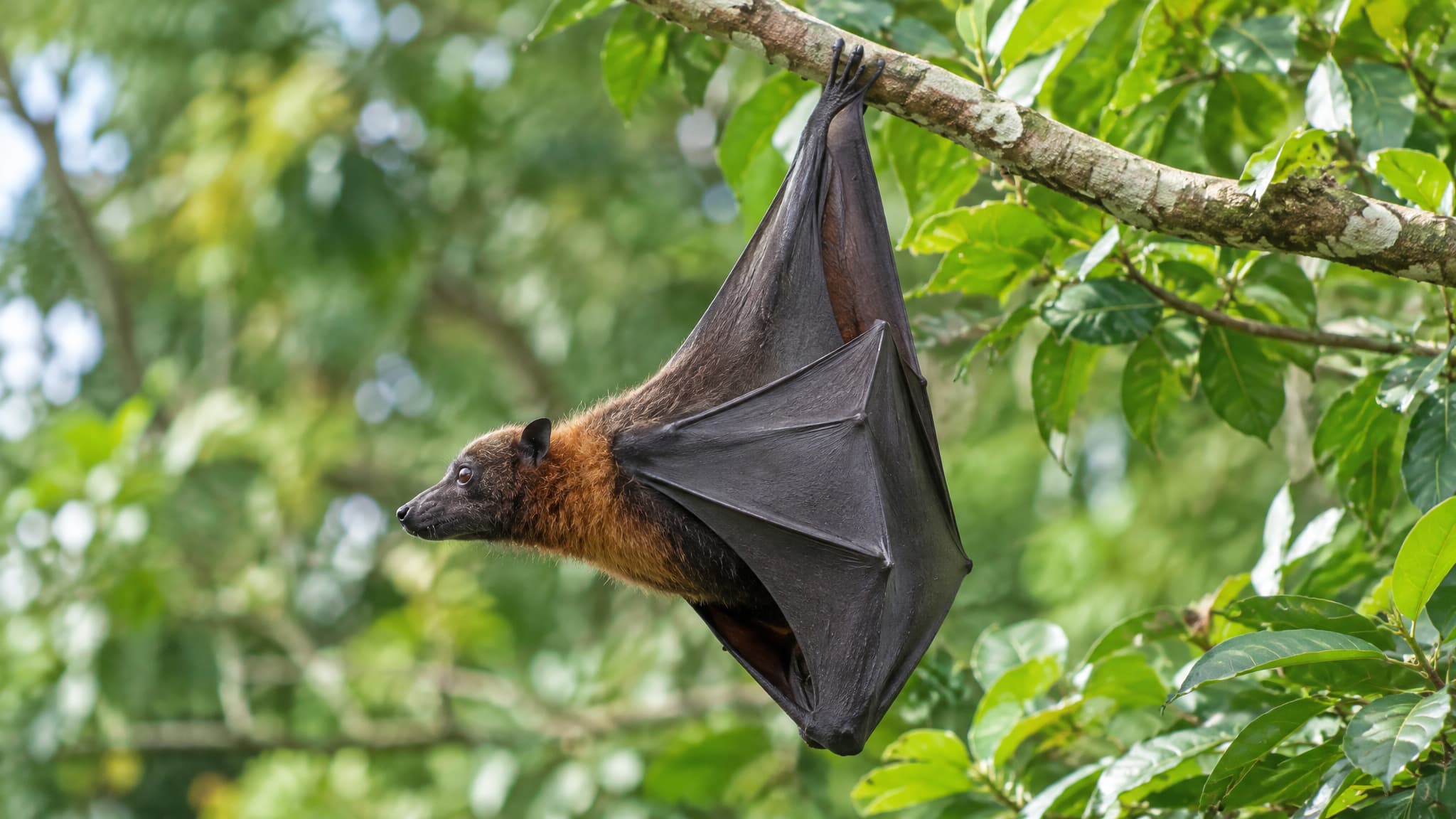
A large flying fox hangs upside down from a tree branch, with its broad dark wing membranes partly spread and its rust-brown neck fur and pointed muzzle visible against leafy forest vegetation.
The large flying fox, also called the Malayan flying fox, is one of the largest bats in the world. Adults weigh 0.65–1.1 kg, measure 27–32 cm from head to rump, have a forearm of 180–220 mm and a wingspan of up to 1.5 m. Its fox-like face, pointed ears and lack of a tail give the genus its common name, and its body is covered in long, woolly fur. Males are larger than females and have thicker, stiffer fur. Like other Old World fruit bats, it finds its way by sight rather than by echolocation.
The species lives in Southeast Asia, from the Malay Peninsula east to the Philippines and south through Sumatra, Java, Borneo and Timor. It uses primary and secondary forest, mangroves, swamps, coconut groves and mixed fruit orchards, and is recorded up to 1,370 m above sea level, although in some regions it favours lowlands and coasts. Colonies roost in large trees, sometimes for years at the same site, and can number in the thousands.
The large flying fox is nocturnal. It leaves the roost around sunset, returns at dawn and may fly up to 50 km in a single night to reach feeding trees. It feeds on flowers, nectar, pollen and fruit such as figs, mangoes, bananas, rambutan and durian, and prefers flowers and nectar when they are available. Males defend harems of up to ten females, and roosts are noisy while feeding groups are quiet in flight.
Breeding happens once a year and its timing varies by region; births peak in March and April in Thailand and in April and May in the Philippines. Gestation lasts 140–192 days and a female usually gives birth to a single pup, which is nursed for 2–3 months. Both sexes reach sexual maturity at about 2 years. Wild individuals live 15 years on average, and captive animals 15–30 years.
By carrying pollen and seeds over long distances, the species pollinates trees such as durian and disperses seeds that help cleared forests regrow; it is often one of the few animals large enough to handle the biggest fruits it eats. It is also a natural reservoir of henipaviruses, including the Nipah virus behind the 1998 outbreak in Malaysia.
The IUCN listed the large flying fox as Endangered in 2022. Intensive hunting for meat and traditional medicine, culling by fruit growers, roost disturbance and deforestation have reduced its colonies. In Peninsular Malaysia, licences issued from 2002 to 2006 allowed about 22,000 bats to be killed each year. The species is listed in CITES Appendix II.