Leatherback Sea Turtle
Dermochelys coriacea
 AI-generated
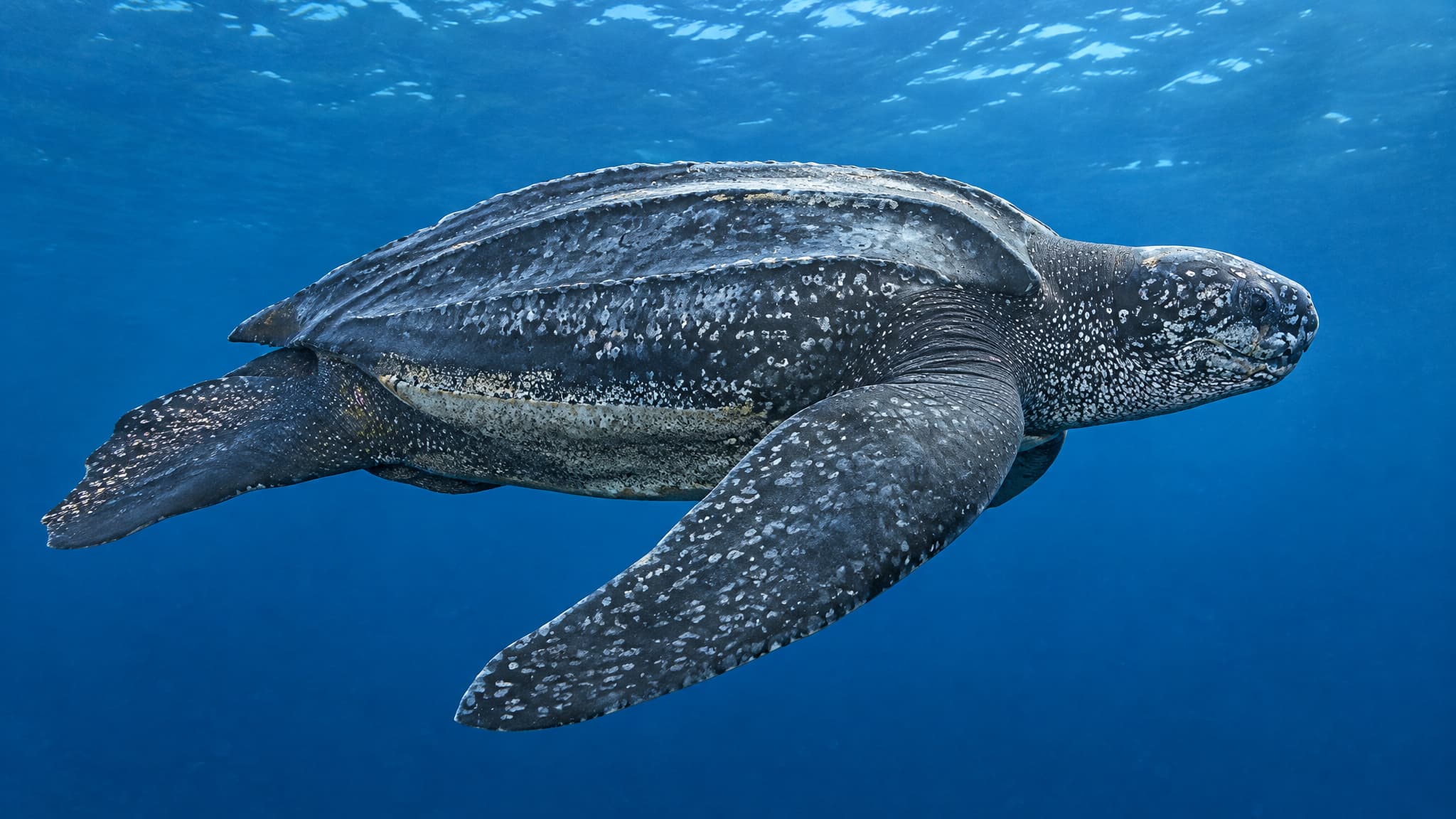
A leatherback sea turtle swims underwater in side profile, with its long front flippers extended. Its dark, mottled body and ridged, leathery carapace are clearly visible against the blue water.
The leatherback sea turtle (Dermochelys coriacea) is the largest living turtle and the only surviving member of the family Dermochelyidae. Unlike other sea turtles, it has no hard, scaly shell. Its teardrop-shaped carapace is made of tough, leathery skin over a mosaic of tiny bones. Adults usually weigh about 290 to 590 kg. Exceptional individuals can approach 900 kg, with a carapace up to about 2.4 m long. Hatchlings look mostly black from above, and their flippers have white edges.
This turtle lives in oceans worldwide and is the most pelagic of all sea turtles, spending most of its life in the open sea. It travels farther north than any other sea turtle. It can keep its body several degrees warmer than the surrounding water, which lets it forage in cold temperate seas far from the tropical and subtropical beaches where it nests.
Leatherbacks feed almost entirely on jellyfish and other soft-bodied marine animals. Off Virginia, for example, moon jellyfish and sea nettles are favored prey. Their jaws are weak and cannot crush hard prey, so they are suited to gelatinous food. Adults have few natural enemies, although sharks, killer whales and jaguars have been reported to injure or kill them.
Mating takes place in the water just offshore from nesting beaches. Males never come ashore. Females crawl onto sandy beaches at night, lay their eggs in a nest and cover it, and give no further parental care. As in other sea turtles, nest temperature during incubation sets the sex of the hatchlings: cooler nests produce mostly males and warmer nests mostly females. Lifespan in the wild is poorly known and is estimated at around 30 years or more.
As a large predator of jellyfish, the leatherback helps control gelatinous zooplankton in the ocean. Globally the species is listed as Vulnerable by the IUCN, and it is federally endangered in the United States. In Brazil it is classed as Critically Endangered. Major threats include bycatch in fisheries, egg poaching and the killing of adults, coastal development, pollution, marine debris and climate change.