
Margay
Leopardus wiedii
 AI-generated
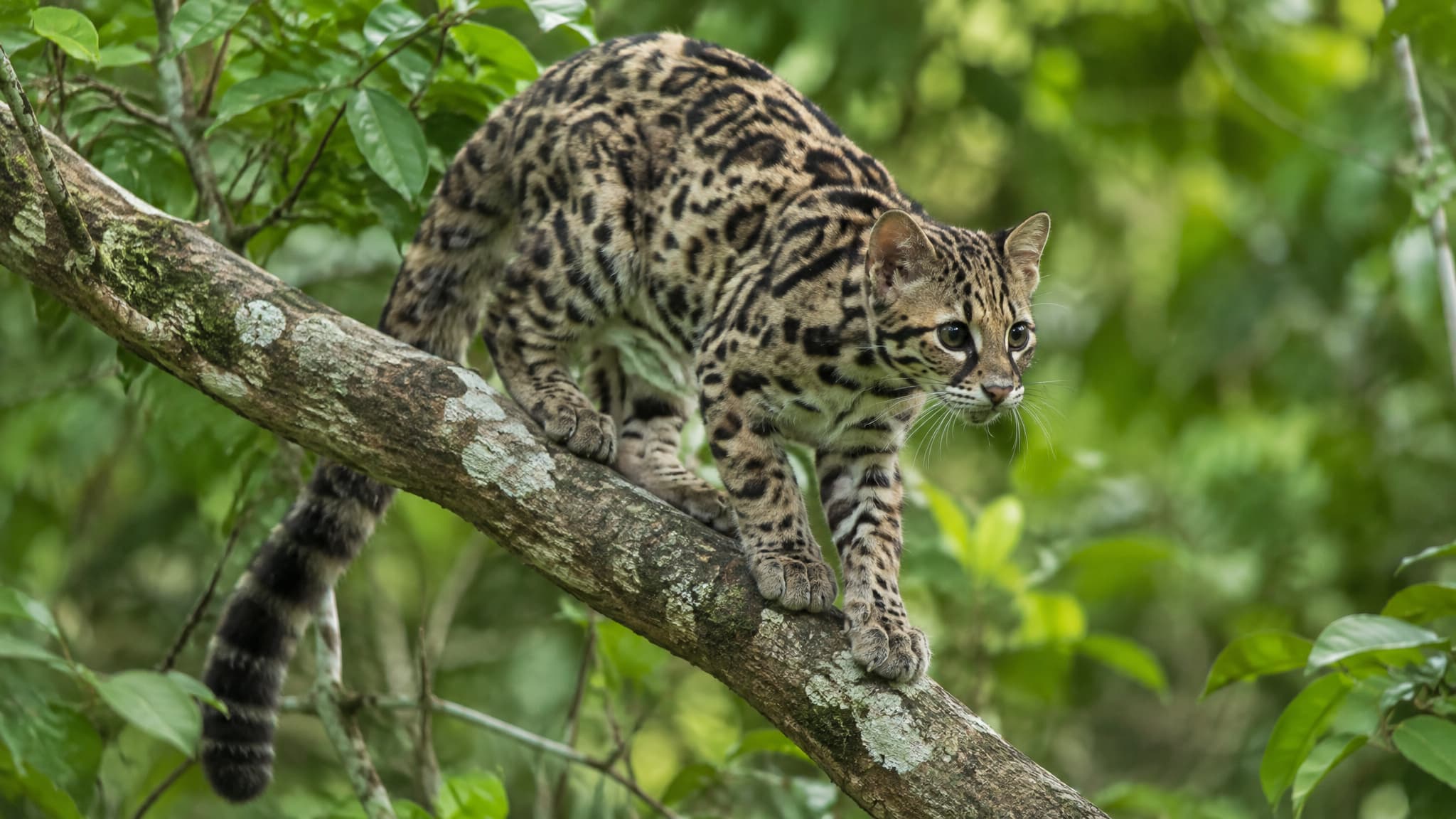
A margay crouches along a lichen-covered tree branch in dense green forest, with its spotted coat, large eyes, rounded ears, and long banded tail clearly visible.
The margay is a small, elegant spotted wild cat of the American tropics. It resembles a slim ocelot, but is generally more lightly built and is especially recognizable by its exceptionally long tail, large feet, and broad eyes. Its coat ranges from grayish-brown to cinnamon above, with dark spots or rosettes often arranged in lengthwise rows; the underparts are pale to white. Adults commonly weigh about 2.3–4.9 kilograms.
This species occurs from northern Mexico through Central America and much of South America, reaching Uruguay and northern Argentina. It is strongly associated with forests, including tropical and subtropical evergreen, deciduous, seasonally flooded, and cloud forests. Although it can occur in altered landscapes and some plantations, it is usually most closely tied to wooded cover and is generally uncommon across much of its range.
Margays are chiefly solitary and territorial, with most activity at night but some daytime movement. They are superb climbers: flexible hind ankles can rotate markedly, helping them grip branches, descend trunks headfirst, or briefly hang from a hind foot. Despite these specialized skills and their tendency to rest in trees, research summarized by the IUCN Cat Specialist Group indicates that they also travel and hunt extensively on the ground.
Their diet is varied and consists mainly of small mammals, with birds, reptiles, amphibians, eggs, arthropods, and occasionally fruit also eaten. By preying on small vertebrates in forest food webs, the margay is one component of the Neotropical small-carnivore community. It may compete with, and be vulnerable to killing by, the larger ocelot where both species occur.
Females usually produce one or two kittens after a gestation of roughly 76–84 days. Much of the detailed reproductive information comes from captive animals, and field ecology remains comparatively poorly known. Captive individuals may live for more than two decades. The margay is listed globally as Near Threatened, principally because forest loss and fragmentation affect its preferred habitat; its low reproductive rate may compound these pressures. International trade is prohibited under CITES Appendix I.



