
Long-finned pilot whale
Globicephala melas
 AI-generated
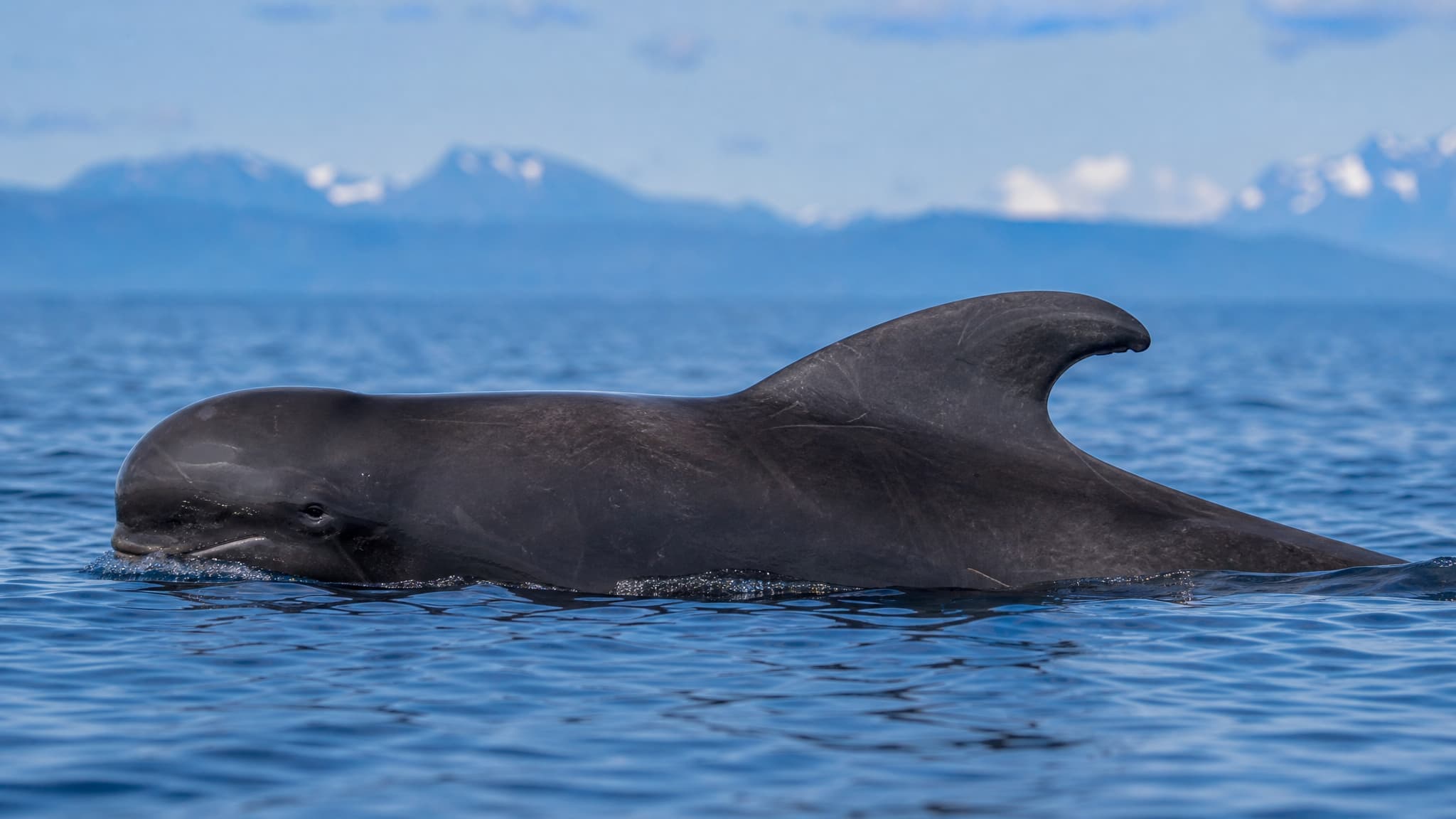
A dark cetacean surfaces broadside in calm blue water, with distant mountainous coast in the background. It shows a rounded forehead, short snout, and an unusually large, high, curved dorsal fin.
The long-finned pilot whale is a large, highly social oceanic dolphin rather than a true baleen whale. It is recognizable by its rounded, bulbous forehead, dark body, low curved dorsal fin, and exceptionally long, tapered flippers. Pale gray or whitish markings may form an eye stripe, a saddle behind the dorsal fin, and an anchor-like patch along the throat and belly. Males are markedly larger than females and may reach about 8.5 m in length.
This species has an antitropical distribution: it occurs in temperate to subpolar waters of the North Atlantic and in southern oceans, while being largely absent from equatorial seas. It usually favors deep offshore water, continental slopes, and shelf edges, but may enter coastal areas seasonally. Its southern range includes waters off southern South America, southern Africa, Australia, New Zealand, and southeastern Brazil.
Long-finned pilot whales live in close, maternally based pods, commonly numbering dozens of animals and sometimes gathering in much larger aggregations. They communicate with whistles and other sounds, use echolocation to find food, and may rest together at the surface in conspicuous aligned formations. Their strong social bonds are also thought to contribute to their tendency for mass strandings.
They are carnivorous predators that feed especially on squid and other cephalopods, while also taking fish and crustaceans. Deep dives, often lasting 10–16 minutes, allow them to forage in dim water; much feeding may occur at night. By consuming substantial quantities of squid and fish, they are important predators in offshore marine food webs.
Females usually mature at about eight years and males at roughly 12–13 years. A female generally produces one calf after a 12–16 month gestation, with births separated by approximately three to six years. Calves nurse for a prolonged period, and older females can help care for young. Females may live at least 60 years, whereas males commonly live around 35–45 years. Globally the species is assessed as Least Concern, but entanglement and hooking in fisheries, hunting in some areas, chemical contaminants, disease, and underwater noise remain important pressures.



