
Mandrill
Mandrillus sphinx
 AI-generated
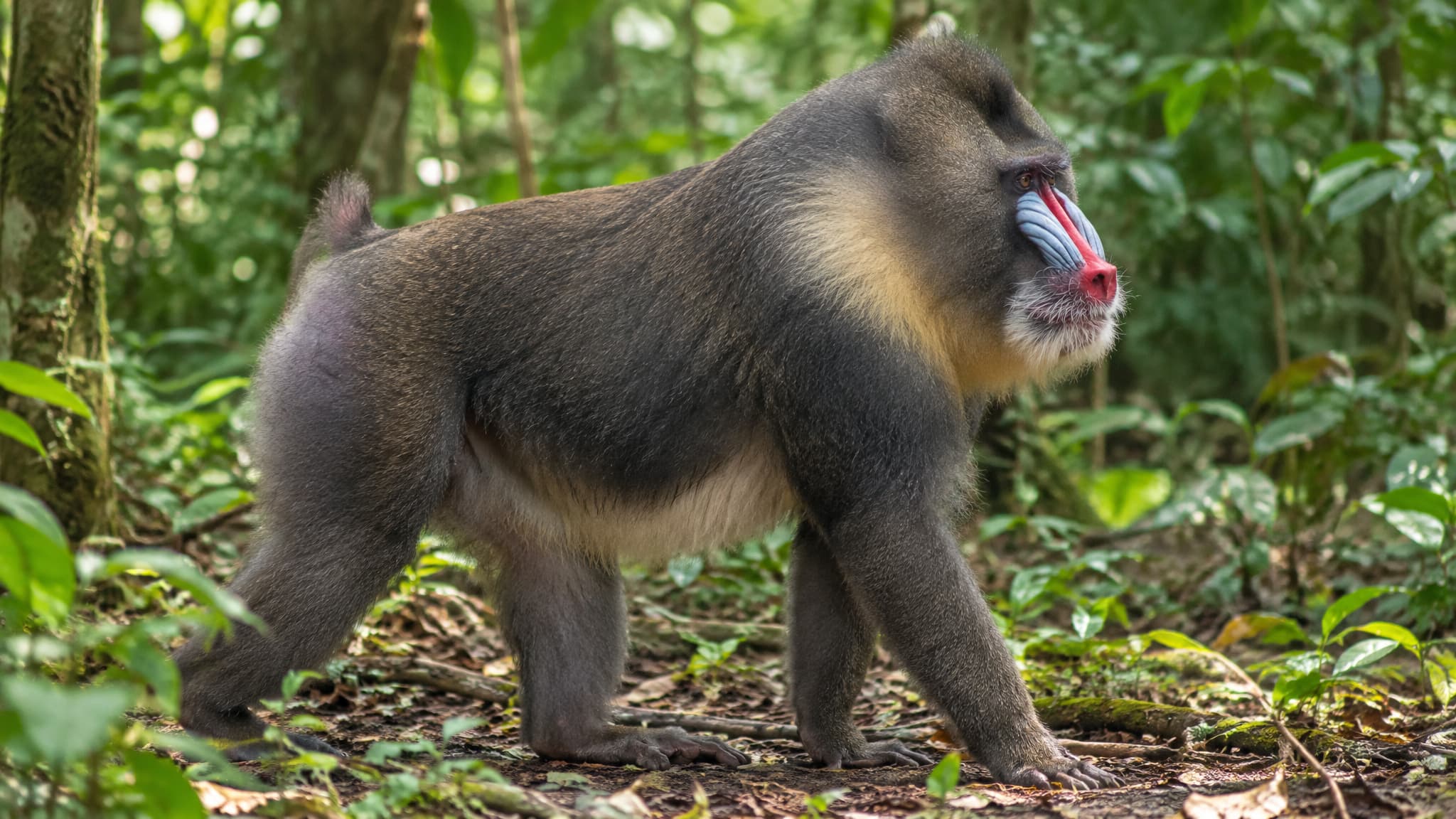
A male mandrill (Mandrillus sphinx) stands quadrupedally on the forest floor, showing its dark coat, pale underside, raised tail, and vivid blue-and-red facial markings.
The mandrill (Mandrillus sphinx) is an Old World monkey of the family Cercopithecidae and is often called the largest monkey in the world. It is strongly sexually dimorphic. Adult males measure about 70–95 cm from head to rump and usually weigh 19–30 kg, with exceptional individuals reported at up to 54 kg; females measure about 55–70 cm and weigh 10–15 kg. The tail is a stub of only 7–10 cm. The coat is olive brown with paler underparts and a yellow-orange beard. Males have a bright red stripe down the muzzle, ridged blue cheeks, long canines of about 4.5 cm and a blue-to-purple rump; females and young are much duller.
Mandrills live in west-central Africa: southern Cameroon, mainland Equatorial Guinea, Gabon and parts of the Republic of the Congo. The Sanaga River bounds the range to the north and the Ogooué and Ivindo rivers to the east, and Gabon holds the main stronghold. They prefer dense tropical rainforest, especially primary forest, but also use gallery forest, thick secondary bush, hills and the edges of fields. They forage mostly on the ground by day and climb into trees to sleep at night.
The diet is varied but mostly plant-based. A study in Lopé National Park found about 51% fruit, 26% seeds, 8% leaves, 7% pith, 3% flowers and only 4% animal matter, and the species eats more than 100 plant species. Insects, snails, worms, frogs, lizards, rodents, birds and eggs are also taken. Females form the stable core of huge groups called hordes; in Lopé these averaged about 620 animals and reached 845, possibly the largest cohesive groups of any wild primate. Adult males are largely solitary and join hordes mainly in the breeding season.
Gestation lasts about 175 days, and most births in the wild happen between January and March, in the rainy season. Females usually give birth to a single infant weighing about 640 g, which is weaned at around 230 days; the interval between births averages about 405 days. Females reach adult size at about 7 years and males at about 10. Wild mandrills are estimated to live about 12–20 years, while captive animals often reach 30–40 years, with a record of 46 years.
By eating so much fruit, mandrills help disperse seeds and shape the forest understory. Leopards, crowned eagles, African rock pythons and chimpanzees prey on them. The IUCN lists the mandrill as Vulnerable, with a suspected decline of more than 30% over 24 years, and it is on CITES Appendix I. The main threats are bushmeat hunting, since their loud calls make groups easy to find, and the loss of forest to logging, farming, mining and settlement.



