Maned wolf
Chrysocyon brachyurus
 AI-generated
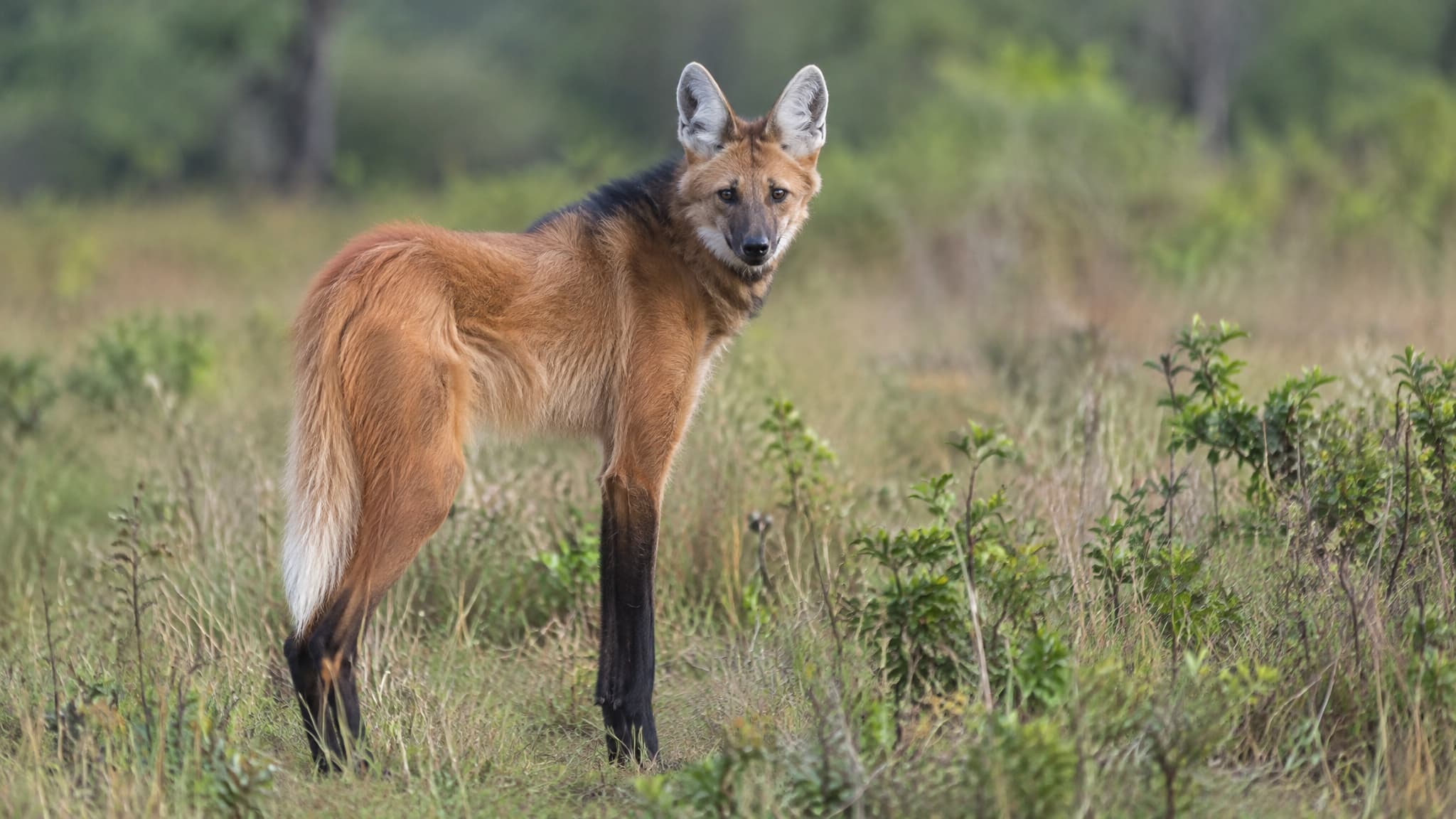
A maned wolf stands alert in tall grass and low vegetation, looking toward the camera. Its unusually long black-legged limbs, reddish coat, dark dorsal mane, large ears, and pale-tipped tail are clearly visible.
The maned wolf is a distinctive South American canid with a foxlike head, oversized upright ears, a reddish-orange coat, a black mane along the neck and back, and exceptionally long dark legs. It is the largest canid in South America, but its slim body and long limbs make it look very different from a gray wolf. Despite its English name and superficial resemblance to a fox, it is neither a true wolf nor a fox; it is the only living member of the genus Chrysocyon.
It occurs mainly in central and eastern South America, especially Brazil, as well as parts of Bolivia, Paraguay, Argentina, and Peru. The species is closely associated with the Cerrado and other open or mixed landscapes, using grasslands, savannas, shrublands, wetland edges, and forest margins. Its long legs are well suited to moving through tall grasses and help it scan above low vegetation.
Maned wolves are mostly solitary, although an adult male and female may occupy and defend a shared territory. They are chiefly crepuscular and nocturnal, resting in dense cover by day. Communication includes scent marking and a low, far-carrying bark. Their diet is notably omnivorous for a large canid: small mammals, birds, reptiles, eggs, insects and other invertebrates are eaten alongside roots and fruit. The wolf apple (Solanum lycocarpum) is an especially important food in much of its range.
Breeding pairs interact more closely during the reproductive season, but the young are generally raised in concealed, above-ground natal sites amid thick vegetation. Litters usually contain a few pups after a gestation of roughly two months. Captive individuals may live around 13 years on average and up to about 15 years. By consuming both prey and fruit, the species is an important omnivorous predator and plant consumer within South American open habitats.
The maned wolf is globally classified as Near Threatened. Conversion of native grasslands and savannas to agriculture, habitat fragmentation, road mortality, persecution, and disease risks linked to domestic dogs all affect populations. Conserving large, connected mosaics of Cerrado, grassland, wetland, and forest-edge habitat is central to its long-term survival.