
Melon-headed whale
Peponocephala electra
 AI-generated
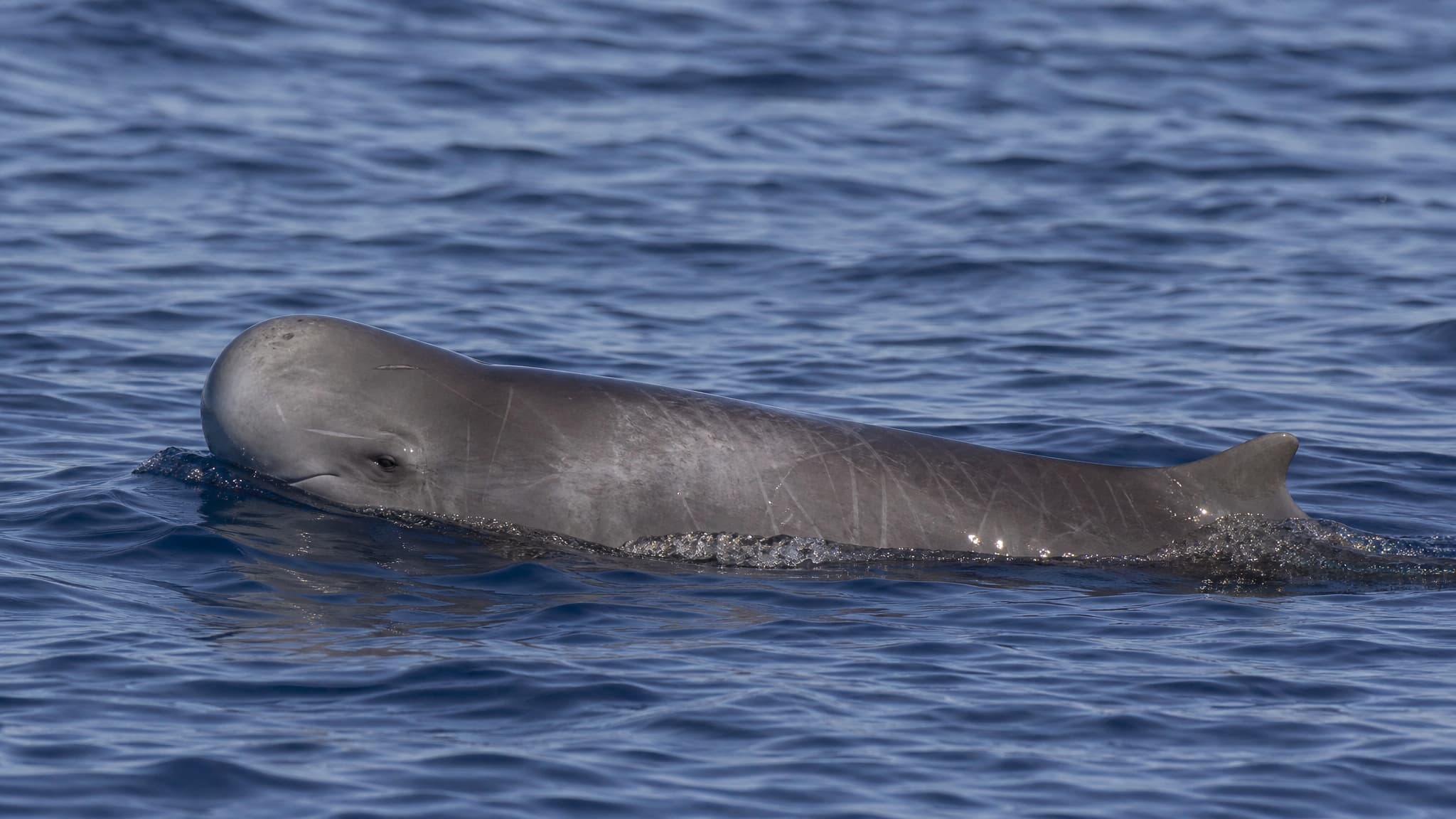
A melon-headed whale (Peponocephala electra) surfaces horizontally in open ocean, with its rounded melon, visible eye, smooth gray body, and dorsal fin above the water.
Melon-headed whale
The melon-headed whale is a compact, dark-colored oceanic dolphin despite its common name. Adults are generally about 2–3 m long, with a robust, torpedo-shaped body, a small rounded forehead or “melon,” and virtually no visible beak. A dark cape lies across the back, while subtle darker facial patches and paler lips or throat markings may be present. Its pointed flippers and relatively tall, curved dorsal fin help distinguish it from the very similar pygmy killer whale.
It occurs in warm tropical and subtropical seas around the world, usually over deep offshore water. In some places, however, it approaches islands and coasts where deep water lies close to shore. In Hawaiian waters, research recognizes a wide-ranging deep-water population and a smaller population associated with shallower coastal habitat around the island of Hawaiʻi.
This is a highly social cetacean, commonly traveling in schools of hundreds and sometimes more than a thousand animals. Groups can be tightly coordinated and energetic, making quick, low leaps and occasionally associating with other dolphins. They tend to rest in the morning, socialize later in the day, and forage mainly at night. Their prey includes fish, squid, cuttlefish, and shrimp; like other toothed whales, they use sound and echolocation in their marine environment.
Females mature at roughly seven years, while males mature later, at approximately 12–15 years. Gestation lasts about 12 months, a single calf is typical, and births are thought to recur every three to four years. Individuals may live up to about 45 years. As mid-level predators, melon-headed whales help link deep-water cephalopod and fish communities with larger marine food webs.
The species is assessed as Least Concern globally, but its total worldwide abundance is not fully known. Risks include incidental capture in fisheries, directed hunts in a few areas, ocean noise, and pollution. Large groups can also be vulnerable to unusual near-shore entrapments or mass-stranding events, making protection of offshore habitat and reduction of human-caused marine disturbance important.



