Southern coral snake
Micrurus frontalis
 AI-generated
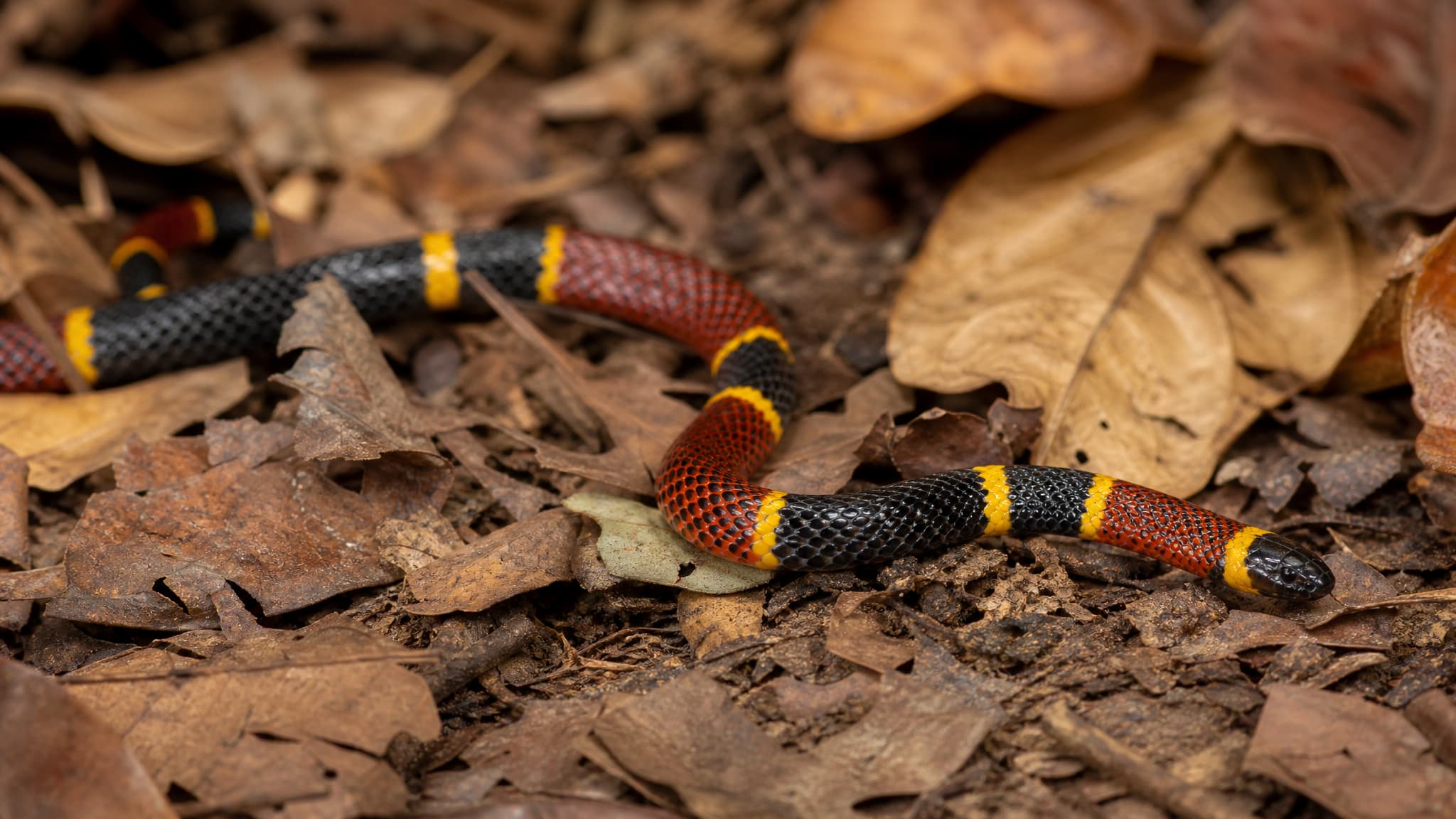
A slender coral snake lies in a loose curve across dry leaf litter, showing glossy red, black, and yellow bands and a rounded black head at the right.
Micrurus frontalis, the southern coral snake, is a venomous elapid of south-central South America. In Brazil it is often called cobra-coral, coral-verdadeira, boipinima, or coral-de-cara-preta. It has a small, blunt head that is not strongly distinct from the neck, smooth glossy scales, and fixed front fangs. Its body is typically patterned in broad red rings separated by repeated triads of black rings, with narrow pale—usually white—rings between the black. The snout and crown are predominantly black with pale-edged facial scales. Adults are often around 0.5–1.4 m long; an exceptional captive male reached 1.70 m.
The species occurs in central and southeastern Brazil, eastern Paraguay, and northeastern Argentina. It uses a varied mosaic of savanna and open formations, seasonal and semideciduous forests, Atlantic Forest localities, pasture or secondary vegetation, and sandy or rocky ground. Much of its life is spent concealed in loose soil, burrows, galleries, leaf litter, and other sheltered sites. This secretive, terrestrial and partly fossorial way of life explains why an animal with a broad regional range is seldom seen.
Southern coral snakes are active by day and at night, with records suggesting greater activity in warm, rainy months. They specialize on elongated, hidden vertebrates: amphisbaenians, small fossorial or cryptozoic snakes, and lizards form important prey, and cannibalism has also been reported. As a predator of burrowing reptiles, it helps link below-ground and leaf-litter food webs. Its venom is medically significant and may cause serious neurotoxic envenomation; it should never be handled or approached.
Like other coral snakes, M. frontalis is oviparous. Available studies indicate a seasonal reproductive cycle, although females may develop yolk-bearing follicles over an extended period and basic reproductive data remain incomplete. Wild longevity is not well established. A documented male lived for eight years in captivity, showing that the species can be relatively long-lived under managed conditions. The IUCN lists it as Least Concern globally because of its broad distribution and lack of a known major range-wide threat, but habitat conversion and uncertainty surrounding populations and taxonomy warrant continued monitoring.