Naked mole-rat
Heterocephalus glaber
 AI-generated
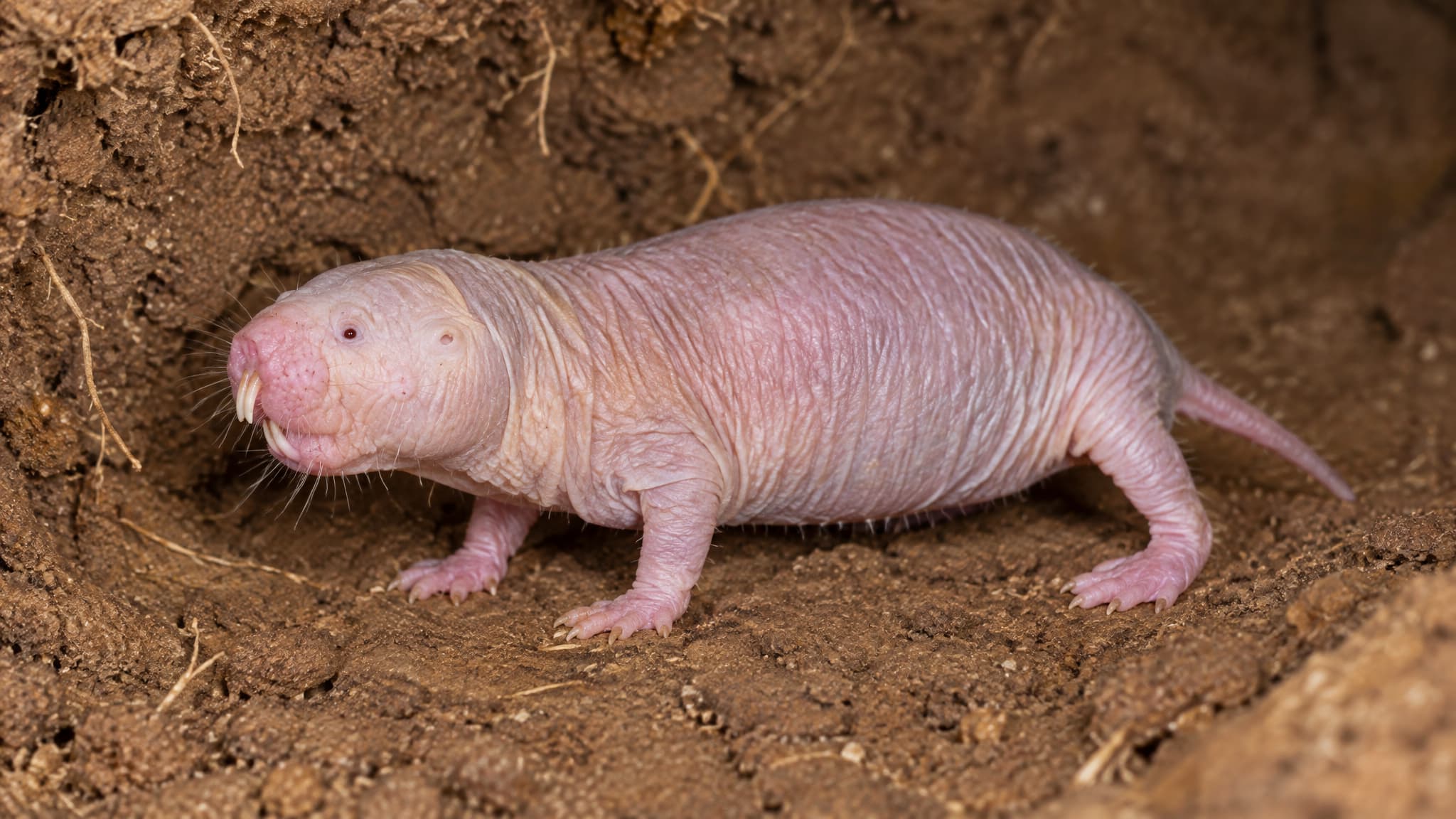
A naked mole-rat stands in a soil-lined tunnel in side profile, showing its wrinkled hairless skin, prominent incisors, small eyes, whiskers, and long tail.
The naked mole-rat (Heterocephalus glaber) is a small burrowing rodent of the Horn of Africa and the only living member of its genus. Most individuals measure 8–10 cm and weigh 30–35 g, though breeding females often exceed 50 g and the heaviest recorded animal reached 80 g. Its pink to brownish skin is almost hairless and loosely wrinkled, the eyes are tiny, and it relies on touch, hearing and vibration. Four large incisors are its main digging tools: about a quarter of its muscle mass serves to close the jaws, and nearly a third of its somatosensory cortex is devoted to these teeth.
The species lives in the drier tropical grasslands and semi-arid savannas of Djibouti, Ethiopia, Kenya and Somalia, spending its whole life underground. Colonies dig tunnel systems that can add up to 3–5 km in length and reach about 2 m deep. The animals dig cooperatively in an assembly line, and they are most exposed to predators when pushing loose soil out onto the surface.
Naked mole-rats are herbivores that feed mainly on roots, bulbs and large tubers found while tunnelling; a single big tuber can feed a colony for months or even years. They do not drink, taking all their water from food, and they eat their own droppings to extract more nutrients from fibrous plant matter. Unlike most mammals, they cannot keep a steady body temperature, which rises and falls with the burrow around them.
The species is one of the few eusocial mammals. A colony averages 75–80 individuals and can exceed 300, but only one queen and one to three males breed; the rest are workers that dig, forage, care for pups and defend the burrow. Gestation lasts about 70 days, and a litter averages about 12 pups weighing roughly 2 g each, with up to about 30 recorded. Lifespans of more than 37 years are known, the longest of any rodent.
Its physiology has made it a model animal for research. Naked mole-rats are highly resistant to cancer, feel no pain from acid on the skin and tolerate very low oxygen: they survive at least 5 hours in air with 5% oxygen and about 18 minutes with none at all.
By digging, the species turns over and aerates the soil, and it is prey for snakes such as the rufous beaked snake (Rhamphiophis oxyrhynchus), honey badgers and birds of prey. It is assessed as Least Concern: it is widespread and numerous, with no major threats, although sweet potato farmers often treat it as a pest.