
Narwhal
Monodon monoceros
 AI-generated
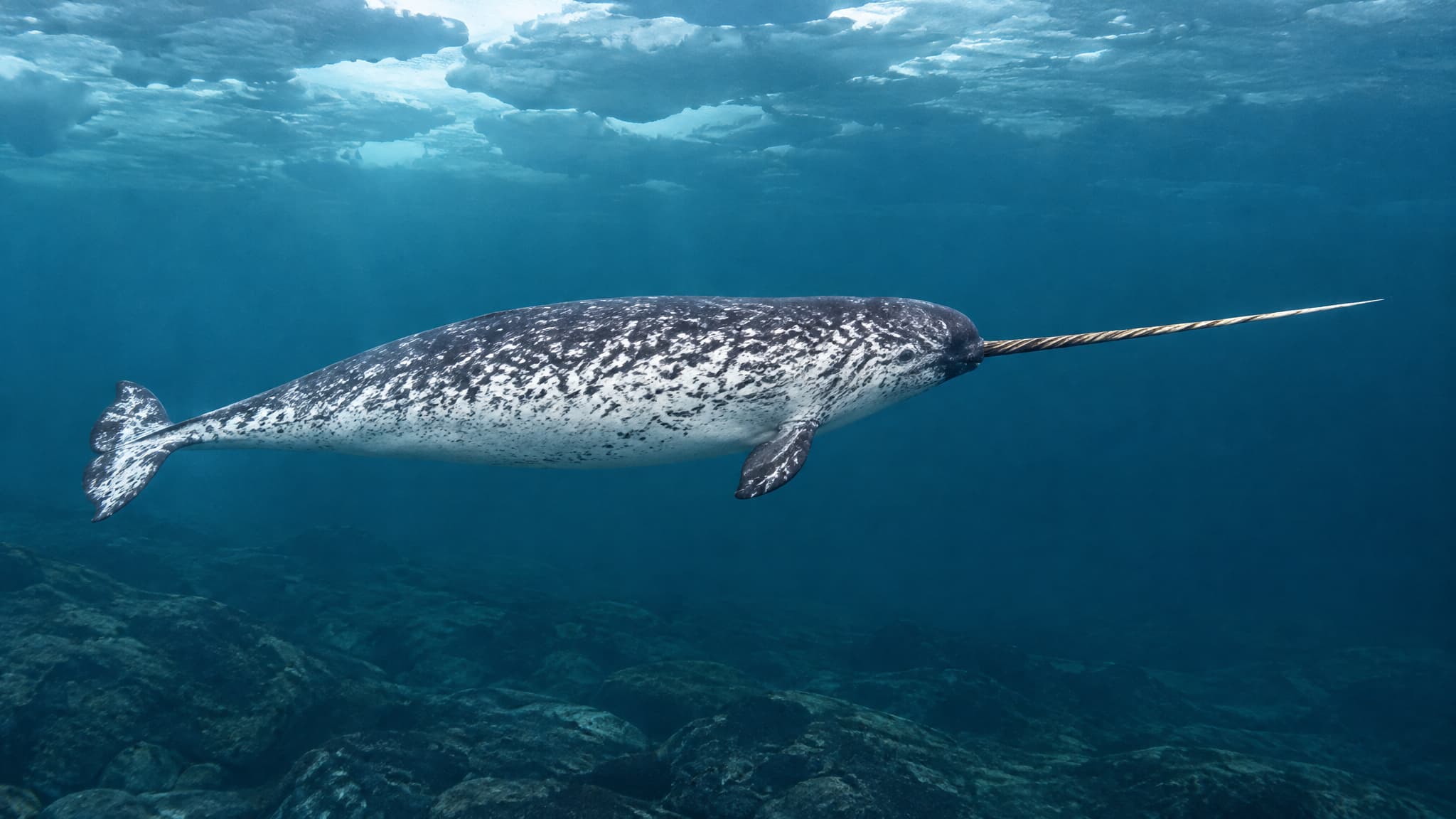
A narwhal swims horizontally underwater above a rocky seabed, with its mottled body, flippers, fluked tail, eye, and long forward-pointing tusk clearly visible.
The narwhal is a medium-sized toothed whale of the high Arctic, famous for the long spiral tusk carried by most males. The tusk is an enlarged upper left canine that grows forward through the lip and twists in a left-handed spiral, reaching up to 3 m. Females usually keep both teeth hidden in the jaw, although tusked females and males with two tusks are occasionally recorded. Adults usually measure about 4 to 5 m and weigh 800 to 1,600 kg, with males larger than females. The body is robust, the head small and rounded, and there is no dorsal fin, only a low ridge along the back. Calves are grey, while adults are pale with dark mottling and old animals can look almost white.
Narwhals live in the Arctic Ocean, mainly in its Atlantic sector, from the Canadian Arctic and Greenland to the waters off Russia, generally between 70° and 80° N. They follow the seasonal cycle of the sea ice: in summer they gather in coastal bays and deep fjords, and in winter they move offshore to dense pack ice, for example in Baffin Bay.
The diet is dominated by fish such as Greenland halibut, Arctic cod and polar cod, with squid and shrimp also taken. Narwhals feed at or near the bottom in deep water, capturing prey by suction. They are exceptional divers, regularly reaching depths of about 1,500 m on dives that can last up to 25 minutes. They usually travel in small pods of 2 to 10 animals, but in summer these can join into gatherings of hundreds or even thousands.
Mating takes place from March to May, and after a gestation of about 14 months a single calf is born, mostly in July and August. Newborns measure about 1.5 m and weigh around 80 kg, and they nurse for about 20 months. Females give birth every 2 to 3 years. Narwhals can live for about 50 years, and they are among the few animals known to go through menopause.
As a deep-diving predator of fish and squid, the narwhal is part of the Arctic marine food web and is itself hunted by orcas, polar bears and Greenland sharks. The IUCN lists it as Least Concern, with a global population of about 170,000 animals, and it is included in CITES Appendix II. Threats include climate change and the loss of sea ice, regulated subsistence hunting by Arctic Indigenous peoples, shipping, pollution and deadly entrapment in suddenly freezing ice.



