
Proboscis monkey
Nasalis larvatus
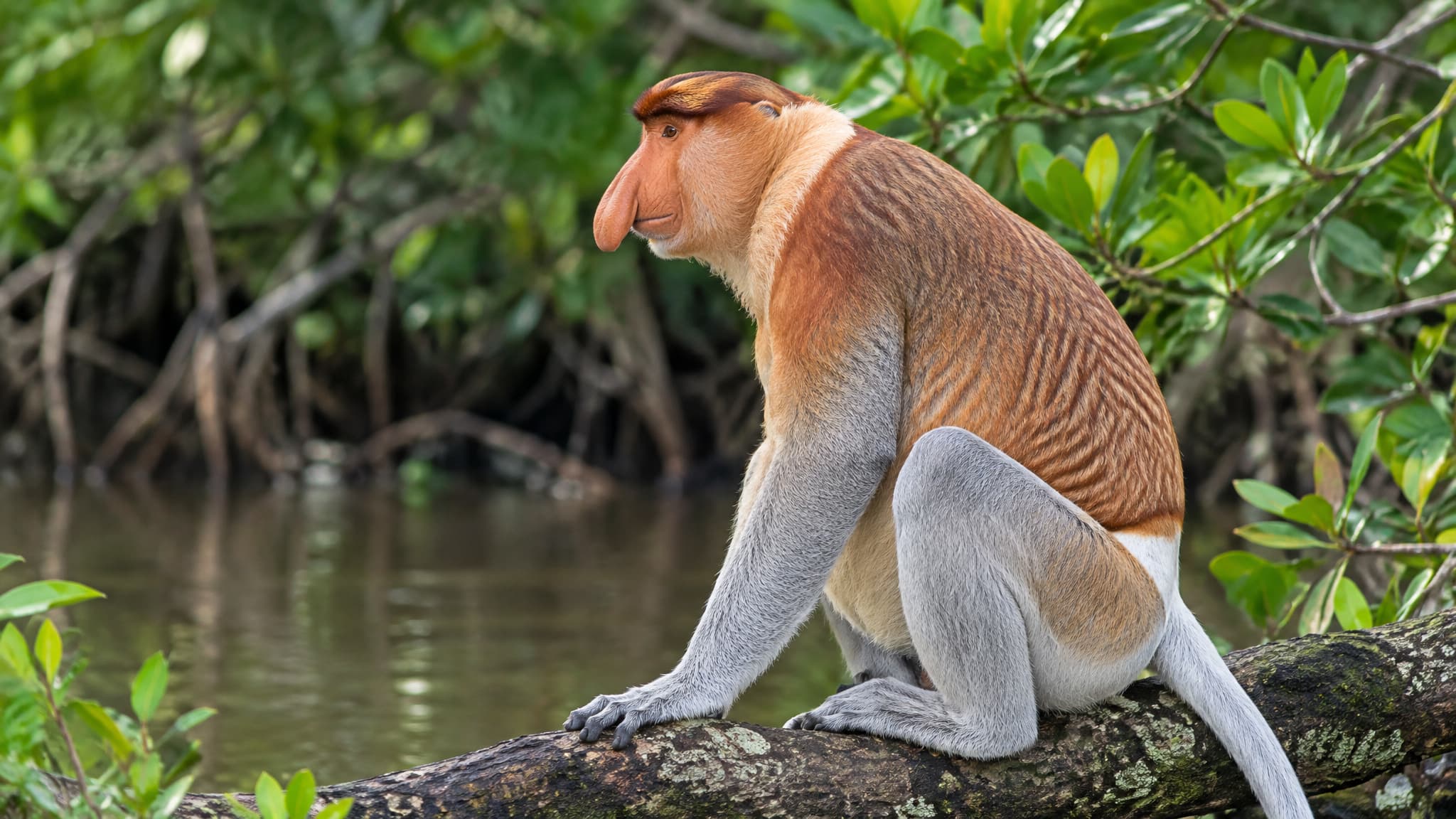 AI-generated
A proboscis monkey sits on a moss-covered branch above calm water, surrounded by dense green vegetation. Its large pendulous nose, reddish-brown back, pale limbs, and long tail are clearly visible.
The proboscis monkey (Nasalis larvatus) is an Old World monkey of the subfamily Colobinae and one of the largest monkeys native to Asia. It is named for the long, fleshy nose of adult males, which can exceed 10 cm and hang below the mouth; females have a smaller nose and the young have upturned noses. The coat is reddish brown on the head and shoulders, paler on the body, with greyish limbs and a long tail of about 55 to 67 cm. Males are about twice the size of females: they measure 66 to 76 cm in head-body length and usually weigh 16 to 22.5 kg, while females measure 53 to 62 cm and weigh 7 to 12 kg. Both sexes have a large, rounded belly.
The species is found only on Borneo, in Brunei, Indonesia and Malaysia, and the largest remaining populations are in Kalimantan. It lives in lowland coastal and riverside habitats, especially mangroves, swamp and peat forests and riverine forests, and it rarely moves more than about 1 km from water.
Proboscis monkeys are herbivores. Across the year their diet is roughly 52% leaves, 40% fruit and 3% flowers, with insects only a tiny share, and they eat more than 90 plant species. Fruit dominates from January to May and leaves from June to December, with young leaves and unripe fruit preferred. A multi-chambered stomach lets bacteria break down tough plant material, and they sometimes regurgitate and rechew their food. They are active by day, spend most of their time in trees and are perhaps the most aquatic of all primates: with partly webbed fingers and toes they cross rivers and can swim up to 20 m underwater.
They usually live in one-male groups of 3 to 19 animals, with one adult male, several females and their young; other males form all-male groups. At night groups gather in trees near the river, and they can join into bands of up to 60. Males honk to warn of danger and their large nose seems to amplify these calls. Gestation lasts about 166 days, sometimes more than 200, and a single infant of about 450 g is born with a blue face. It is weaned at about 7 months; females mature at about 5 years and males at about 7. Lifespan in the wild is not well known, but individuals have lived more than 20 years in captivity.
As seed eaters and leaf browsers they shape the plants of mangrove and swamp forests, and they are prey for crocodiles, false gharials, Sunda clouded leopards and eagles. The IUCN lists the species as Endangered, and its numbers fell by more than half over roughly 40 years. The main threats are the loss of riverine and mangrove forest to logging, oil palm plantations, shrimp farms and fires, plus hunting. It is listed in CITES Appendix I and protected by law across Borneo.



