Nile Crocodile
Crocodylus niloticus
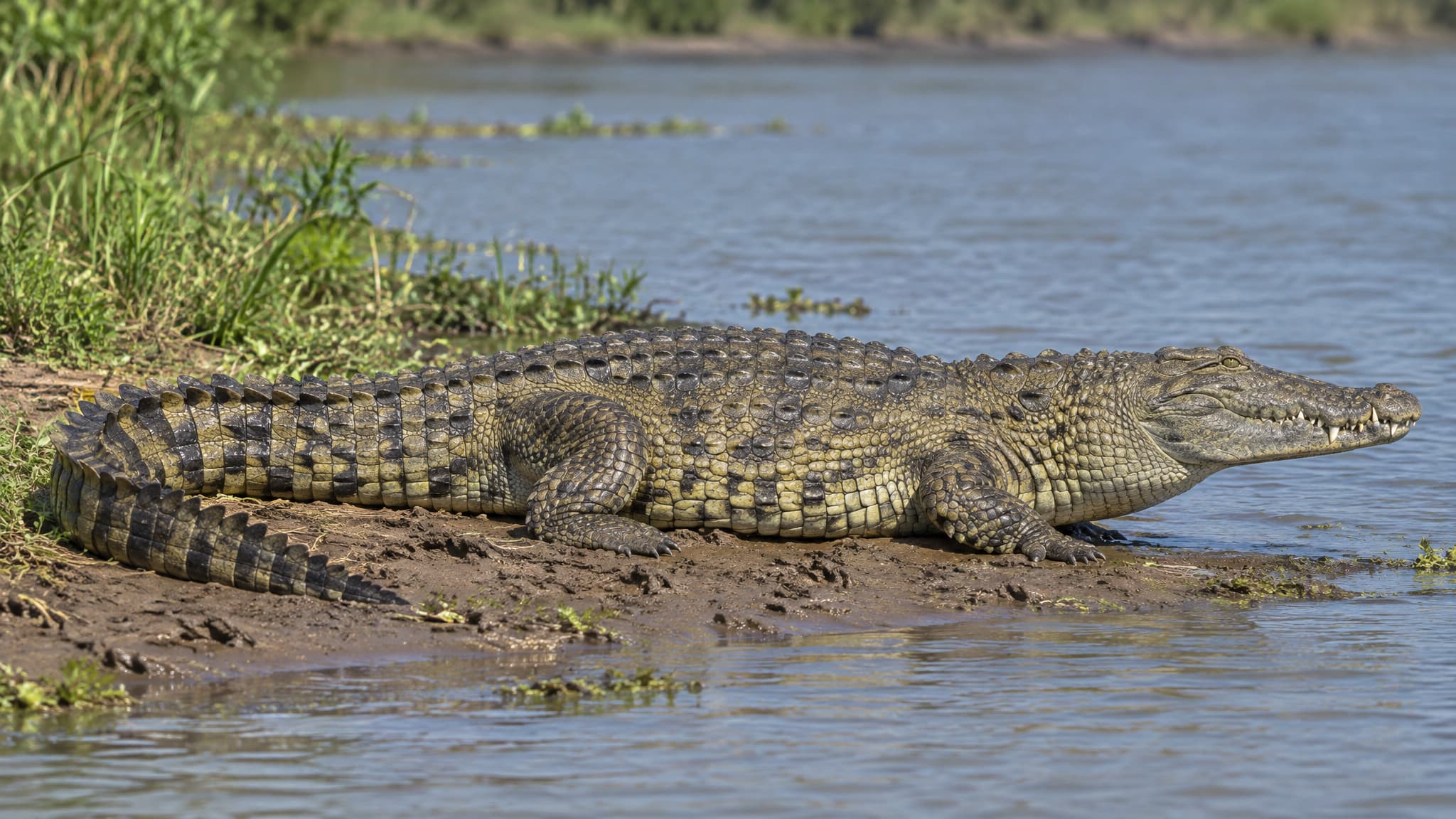 AI-generated
A Nile crocodile lies in side profile on a muddy vegetated shoreline beside open water, with its armored back, long tapering tail, sturdy limbs, and several teeth visible.
The Nile crocodile (Crocodylus niloticus) is the largest crocodilian in Africa. It is a heavy reptile with a body like a lizard, four short clawed legs, webbed hind feet and a long, powerful tail. The tail makes up about 40% of its total length and has two raised ridges along the top. Its eyes and valved nostrils sit on top of the head, so it can watch and breathe while almost fully underwater. The skin is covered with rows of hard, often bony, keeled plates.
Adults usually reach about 4–5 m in length and can weigh several hundred kilograms. Exceptionally large males may grow to around 6 m and weigh more than 1,000 kg. Hatchlings are greenish with irregular black markings and a pale yellow throat and belly. As they age they darken to a fairly even olive or grey, with a cream or yellowish underside.
Distribution and habitat
The species lives across much of sub-Saharan Africa and on Madagascar. It is found in rivers, lakes, swamps and marshes, and also in the brackish waters of eastern and southern Africa. Kenya's Lake Turkana holds one of the largest undisturbed populations. Crocodiles of West Africa are now often treated as a separate species, Crocodylus suchus.
Diet and behavior
Nile crocodiles are opportunistic carnivores. Young ones eat fish, crustaceans, amphibians and small reptiles. Adults eat a lot of fish but also take birds, reptiles and carrion, as well as large mammals such as antelopes and wildebeest that come to drink. They wait close to the surface, then lunge, grab the prey and drown it. They tear apart large prey by twisting their bodies, and groups sometimes work together to herd fish. They often bask on riverbanks to control their body temperature.
Reproduction and lifespan
Breeding happens in the dry season. The female lays about 25–80 eggs in a nest she dug and guards it for roughly three months, often without eating. After hatching, the young stay near their mother for some time and then gradually move away. Wild Nile crocodiles usually live about 40–60 years.
Ecological role and conservation
As a top predator and scavenger, the Nile crocodile helps control fish and other prey populations and removes carcasses from wetlands. The IUCN lists it as Least Concern, with an estimated 250,000–500,000 animals. Still, local populations face habitat loss, pollution, conflict with people and, in the past, heavy hunting for skins. The species is listed on CITES.