Northern king cobra
Ophiophagus hannah
 AI-generated
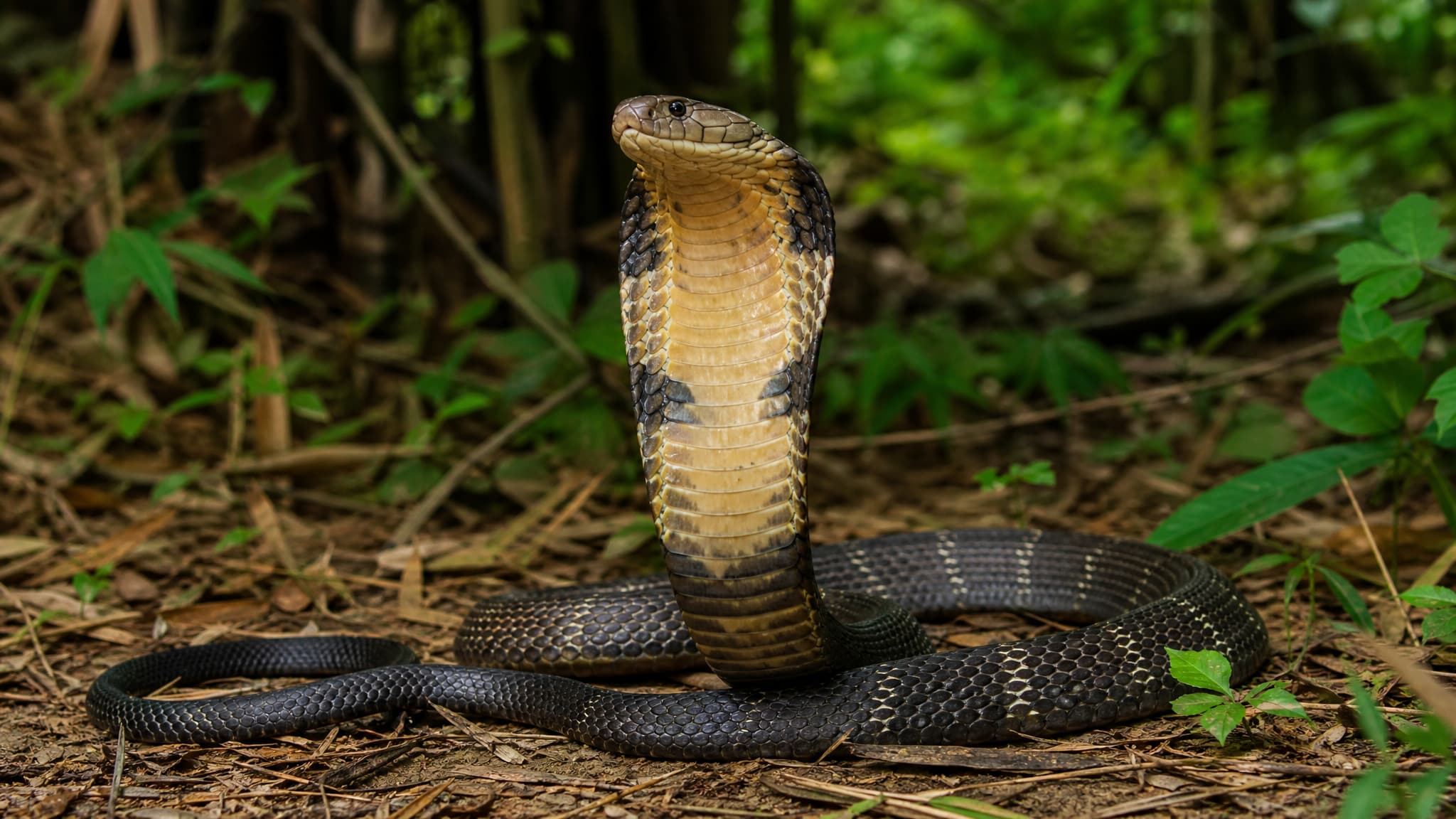
A dark, heavily scaled cobra is coiled on the forest floor with its forebody raised, broad hood expanded, and head turned slightly to the side.
Northern king cobra
Ophiophagus hannah is a very large, highly venomous elapid snake, commonly called the northern king cobra or hamadryad. It is not a true cobra of the genus Naja, although it can spread the neck into a hood when threatened. Adults may be olive, brown, greenish, or nearly black, often marked with pale crossbars or chevrons; young snakes are usually glossy black with bold pale bands. It is the world’s longest venomous snake, with most adults around 3–3.6 m and exceptional individuals exceeding 5 m.
A 2024 taxonomic revision narrowed O. hannah to populations from eastern Pakistan, northern and eastern India, the Andaman Islands, Indo-Burma, Indochina, southern China, and approximately central Thailand. It uses forests, bamboo thickets, scrub, mangroves, and nearby agricultural mosaics, generally where cover and watercourses are available. Earlier sources may show a much broader range because they treated several now-recognized king cobra species as one.
Its genus name means “snake eater,” accurately reflecting a diet centered on other reptiles—especially snakes, including rat snakes, pythons, kraits, and other cobras. The northern king cobra is mainly active by day and usually avoids people, but a cornered animal or a female defending a nest can make an emphatic defensive display, raising the front of the body, expanding its hood, and hissing. Its potent neurotoxic venom makes close approach dangerous.
Females are unusual among snakes in constructing a nest: they gather leaves and other vegetation into a mound, whose decomposition helps warm the eggs. Clutches often contain a few dozen eggs, and the female guards the nest; recent observations in China also documented more than one individual near nests. Captive and field-based references suggest a lifespan that can approach about 20 years. As a predator of other reptiles, it helps shape local food webs, but it is threatened by forest loss and fragmentation, deliberate killing, and collection or trade. It is listed as Vulnerable, while post-revision conservation assessment remains important.