Northern right whale dolphin
Lissodelphis borealis
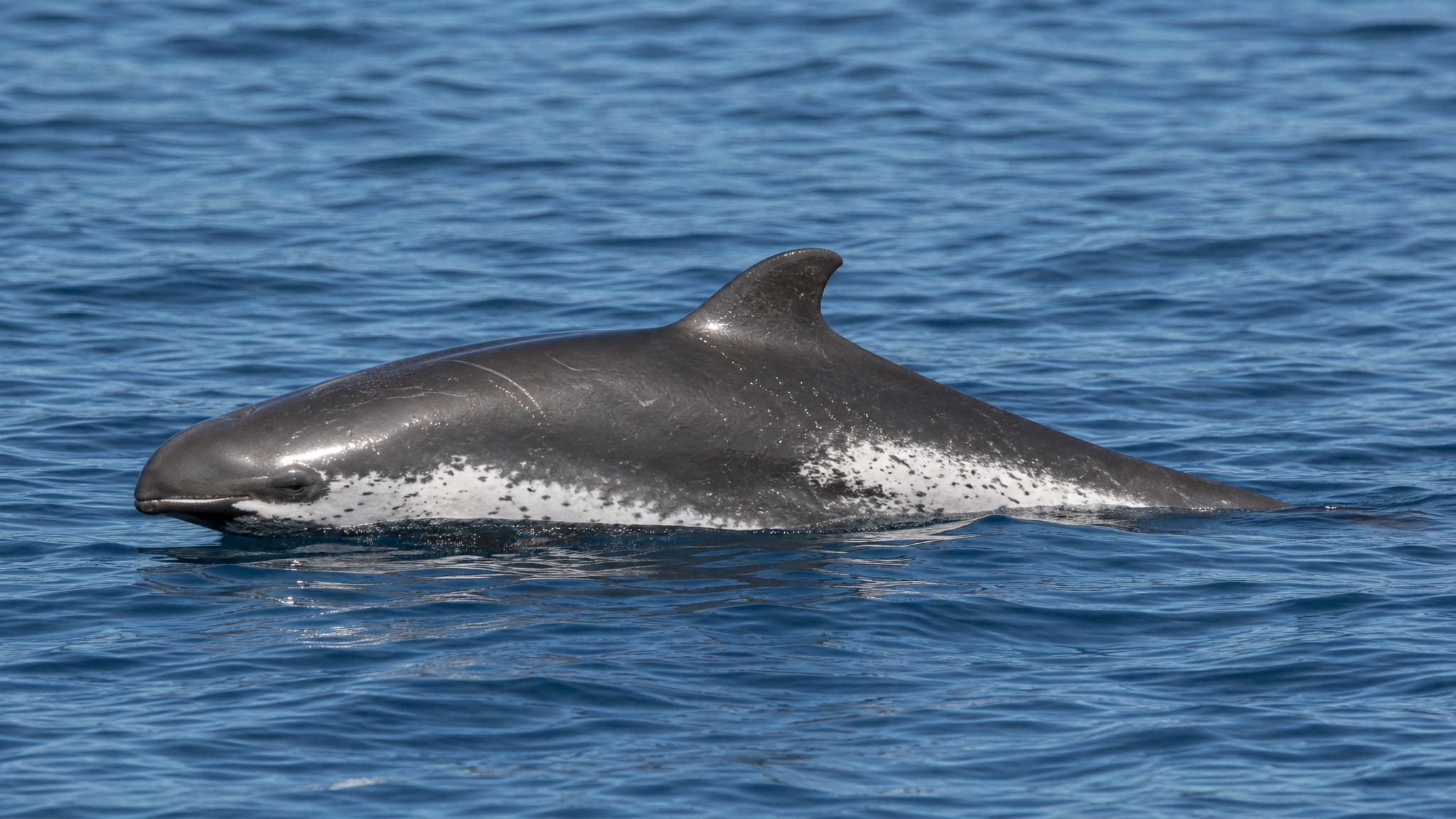 AI-generated
A dark gray dolphin swims at the ocean surface, showing a prominent curved dorsal fin and a broad mottled-white flank.
The northern right whale dolphin is a streamlined oceanic dolphin distinguished by an extraordinary feature: it has no dorsal fin. Its upper body is glossy black, while a sharply contrasting white patch begins at the throat and extends along the underside toward the tail. Adults are slender, with a short beak and sloping forehead, and measure about 2–3 m (6.5–10 ft) long. Males are generally larger than females.
This species inhabits deep, cool to warm-temperate waters of the North Pacific, broadly between about 30° and 50° N. Its range extends from Baja California and the Gulf of Alaska across the ocean to waters near Japan and Kamchatka. It usually occurs offshore or near the continental-shelf edge, but may approach the coast where submarine canyons bring deep water close to land. Seasonal shifts in distribution appear linked to changing water temperatures and prey.
Northern right whale dolphins are notably social. Groups commonly contain roughly 100–200 animals, although gatherings of thousands have been reported, sometimes alongside Pacific white-sided dolphins, pilot whales, or other cetaceans. Fast, graceful swimmers, they can make low leaps and occasionally ride vessel wakes. They use clicks and pulsed calls, rather than the familiar whistles of many dolphins, and can dive for several minutes while foraging.
Their food is mainly mesopelagic fish—especially lanternfishes—and cephalopods such as squid. By feeding on abundant midwater animals, they are predators within the North Pacific pelagic food web. Females carry one calf for about a year, with births apparently peaking in summer and at least two years generally separating calves. Sexual maturity is reached near age ten, and longevity is estimated at 42 years or more.
The species is assessed as Least Concern globally, but it faces real local and historical pressures. Incidental capture and entanglement in driftnets, gillnets, and other fishing gear can injure or kill dolphins; underwater noise can also disrupt communication, echolocation, feeding, and orientation. Northern right whale dolphins are protected under the U.S. Marine Mammal Protection Act and listed in CITES Appendix II.