Okapi
Okapia johnstoni
 AI-generated
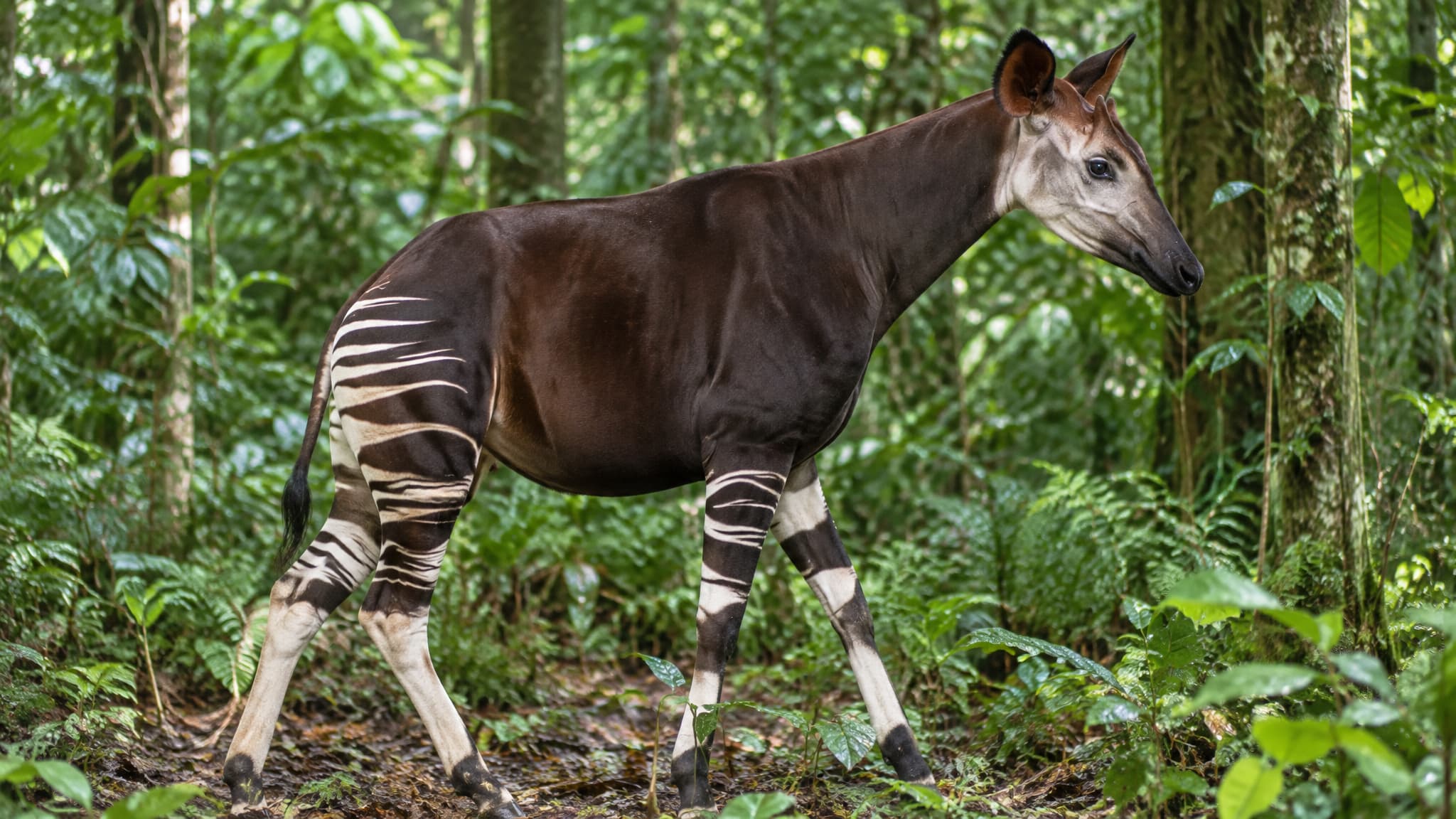
An okapi (Okapia johnstoni) walks in profile through dense tropical forest, showing its dark brown body, elongated neck, large ears, and boldly striped hindquarters and legs.
The okapi is a large, forest-dwelling ruminant and the giraffe’s only living close relative. Its velvety coat is rich reddish brown to dark chestnut, while bold cream-and-black horizontal stripes mark the upper legs and hindquarters. These stripes break up its outline in the shadowy understory and help calves follow their mothers. Large mobile ears detect faint sounds, and males usually carry two short, skin-covered bony horns called ossicones.
Okapis are endemic to the Democratic Republic of the Congo, where they inhabit dense tropical rainforest, especially the central and northeastern forests. They use established paths through tangled vegetation and are generally solitary, although individual home ranges can overlap. Their thick, oily fur sheds rain effectively in the humid forest environment.
A browser and ruminant, the okapi feeds chiefly on leaves, shoots, buds, twigs, and some fruit. Its long, flexible prehensile tongue strips foliage from branches and selects food from the understory. Okapis also consume mineral-rich clay or other materials that may supplement their diet. They are quiet and elusive; scent marks, body posture, and low-frequency vocal signals contribute to communication.
Breeding can occur throughout the year. After a gestation of roughly 14 to 16 months, a female usually gives birth to one calf, which spends much of its early life concealed in a nest site. Captive individuals may live about 15 to 30 years, while longevity in the wild is less certain. As a large herbivore, the species helps shape forest vegetation and is prey for leopards. The okapi is classified as Endangered, threatened principally by forest loss and fragmentation, illegal hunting, human encroachment, and instability within parts of its range.