Olive ridley sea turtle
Lepidochelys olivacea
 AI-generated
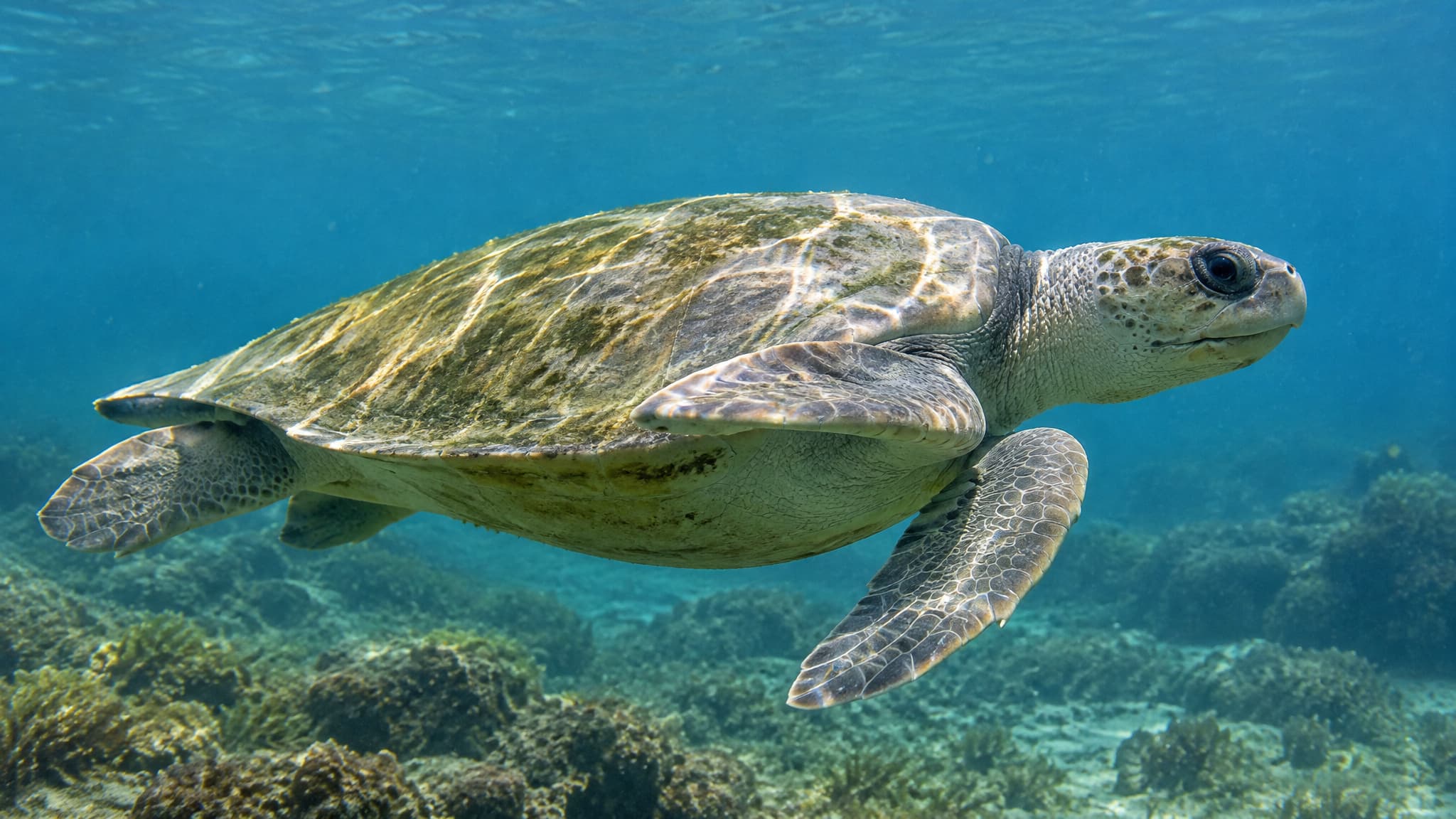
A sea turtle swims horizontally through clear blue water above a coral reef, with its flippers extended and a broad, domed, mottled shell and blunt head clearly visible.
The olive ridley sea turtle (Lepidochelys olivacea) is one of the smallest sea turtles and belongs to the family Cheloniidae. Its heart-shaped carapace is olive to grayish green, and adults reach a curved carapace length of up to about 72 cm. Adults rarely weigh more than 50 kg; in a study in Oaxaca, Mexico, they weighed 25 to 46 kg. Hatchlings measure 37 to 50 mm and weigh 12 to 23.3 g. Its only living relative in the genus is Kemp's ridley (Lepidochelys kempii).
The species is circumtropical, living in warm waters of the Pacific, Indian and Atlantic oceans and using the coastal waters of more than 80 countries. It spends most of its time within about 15 km of mainland shores, in sheltered, fairly shallow waters 22 to 55 m deep, but also travels through the open ocean. In Brazil, its main nesting area runs from southern Alagoas through Sergipe, which has the highest nest density, to the northern coast of Bahia, with about 10,500 nests per season.
The olive ridley is mainly carnivorous. It eats tunicates such as salps, jellyfish, sea urchins, starfish, bryozoans, bivalves, snails, shrimp, crabs, lobsters, squid, fish and fish eggs, and turns to filamentous algae when other food is scarce. It can dive to about 150 m to forage on bottom-dwelling invertebrates.
Females nest one to three times per season and lay about 100 eggs per clutch, with recorded clutches ranging from 30 to 168 eggs. Most nest alone, but the species is famous for its arribadas, synchronized mass nestings in which thousands of females come ashore on the same beach, as at Gahirmatha in Odisha, India. Incubation usually lasts 45 to 51 days and can stretch to 70 days in poor weather. Sex depends on nest temperature: 31 to 32 °C produces only females and 28 °C or less only males. Maturity comes at around 14 years, and lifespan is estimated at 30 to 50 years.
As a predator of jellyfish, tunicates and other invertebrates, the olive ridley feeds both near the coast and in the open ocean, while egg losses in its mass nestings are enormous: at one arribada at Playa Nancite, Costa Rica, only 0.2% of 11.5 million eggs hatched, mostly because later females dug up earlier nests. Tiger sharks and crocodiles prey on adults, and jaguars attack nesting females on some beaches.
The IUCN Red List classifies the species as Vulnerable, and it is listed on CITES Appendix I. In Brazil, the national list of the Ministry of the Environment also classifies it as Vulnerable. Bycatch in trawls, gillnets and longlines is the greatest threat, together with harvest of eggs and adults, loss of nesting beaches, artificial lighting that disorients hatchlings, vessel strikes, marine debris and climate change. Global numbers of nesting females fell to about 852,550 by 2008.