
Pampas deer
Ozotoceros bezoarticus
 AI-generated
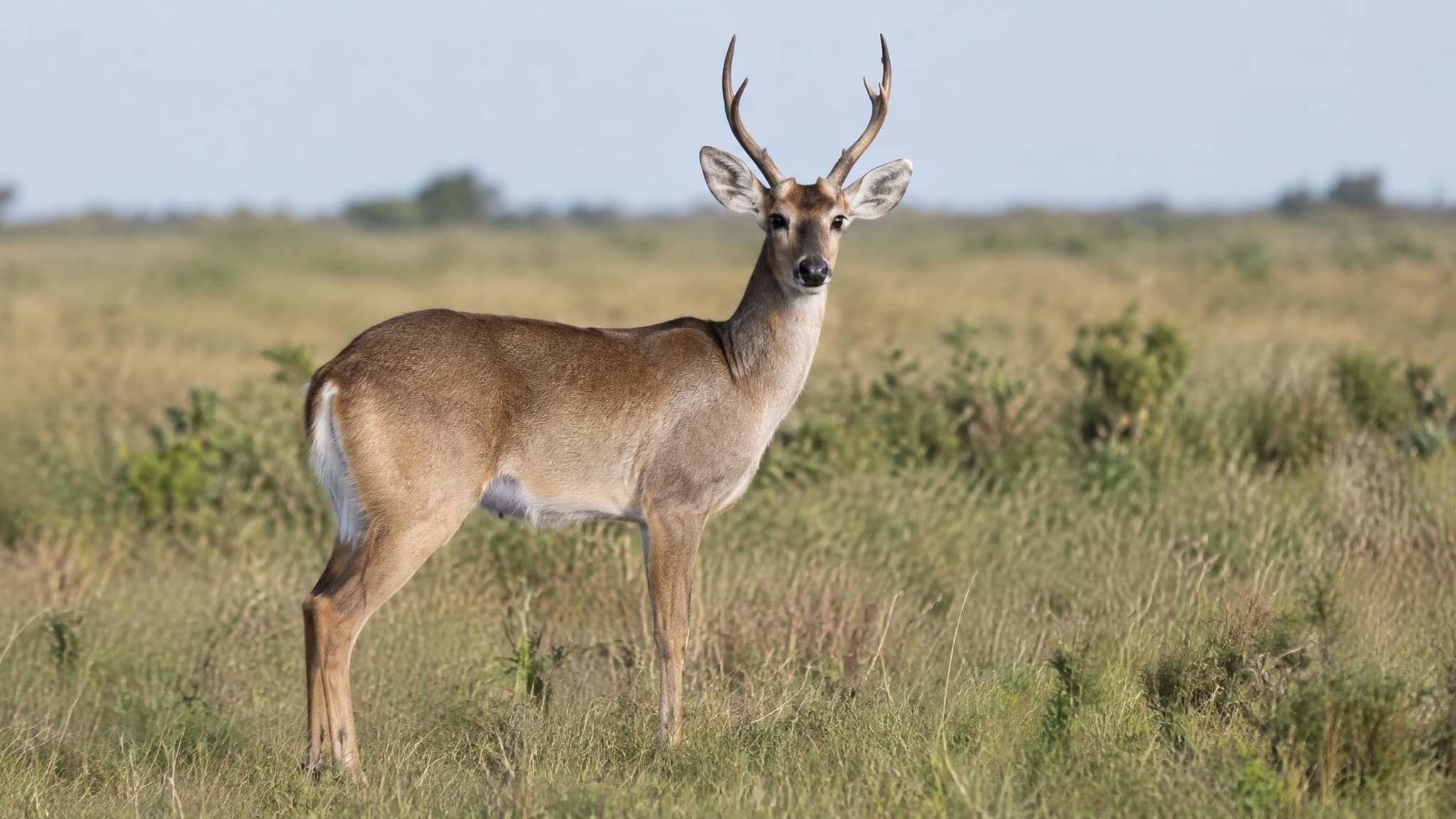
A male deer stands alert in an open grassy plain, facing the camera with its ears upright and branched antlers clearly visible. Its tawny coat contrasts with the white rump and pale underside.
The pampas deer is a medium-sized South American deer and the sole living species in its genus. Its coat is generally tawny to reddish-brown above, with paler underparts and conspicuous white areas on the throat, belly, and around the tail. Males carry branched antlers, commonly with three points per antler, which are shed and regrown through a yearly cycle. In Brazil it is widely known as the veado-campeiro.
Historically, this deer occupied extensive open landscapes in eastern and southern South America. Its modern distribution is fragmented into local populations in grasslands, savannas, seasonally flooded plains, and other low-elevation open habitats in countries including Argentina, Brazil, Paraguay, and Uruguay. It favors habitats with a mosaic of short vegetation, foraging sites, and cover, rather than dense forest.
It is a ruminant herbivore that selectively feeds on nutritious, easily digested plant parts such as young leaves, shoots, flowers, and shrubs. Pampas deer are mostly sedentary. They may occur alone or in small, fluid groups, although larger temporary gatherings can form at favorable feeding grounds. They rest and ruminate in open areas when conditions are calm, and use scent and visual signals in social and reproductive interactions.
Reproduction is seasonal in many populations, though timing varies geographically. Gestation lasts a little over seven months and a female normally gives birth to one fawn, which is concealed in cover during its earliest stage. The species helps shape grassland plant communities through selective browsing and serves as part of the food web of open South American ecosystems. Habitat conversion for agriculture and pasture, fragmentation, illegal hunting, disease transmission from domestic animals, and interactions with introduced species threaten remaining populations. Globally it is listed as Near Threatened, while some Brazilian subspecies receive stronger national threat categories.



