Pacific white-sided dolphin
Aethalodelphis obliquidens
 AI-generated
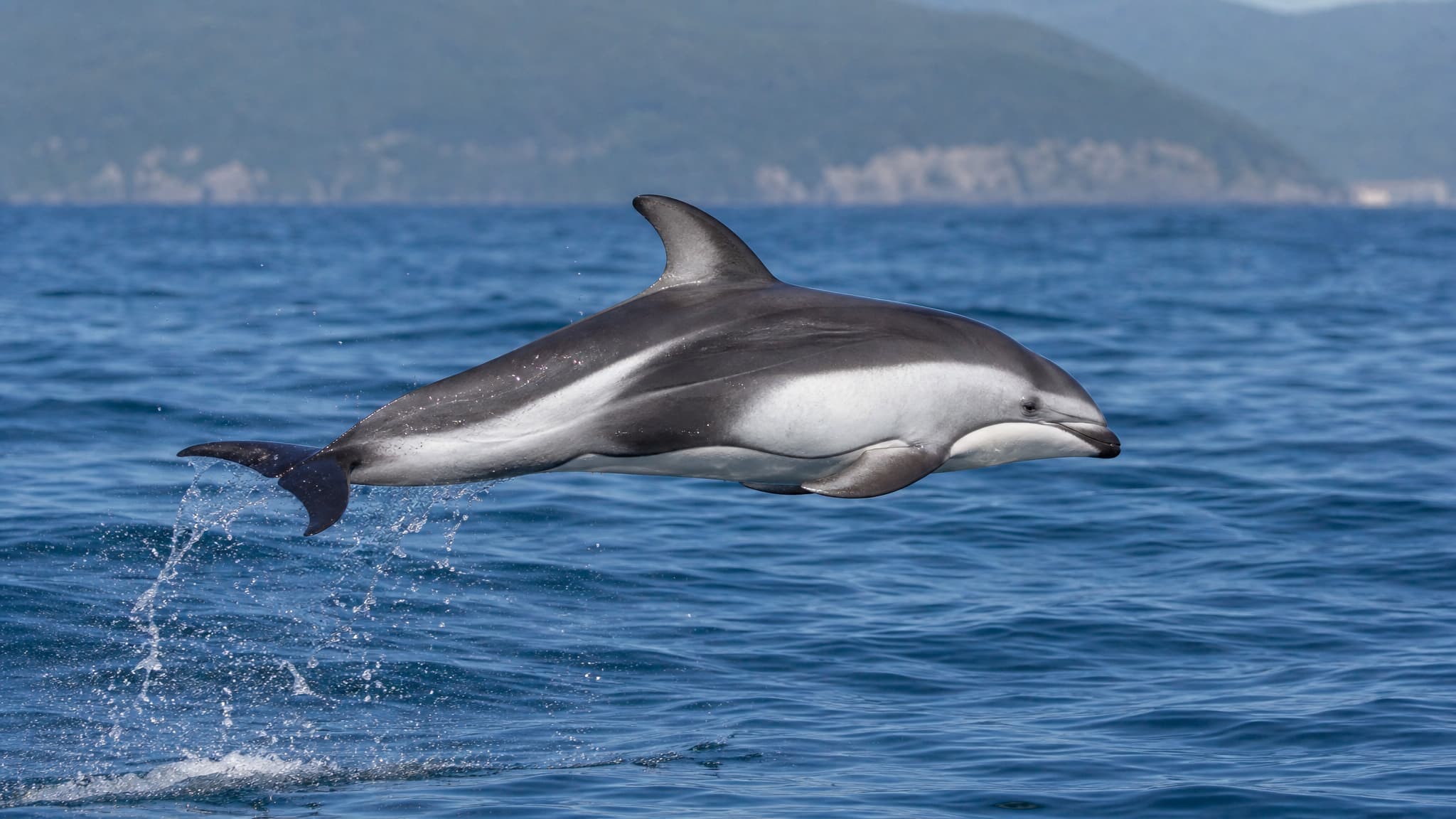
A Pacific white-sided dolphin is captured in a horizontal leap above the ocean, with its tall dorsal fin, pale flanks, rounded forehead, beak, and one visible pectoral fin clearly shown. A mountainous coastline is visible in the background.
The Pacific white-sided dolphin is a robust, fast-moving oceanic dolphin recognized by its striking countershaded pattern: a dark back, white belly, pale gray flanks, and a light stripe running from near the eye toward the tail. It has a short beak, rounded flippers, and a conspicuous tall, hooked dorsal fin with dark and pale areas. Adults are usually about 1.7–2.5 m long, and males tend to be larger than females.
It inhabits cool to temperate waters of the North Pacific, ranging from the waters around Japan, China, Russia, and the Bering Sea to Alaska and the Pacific coast of North America, south toward Baja California. Although it may occur in nearshore waters, it is mainly pelagic and is generally associated with deeper offshore habitat. Seasonal shifts in distribution occur in parts of its range.
Highly social and energetic, this dolphin commonly travels in groups and may gather in much larger aggregations. It is noted for leaping, bow-riding, and other aerial activity. Like other toothed whales, it uses sound, including echolocation clicks, to orient and locate prey. Its diet consists chiefly of squid and small schooling fishes such as herring, sardines, and capelin; groups can cooperate to concentrate fish before feeding.
Females generally mature at about 8–11 years and males at about 10–11 years. After a gestation of roughly 9–12 months, a female normally bears one calf. Calves are nursed for as long as 18 months, and births are commonly separated by several years. Individuals can live for more than 40 years.
As a mid-level marine predator, the species helps transfer energy from schooling fish and cephalopods through North Pacific food webs; feeding dolphins may also make prey available to attendant seabirds. It is assessed as Least Concern, though it faces hazards from entanglement or bycatch in fishing gear and from underwater noise that can disrupt communication, navigation, and feeding. The currently used scientific name follows a 2025 revision that moved this species from the former genus Lagenorhynchus to Aethalodelphis.