
Pancake tortoise
Malacochersus tornieri
 AI-generated
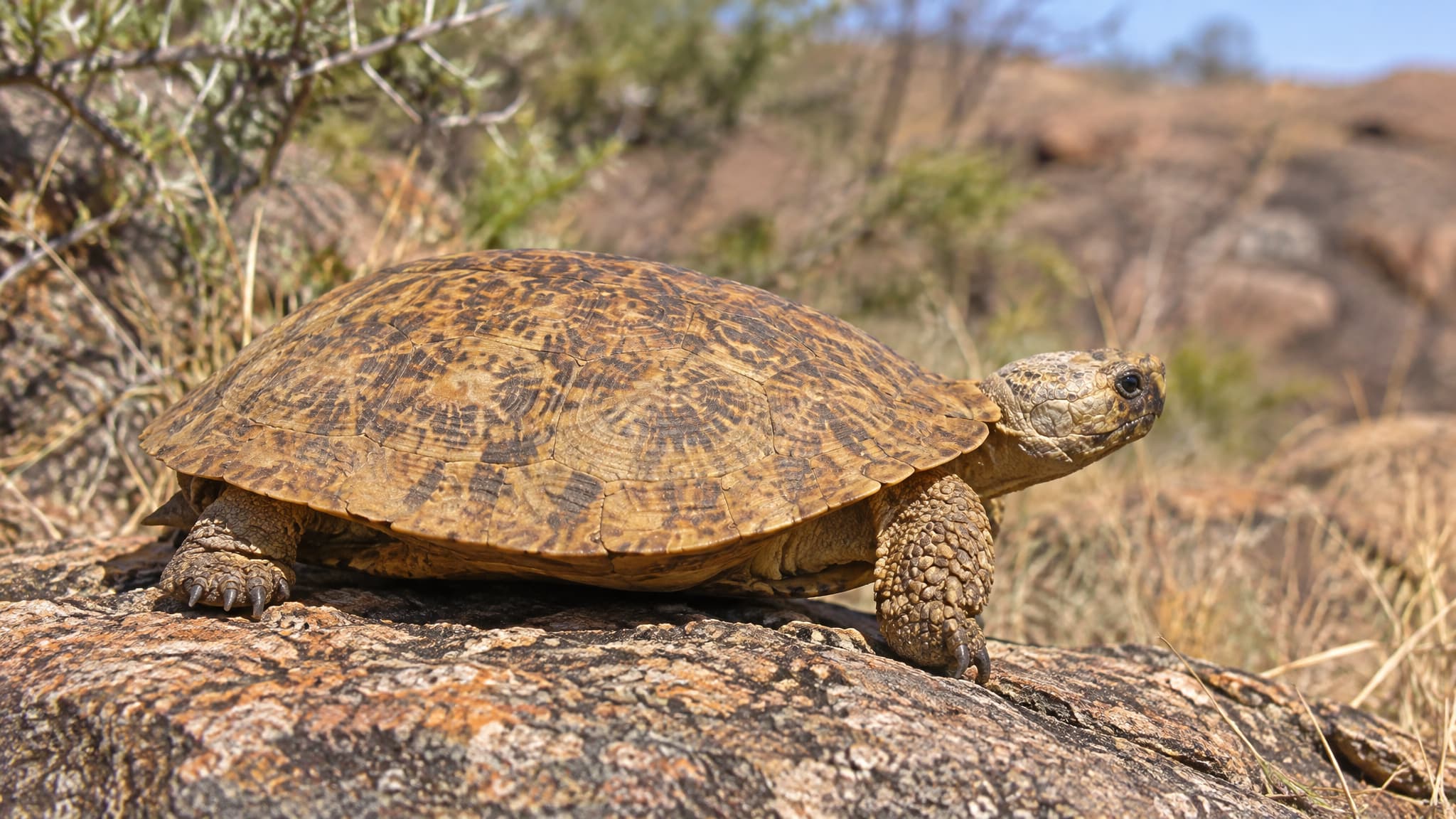
A pancake tortoise rests on a sunlit rock, shown in side profile with its patterned shell, scaly head, and sturdy clawed legs visible amid dry scrubland.
The pancake tortoise (Malacochersus tornieri), also called Tornier's tortoise, is the only member of its genus and one of the most unusual tortoises alive. Instead of a high dome, adults carry a thin, flat and flexible shell whose bones are full of openings, which makes the animal light and agile. The carapace reaches up to about 17.8 cm and is brown with yellow markings, often with dark radiating lines, while the plastron is pale yellow with dark seams. Adults weigh around 450 g. Hatchlings are only 2.5 to 5 cm long and start with a domed shell that flattens as they grow.
The species is native to southern Kenya and northern and eastern Tanzania, with records also from Zambia and Malawi and a possibly introduced population in Zimbabwe. It lives in isolated colonies on rocky hills and outcrops, known as kopjes, set in arid thorn scrub, savanna and dry woodland, from about 30 to 1,800 m above sea level.
Pancake tortoises are herbivores that feed mainly on dry grasses, along with succulents such as aloe, fallen fruit and most other vegetation. They are most active in the morning and in the late afternoon or early evening, leaving their crevice for about an hour at a time to bask and forage. When threatened they do not withdraw into the shell; they run, climb with surprising speed and wedge themselves into a narrow rock crack. Up to ten tortoises may share one crevice, and during the hottest months they may aestivate under flat rocks.
Males fight for access to females in January and February. In the wild, nesting takes place mainly in July and August, when the female digs a hole 7.5 to 10 cm deep in loose, sandy soil and lays a single egg. She can lay again every 4 to 8 weeks, so several eggs may be produced in one season. Incubation lasts 4 to 6 months, sex is set by incubation temperature, and the young are independent from hatching. Zoos report a lifespan of 25 to 35 years or more in the wild.
The pancake tortoise is listed as Critically Endangered by the IUCN and is on CITES Appendix I. Collection for the pet trade, which often targets juveniles, has emptied many colonies, and habitat is lost to farming in Kenya and to overgrazing by goats and cattle in Tanzania. Coordinated zoo breeding programmes in Europe and North America help keep a reserve population.



