Panther Chameleon
Furcifer pardalis
 AI-generated
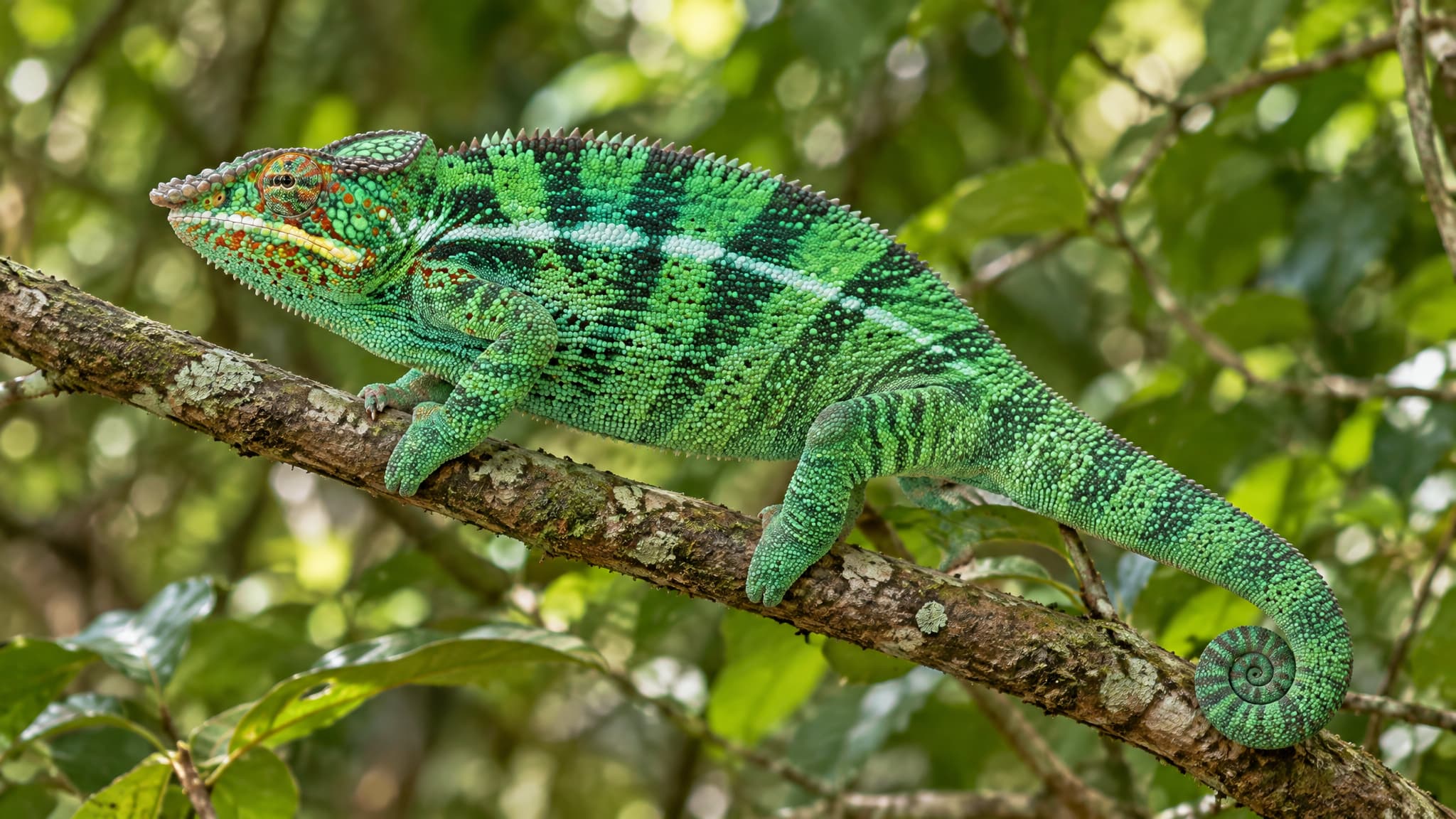
A vividly patterned panther chameleon rests lengthwise on a mossy branch, with its raised casque, independently oriented eye, gripping feet, serrated dorsal crest, and tightly coiled prehensile tail visible amid leafy vegetation.
The panther chameleon (Furcifer pardalis) is a large, strikingly colorful chameleon described by Georges Cuvier in 1829. Its genus name refers to the forked shape of its feet, on which the toes are fused into opposing groups of two and three for gripping narrow branches, while the species name alludes to leopard-like markings. Males are notably bigger than females and can reach roughly 50 cm including the tail; their coloration varies dramatically between localities, ranging from blues and greens to reds and oranges, whereas females are smaller and more subdued in tone.
The species is native to the northern and eastern parts of Madagascar, and introduced populations live on Réunion and Mauritius. It is a habitat generalist, occupying tropical forests and shrubland, where it lives mostly among the branches of trees and bushes.
Panther chameleons are diurnal, arboreal and solitary. Their eyes move independently, giving a nearly all-round field of view, but lack adaptations for night vision. They feed mainly on insects, captured with a projectile tongue that can extend well beyond the length of the body; small vertebrates such as reptiles, amphibians or birds are taken only rarely. Males are territorial and display intense colors toward rivals and potential mates.
Mating behavior consistent with serial polygyny has been reported, and in some areas females can breed several times per year. After a gestation of two to three weeks, the female digs a burrow and lays roughly 10 to 46 eggs, then buries and disguises the nest; there is no further parental care. Eggs may take from six months to a year to hatch. Wild individuals typically live only one to three years, while captive animals average about five years, and females tend to be shorter-lived because of the demands of egg production.
As an insect predator the panther chameleon helps regulate local invertebrate populations. The IUCN lists it as Least Concern because populations appear stable, but it is one of the chameleons most heavily collected for the international pet trade, and habitat loss and climate change are considered potential threats.