Corn snake
Pantherophis guttatus
 AI-generated
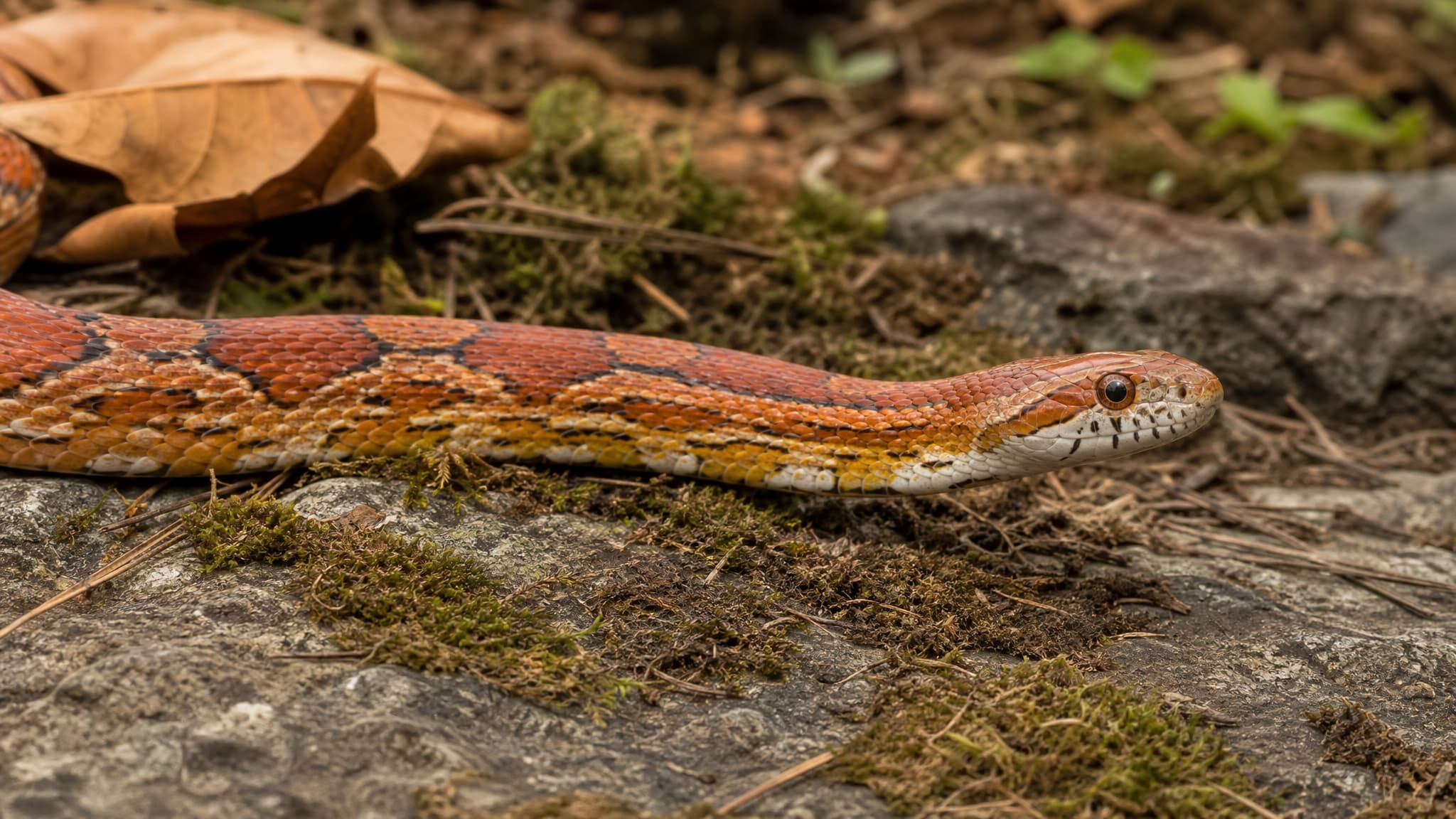
A corn snake rests horizontally on a mossy rock amid leaf litter and forest-floor debris. Its orange-and-brown patterned scales, pale lower jaw, and dark round eye are clearly visible.
The corn snake, also called the red cornsnake or red ratsnake, is a non-venomous North American colubrid. Adults are usually orange-brown, tan, or reddish, with a series of orange, red, or brown dorsal blotches edged in black. A pale spear-shaped marking commonly appears on the head and neck, while the underside is often patterned in black-and-white checks. Adults commonly measure about 76–122 cm long, although larger individuals occur. Young snakes are typically browner and less vivid than adults. Captive breeding has produced many color and pattern morphs, but these do not represent separate wild species.
Its native range lies chiefly in the southeastern United States, from New Jersey south through Florida and west to parts of Louisiana; records and range limits should be distinguished from those of related rat snakes. Corn snakes use varied terrestrial habitats, including pine woods, hardwood forests, rocky areas, fields, wetland edges, agricultural land, and suburban sites near suitable cover. Logs, stumps, rock crevices, burrows, and other sheltered places provide refuge, egg-laying sites, and overwintering cover. They are capable climbers and may hunt in shrubs or trees as well as on the ground.
A solitary ambush-and-search predator, the corn snake detects chemical cues with its tongue and vomeronasal organ and can also sense ground-borne vibrations. It feeds mainly on small mammals, especially rodents, and also takes birds, eggs, lizards, amphibians, and occasionally other snakes. Prey is subdued by constriction rather than venom. Activity is generally daytime-oriented but may shift toward dawn, dusk, or nighttime during hot weather. In cooler portions of its range, it shelters through winter and becomes active again in spring.
Breeding usually follows winter inactivity. Males locate females through pheromones and may engage in combat-like dominance displays. Females generally lay one clutch annually, commonly 10–15 eggs but sometimes up to 30, in warm, humid, concealed sites such as rotting logs or burrows. Hatchlings are independent immediately after emerging. Sexual maturity may be reached at roughly 16–18 months under favorable conditions. Captive individuals have lived for more than 32 years; longevity in the wild is less well documented.
By consuming rodents and other small vertebrates, corn snakes contribute to food-web balance and can help limit local rodent populations. They are prey for larger snakes, raptors, and carnivorous mammals, relying mainly on camouflage and escape to avoid danger. The species is assessed as Least Concern globally, although local populations can be affected by habitat conversion, road mortality, and persecution by people who mistake non-venomous snakes for dangerous species. A defensive bite is possible if handled or cornered, but corn snakes normally avoid confrontation.