
Peale's dolphin
Cephalorhynchus australis
 AI-generated
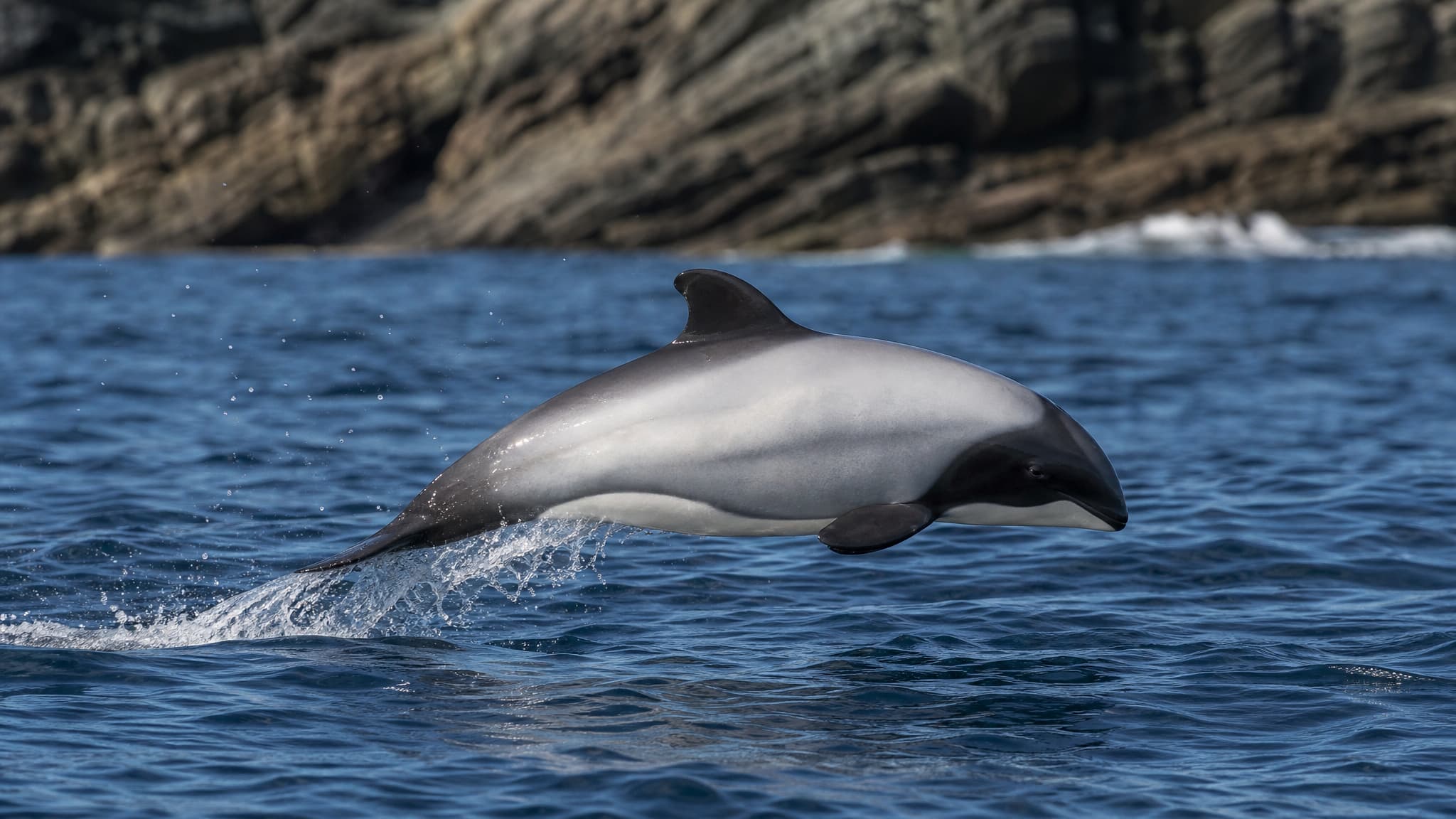
A Peale’s dolphin is shown in a side-on leap above blue coastal water, with a dark upper body, pale underside, rounded dorsal fin, and visible flipper; rocky shoreline lies behind it.
Peale’s dolphin is a compact, small coastal dolphin of southern South America, also called the black-chinned dolphin. Its back and head are dark gray to nearly black, contrasting with a white underside, pale gray side patches, and a conspicuous light mark behind each flipper. It has a short pointed beak and a tall, curved dorsal fin with differently shaded leading and trailing edges. Adults are roughly 1.3–2.2 m long.
It occurs along the coasts of Chile and Argentina, around Tierra del Fuego, the Strait of Magellan and Cape Horn, and around the Falkland Islands. It favors cool, shallow coastal waters, including exposed continental-shelf coasts, protected bays, channels, fjords, and kelp forests. The species’ close association with kelp beds is especially notable in the complex coastal ecosystems of southern Chile.
Peale’s dolphins eat a broad range of marine prey, including fishes, squid, octopus, crustaceans, and other invertebrates. They may forage alone near shore or feed cooperatively in groups, at times circling prey in a “starburst” formation. Small groups are typical, though they may join mixed groups with other dolphin species. Their predation helps link kelp-forest and nearshore food webs with higher marine consumers.
Much of its life history remains poorly documented. Births have been reported from austral spring through autumn, usually as a single calf, but details of mating, gestation, nursing, and population structure need further study. A study of museum and bycaught specimens recorded an age of 13 years, not necessarily the species’ maximum lifespan. The species is globally assessed as Least Concern, although accidental capture in gill nets, historic or illegal killing for crab bait, and disturbance or degradation of coastal habitat remain important localized threats.



