
Philippine tarsier
Carlito syrichta
 AI-generated
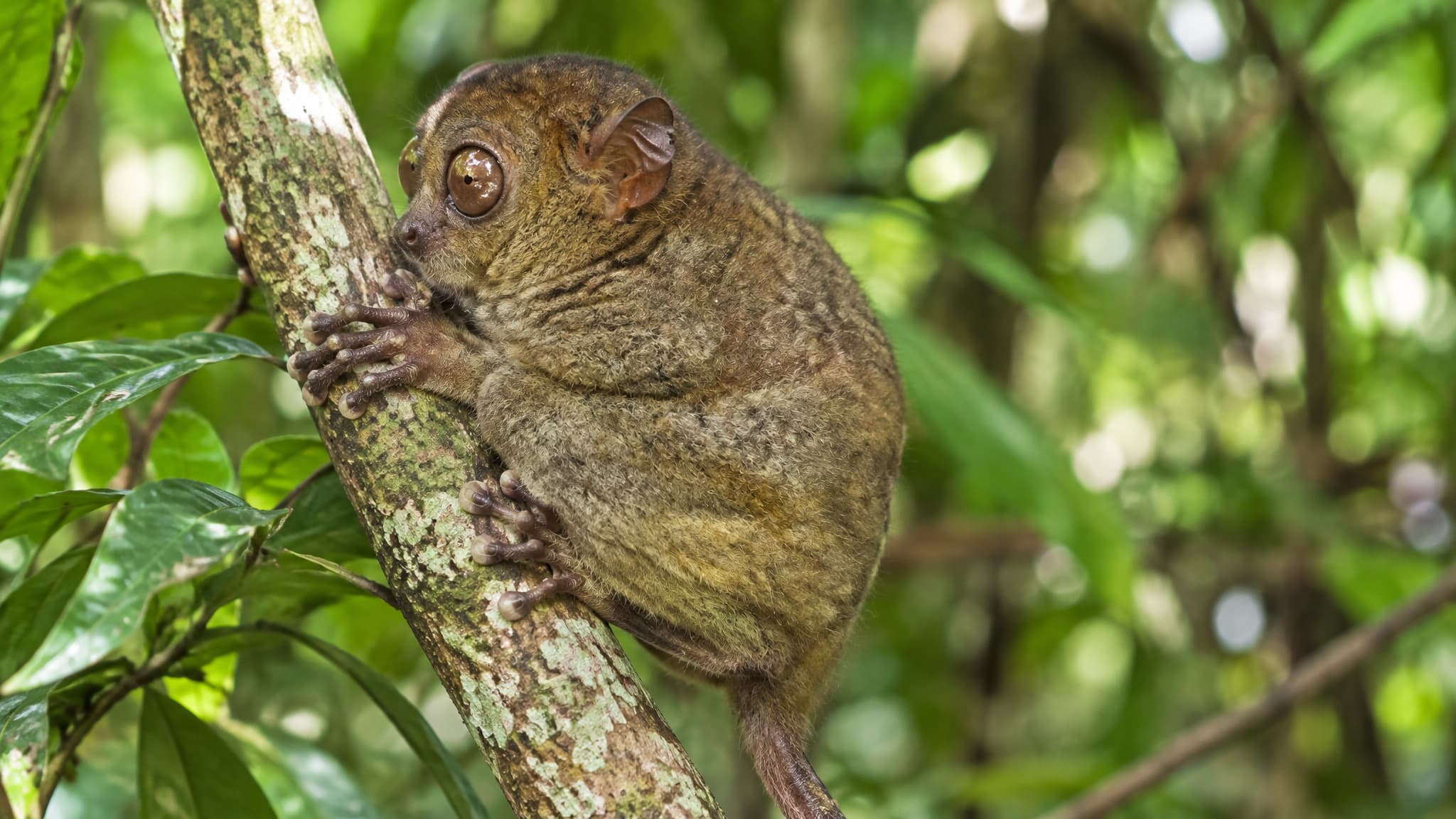
A Philippine tarsier clings to a mossy tree trunk in lush forest vegetation, showing its oversized eye, rounded ear, dense fur, and long grasping fingers and toes. Its body is curled around the trunk in profile.
The Philippine tarsier (Carlito syrichta) is a tiny nocturnal primate with a head-and-body length of about 11.7 to 12.7 cm. Adult males weigh about 119 to 153 g and females about 110 to 132 g. Its slender tail is roughly twice as long as the body and nearly naked,, and its huge eyes are the largest relative to body size of any mammal.
It lives only in the southeastern Philippines, mainly on Bohol, Samar, Leyte and Mindanao, with populations also on smaller islands such as Dinagat, Siargao, Maripipi and Basilan. It occupies primary and secondary forest from sea level to about 700 m, favoring dense, low vegetation. By day it rests in thick tangles of plants close to the ground, often around 2 m up, and uses a few regular sleeping sites near the edges of its range.
Tarsiers are almost entirely insectivorous hunters. They catch live prey at night, especially crickets and grasshoppers, and also take beetles, butterflies and moths, ants, termites, spiders and small crustaceans, and occasionally small lizards and birds. Adults are shy and mostly solitary. Average home ranges are about 6.45 ha for males and 2.45 ha for females, and males usually travel farther each night, about 1.6 km against 1.1 km for females.
A male's range overlaps those of several females. Gestation lasts about 180 days and ends with a single, well-furred infant whose eyes are already open. In captivity, newborns average about 23.2 g. Young can move about two days after birth, jump after about four, and soon start catching insects. Females provide nearly all care, and young reach sexual maturity at about two years. Captive animals have averaged 12 to 15 years of life, while lifespan in the wild is poorly documented.
As a nocturnal predator of insects, the tarsier helps shape invertebrate communities in the forest understory, and it is in turn taken by owls and feral cats. The species is listed as Near Threatened by the IUCN and is on CITES Appendix II. The main threats are forest loss from logging and slash-and-burn farming and capture for the pet trade. Philippine law declared it a specially protected species in 1997, and sanctuaries on Bohol help protect it.



