Lichtenstein’s green racer
Philodryas olfersii
 AI-generated
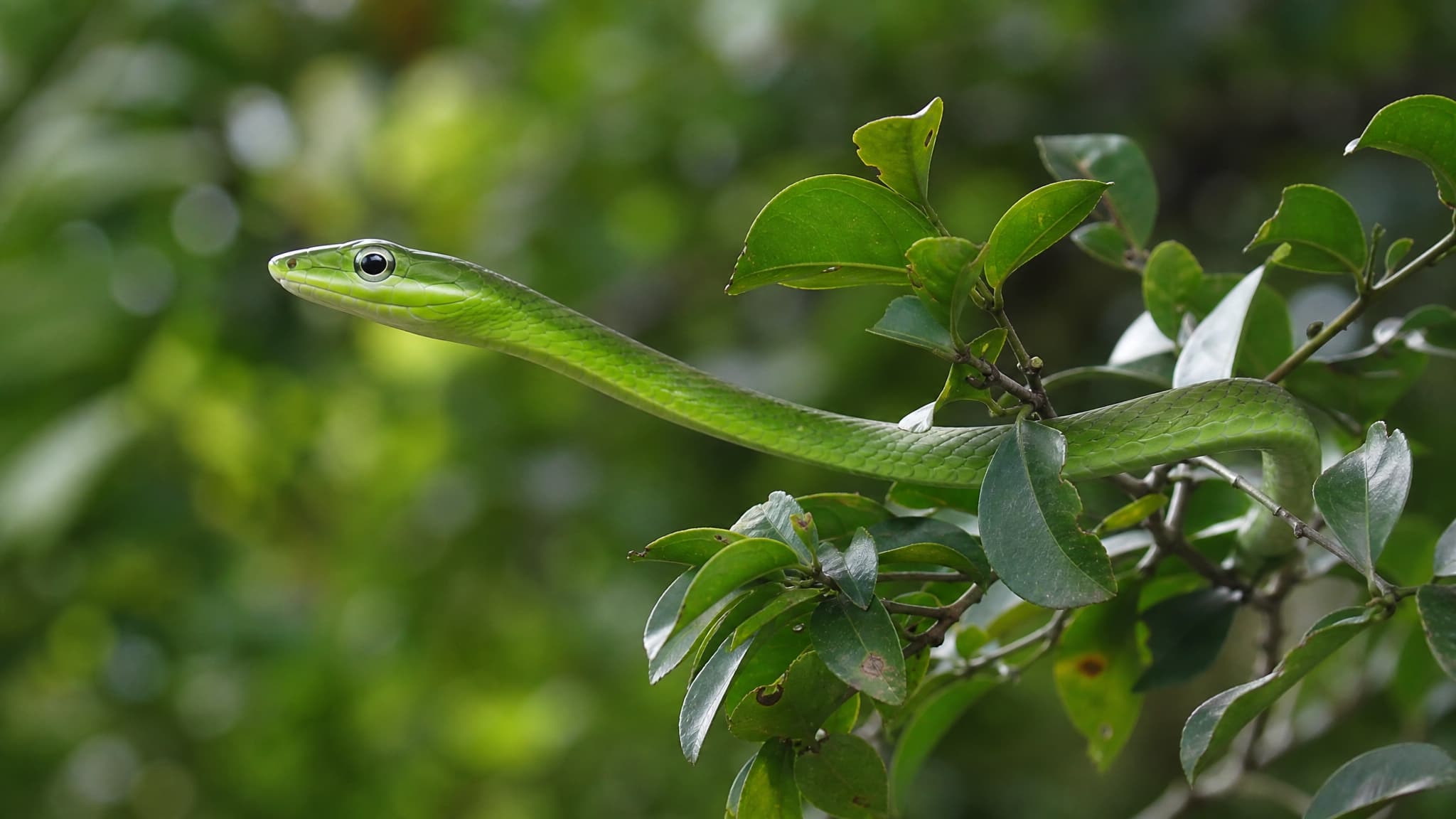
A slender bright-green snake extends along a leafy branch, with its head raised toward the left and its smooth, keeled-looking scales and large round eye visible.
Lichtenstein’s green racer (Philodryas olfersii) is a slender, long-tailed South American snake, often known in Brazil as the green vine snake. Adults commonly exceed 1 m in total length. Its intense green upper surface and yellowish underside provide effective camouflage in foliage; it also has an elongated head and large, round-pupilled eyes. Colour and markings can vary among individuals and across its extensive range.
This species occurs broadly in South America, with records from Brazil and neighbouring countries including Colombia, Venezuela, the Guianas, Peru, Bolivia, Paraguay, Uruguay, and northern Argentina. It uses a range of wooded and shrubby environments, including forest edges and other vegetation-rich landscapes. It is notably arboreal, moving readily through bushes and trees, but may also be encountered on the ground.
An active, mainly daytime hunter, it feeds chiefly on frogs and other anurans, while small mammals, lizards, and young birds can also be taken. It uses constriction together with venom to subdue prey. The venom is delivered by enlarged rear teeth, so the species is opisthoglyphous; it is not an animal to pick up or handle. As a predator of small vertebrates, it is part of food webs in the forests, savannas, and human-modified green spaces where it persists.
P. olfersii is oviparous. In a studied subtropical Brazilian population, females produced clutches of 4–11 eggs, and larger females tended to carry more eggs. Females are generally larger-bodied than males, whereas males have proportionally longer tails. Its wild lifespan has not been well established in reliable species-specific sources. The IUCN assessment listed the species as Least Concern, but habitat conversion, road mortality, and persecution of snakes can still affect local populations.