
Platypus
Ornithorhynchus anatinus
 AI-generated
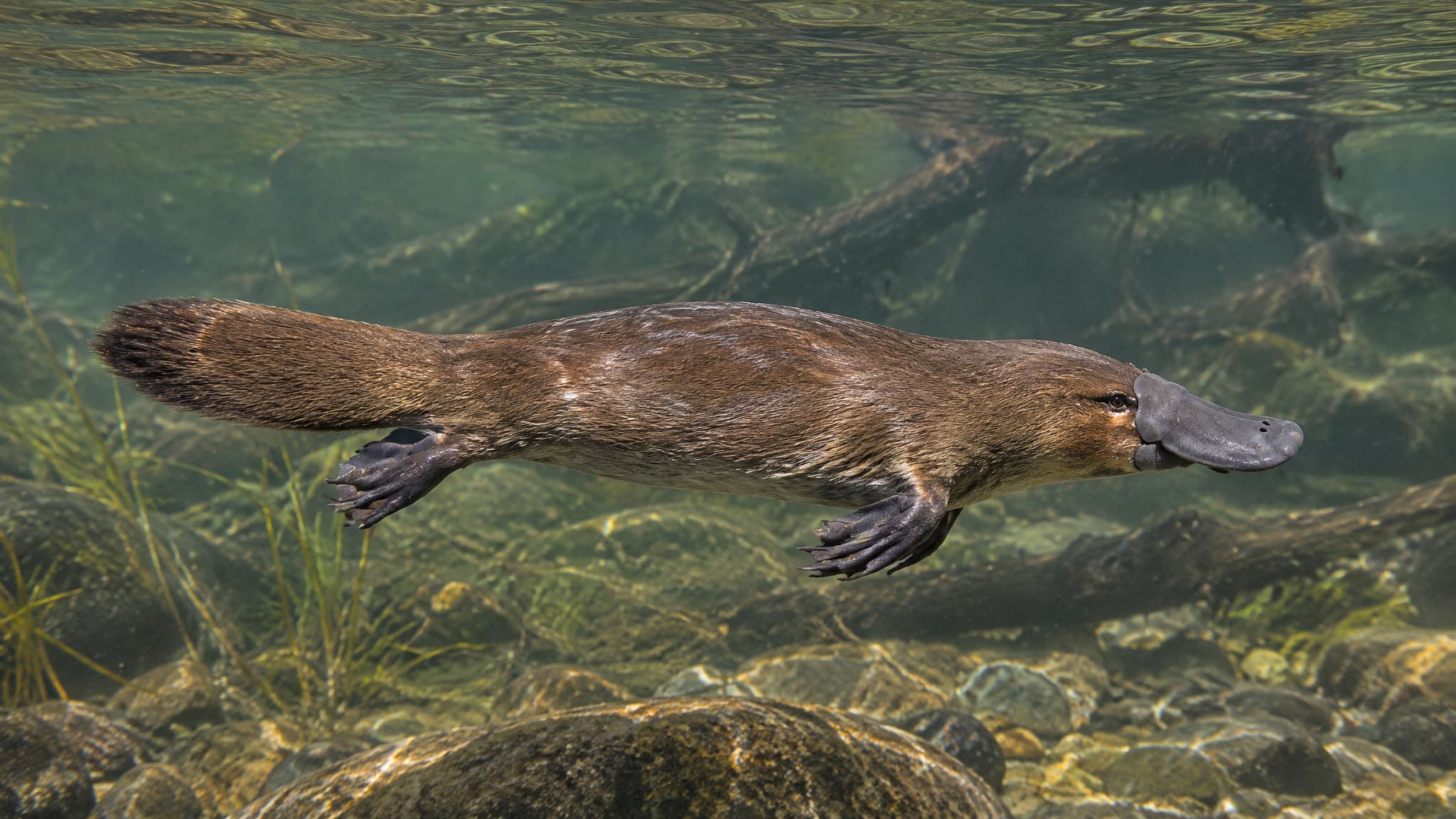
A platypus swims horizontally underwater above a rocky, vegetation-lined streambed, with its broad bill, webbed feet, dense brown fur, and flattened tail visible.
The platypus (Ornithorhynchus anatinus) is a semiaquatic, egg-laying mammal and one of only a few living monotremes. Its soft, leathery bill resembles a duck's, its broad flat tail stores fat, and its webbed feet and dense brown fur suit life in cold water. Adult males measure about 40–63 cm from bill to tail tip and weigh 0.8–3 kg, while females are smaller at 37–55 cm and 0.6–1.7 kg. Adults have no teeth, and the average body temperature of about 32 °C is lower than that of most placental mammals.
The species lives in the fresh waters of eastern Australia, from Queensland to Tasmania, including King Island. It uses rivers, streams, lakes and ponds, foraging mostly in water 1–5 m deep, and rests in burrows dug into the banks.
Platypuses hunt mainly at night. Underwater they close their eyes, ears and nostrils and find prey with the bill, which carries about 40,000 electroreceptors that detect the weak electric fields of moving animals. They probe the bottom for insect larvae, annelid worms, shrimp, crayfish, bivalves, tadpoles and fish eggs, storing food in cheek pouches and chewing it at the surface. Typical dives last 30–60 seconds, rarely up to 2 minutes, and an animal may spend about 12 hours a day foraging and eat around 20% of its body weight daily.
The female digs a nesting burrow with several chambers and lays 1–3 leathery eggs, usually two, about 17 mm long. She incubates them for about 10 days and, lacking nipples, feeds the young on milk secreted onto her skin for 3–4 months. Adult males carry a venomous spur on each hind ankle that is very painful to people, and the venom is more plentiful in the breeding season. Lifespan averages 12–15 years; wild animals have been recaptured at 24 years old and captive ones may live up to 30 years.
As a predator of bottom-dwelling invertebrates, the platypus is part of the food web of Australian streams and is itself taken by goannas, Murray cod, carpet snakes, eagles and introduced red foxes.
A 1912 law ended the platypus fur trade. Today the species is assessed as Near Threatened, and its numbers are estimated to have fallen by about 30% since European settlement. Dams, pollution, urban runoff, drought, water extraction and drowning in fishing nets and traps are its main threats.



