Plumed Basilisk
Basiliscus plumifrons
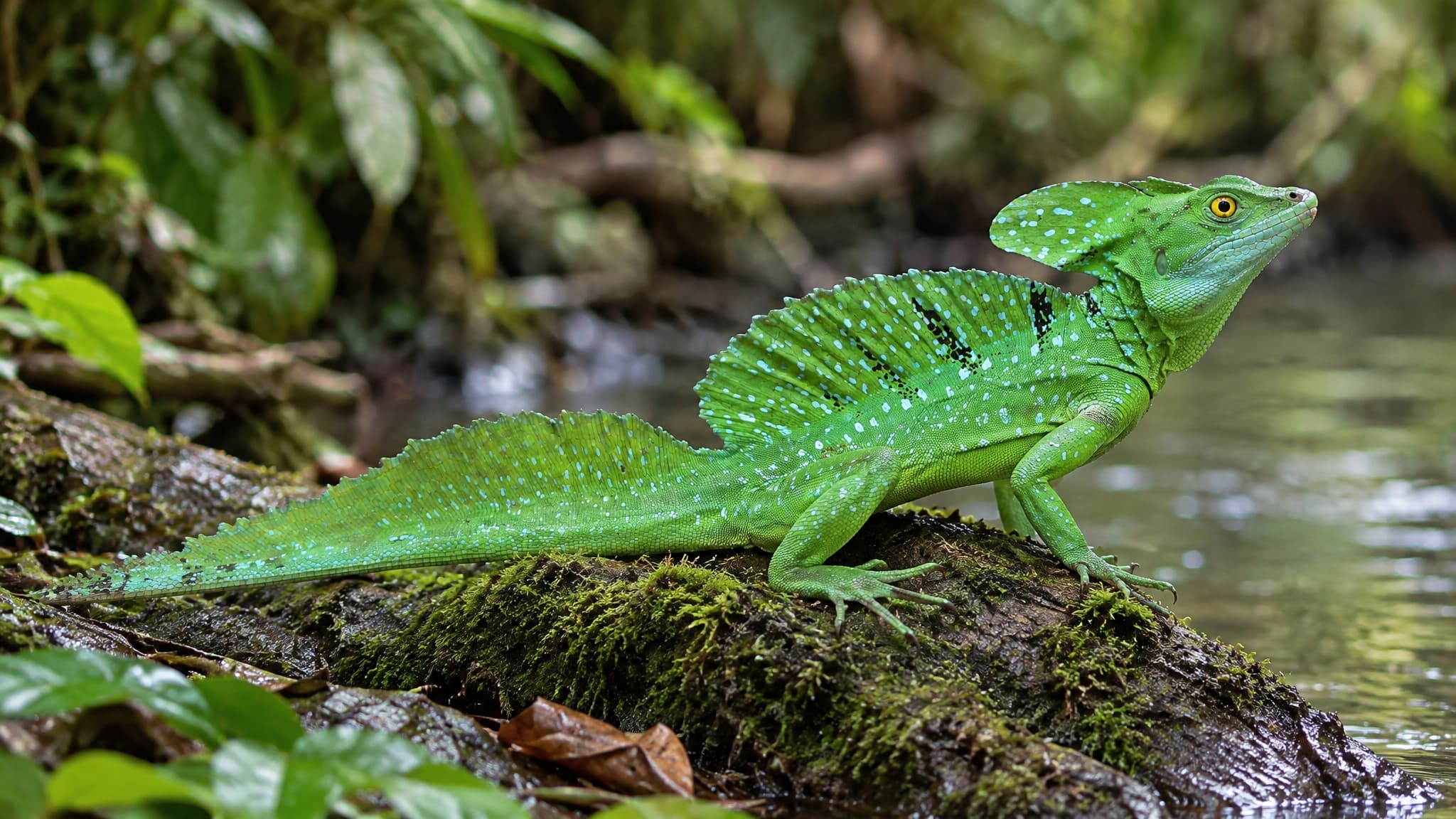 AI-generated
A bright green Plumed Basilisk rests in profile on a moss-covered log beside a stream, facing right; its blue spotting, tall dorsal and tail crests, long tail, and clawed feet are clearly visible.
The plumed basilisk (Basiliscus plumifrons), also called the green basilisk, double-crested basilisk or 'Jesus Christ lizard', is a large lizard in the helmeted lizard family Corytophanidae. Adults are bright green, sometimes with a blue tint, and often have pale or bluish spots along the back and sides. Their eyes are bright yellow. Males have a tall lobe on the head and sail-like crests along the back and tail, while females have much smaller crests. Most of its length is tail, and it can grow to about 90 cm in total.
The species is native to Central America. The Reptile Database lists Honduras, Nicaragua, Costa Rica and Panama, and the species was first described from Sipurio, Costa Rica. It lives mainly on the Caribbean (Atlantic) slope in warm, humid lowland rainforest, from sea level to about 775 m, and is almost always found near rivers, streams or other water. It lives partly in trees and partly in water, often resting on branches above the water. A study on a working cacao farm in Costa Rica found that individuals used areas of about 1,700 to 1,900 square metres.
The plumed basilisk is famous for escaping predators by running upright on its hind legs across the surface of water. Flaps of skin on its long hind toes, together with its speed, keep it from sinking for a short distance. After that it swims well and can stay underwater for more than ten minutes. It is active by day and basks in the sun to warm up. It eats mostly insects and other invertebrates such as spiders, crayfish and snails. It also takes small vertebrates, including smaller lizards and small mammals, and some fruit or other plant matter.
The species lays eggs. Females lay about 10 to 20 eggs at a time in moist soil or leaf litter, often in shallow burrows near water, and the eggs hatch after about two to three months. Hatchlings are on their own from the start and can climb and swim right away, relying on camouflage and speed to survive. Young become able to breed at about 18 to 24 months. In captivity they commonly live about 7 to 10 years. Their wild lifespan is less well documented and is probably shorter.
The plumed basilisk is a common mid-sized predator of insects along rivers, so it helps keep invertebrate numbers in check, and larger predators eat it in turn. The IUCN lists it as Least Concern. It survives in some altered habitats such as cacao plantations, but clearing of forests, especially along rivers, can affect local populations. It is also widely kept in zoos and as a pet.