
Crab-eating Raccoon
Procyon cancrivorus
 AI-generated
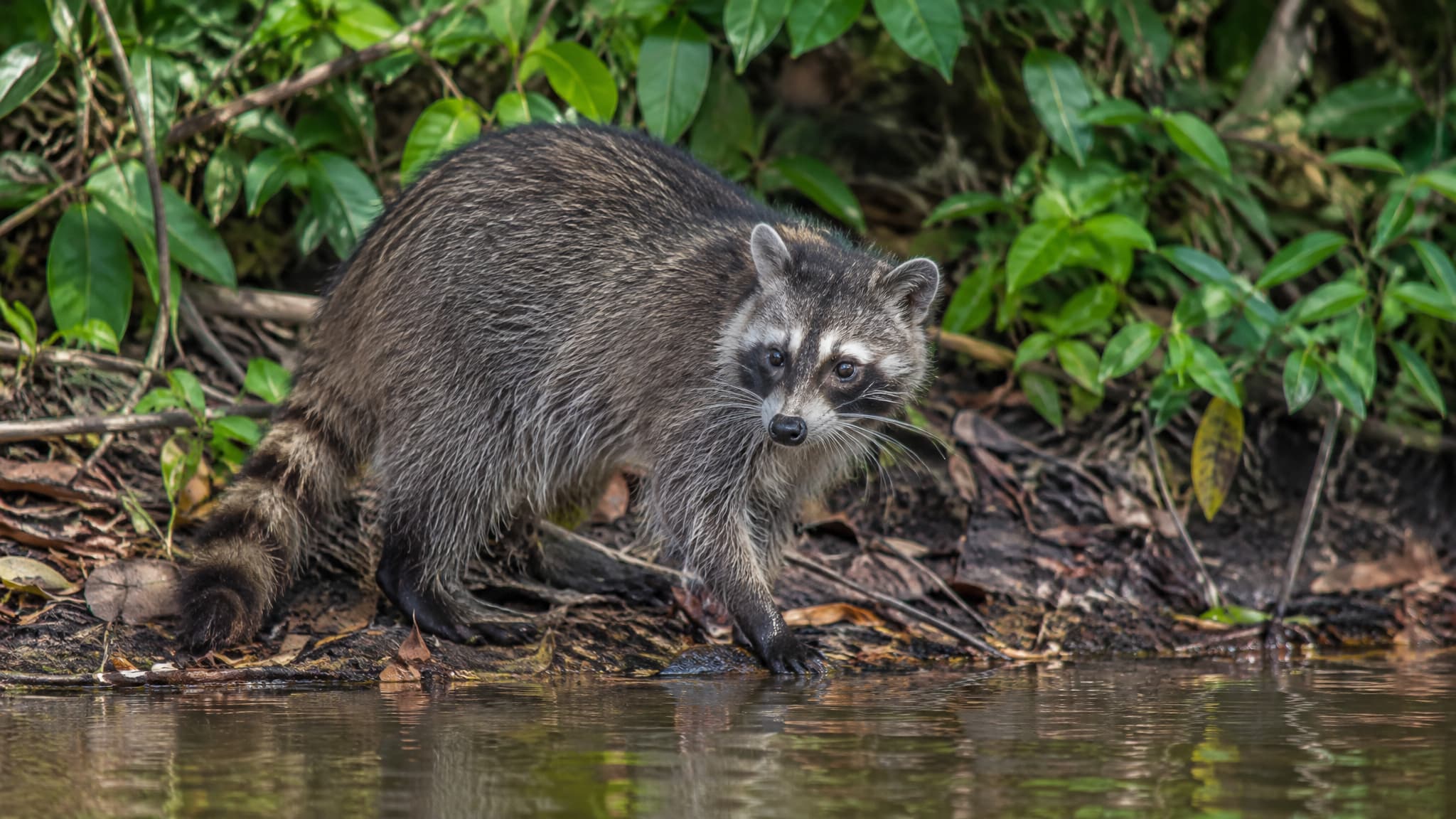
A crab-eating raccoon stands at the edge of shallow water in dense green forest, facing the camera with one forepaw extended into the water. Its gray-brown coat, dark facial mask, rounded ears, long whiskers, and partially visible bushy tail are clear.
The crab-eating raccoon, Procyon cancrivorus, is a medium-sized procyonid of Central and South America. It is also known as the southern or South American raccoon. Adults typically have a head-and-body length of about 54–65 cm, a 25–38 cm ringed tail, and a mass of roughly 3–7 kg; males average larger than females. Its dark facial mask, brown to grayish coat, dark legs, and alternating tail bands give it the familiar raccoon-like appearance.
Despite its English name, crabs are only part of a flexible omnivorous diet. Fruit can be important, alongside insects and other invertebrates, crustaceans, fish, frogs, small reptiles, eggs, and other small vertebrates. Highly sensitive forepaws help it locate and manipulate food, particularly near water. It is mainly nocturnal and generally solitary, though individuals may tolerate one another at concentrated feeding sites.
This species ranges from Costa Rica south through much of tropical and subtropical South America to Uruguay and northern Argentina. It uses primary and secondary forests, Amazonian habitats, Chaco vegetation, and wetlands, but is especially associated with rivers, lagoons, swamps, and other water-rich places that provide food and den sites. In Brazil it occurs in all biomes and is widely called mão-pelada, “bare hand,” referring to its sparsely furred, dexterous paws.
Breeding is seasonal in studied populations, with one litter per year. After a gestation of approximately 60–73 days, females give birth in sheltered dens such as hollow trees, rock crevices, or abandoned burrows; litters usually contain 2–7 young. The mother alone provides care, and young become independent at around eight months. Species-specific longevity in the wild remains poorly documented.
As an omnivore, the crab-eating raccoon participates in wetland and forest food webs both as a consumer of small animals and fruit and as potential prey for larger predators. The IUCN lists it as Least Concern, reflecting its broad distribution, although its reliance on waterside habitats makes the maintenance of intact wetlands, forest cover, and safe movement corridors important locally.



